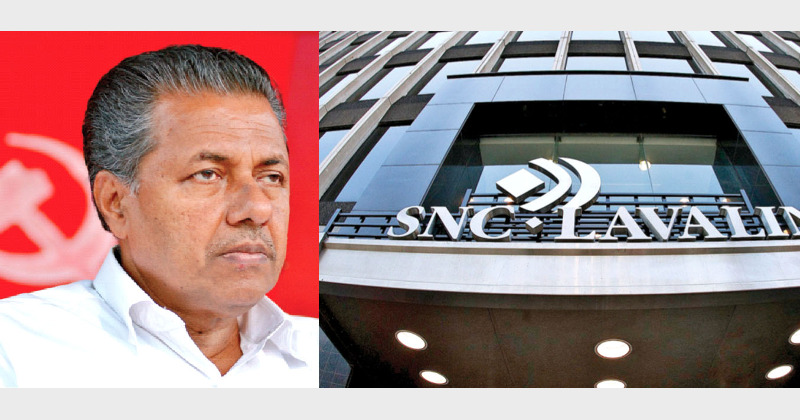
 The Communist parties generally claim to be righteous and clean in their public functioning. A revision petition filed by the CBI has put Kerala Chief Minister Pinarayi Vijayan in the dock for his alleged role in the SNC-Lavalin scam. Organiser revisits the SNC-Lavalin scam
T Satisan from Kochi
The first Hydro-electric project in Kerala was established at Pallivasal during the reign of Maharajah Sree Chithira Thirunal Balarama Varma. Built in 1940 and utilising water from the Ramaswami Iyer Headworks, a reservoir, for power generation, it had an installing capacity of 37.5 MW. For over half a century, it produced power and was still good in condition until the late nineties. The Central Electric Authority (CEA) rejected a proposal by Kerala State Electricity Board (KSEB) to renovate and modernise the Pallivasal hydropower project citing its excellent working condition as well as an existing proposal under consideration for an augmentation scheme to produce 60 MW (Pallivasal Extension Scheme). In view of the proud history of this working wonder, a suggestion was also doing the rounds in the corridors of KSEB to preserve the existing powerhouse as a museum, once the Pallaivasal Extension Scheme was operational.
Pinarayi bats for privatisation During his Canadian visit to negotiate the Lavalin deal, the CPM Minister Vijayan also held a discussion on methods to privatise the public sector power utility, KSEB named Kerala Energy Infrastructure Services Project (KEISP). The minutes of the meeting, as well as the funds provided by Canadian agency, provide ample evidence of this duplicity of CPM. Announcing the funding support for studies to justify privatisation, Lloyd Axworthy, the then Canadian Foreign Minister declared on January 8, 1997: |
However, the ruling Congress and Communist ministries had different ideas. The idea that was rejected by the CEA was resurrected by late G Karthikeyan, the then Congress Minister For Power in Kerala Government led by CM A K Antony. He brought in SNC-Lavalin, a Canadian company as consultants for Renovation and Modernisation (R & M) of the three hydropower projects, Pallivasal, Sengulam and Panniyar (PSP) in February 1995. It was based on a flimsy feasibility report, prepared by Radhakrishna Pillai, a retired Chief Engineer of Kerala State Electricity Board (KSEB), who himself later became a consultant for SNC-Lavalin.
This proposal took an unusual turn in October 1996, with the then Power Minister of Kerala Pinarayi Vijayan (currently CM of Kerala) in the LDF Ministry led by CPM veteran and CM E K Nayanar, leading a Ministerial Delegation to Canada to negotiate with SNC-Lavalin. After the discussion, the consultants became suppliers! Despite SNC-Lavalin not being the original equipment manufacturer (OEM), they were given the contract to supply the machinery. Alstom, Canada was the manufacturer.
There was no price negotiation, no details on specifications etc., which are normal in such a deal. Additionally, a collection of Canadian assistance worth Rs 100 crore for Malabar Cancer Centre (MCC) by SNC-Lavalin was linked with the renovation project of KSEB by the Government of Kerala. The MCC got only around 10 % of this proposed assistance. The cost per MW works out to Rs 3.24 crore. The R & M works of Sholayar, another project in Kerala, was Rs 0.14 crore per MW! Except in Tripura and Meghalaya, every other R & M project in India cost below Rs 0.78 crore per MW. Even in Meghalaya despite being a state of armed insurgencies, it was Rs 2.34 crore and in Tripura Rs 1.17 crore per MW.
The CAG report on the PSP projects is extremely revealing. The deal has cost the exchequer dearly. After years of legal proceedings, today SNC-Lavalin case is looming large on the political horizon of Kerala once again since it has a lot to do with the political career of the CM Pinarayi Vijayan. His stakes are high in this game as not only both BJP and UDF, but also his bête noire in his own party and CPM veteran and former CM V S Achuthanandan have been prodding him since the last about one decade in connection with this alleged scam. The issue is now in the Kerala High Court. Court has reserved its order on a revision petition filed by the CBI seeking to quash the Thiruvananthapuram CBI Special Court order discharging Chief Minister Pinarayi Vijayan and six others from the case. The judgment was reserved on completion of the arguments by the CBI and the counsel for the accused. Harish Salve, senior advocate and Supreme Court counsel, appeared for Pinarayi while Additional Solicitor General Natarajan appeared for the CBI. If the High Court admits the CBI plea it is going to create a gigantic earthquake in Kerala politics. Pinarayi will find it difficult to bear this latest straw on the camel’s back since he has been facing sticks, blows and brickbats on daily basis from day one in office which he has been occupying for the last 11 months.
Judge of Thiruvananthapuram CBI Special Court, in his judgment of November 5, 2013, stated that no trial needed in the case in which Pinarayi is the 7th accused since he was not in power when the initial procedures took place.
If the Report of The Comptroller & Auditor General of India for the year ending 31 March 2005 is to be believed (no reason in the vicinity to disbelieve) SNC-Lavalin case with the alleged involvement of Kerala CM and veteran CPM leader Pinarayi Vijayan is a matter of blatant corruption. It is all about the alleged corruption in awarding the contracts for the Renovation & Modernisation (R & M) of three hydel projects of Kerala, namely, Pallivasal, Senkulam and Panniyar (PSP) to SNC-Lavalin based in Montreal, Canada. Pallivasal’s capacity was 37.5 MW. Interestingly, the following data from some states reveal the hollowness of the much-propagated justification:-
Umium project in Meghalaya : Rs 2.34 crore/MW
Gumti in Tripura : Rs 1.17 crore/MW
Other projects : Rs 0.036 crore to 0.78 crore/MW
But, when one probes into the genuineness of the wishful thinking floated to justify the contract, desperation will the only result. The following data be speaks it out:
Project: Pallivasal, Senkulam & Panniyar (PSP)
Year Rains Power generation
1994-95 4277 MM 555.17 MU
(Prior to R & M)
2004-05 5607 MM 533.56 MU
(After R & M)
The ministerial delegation led by Pinarayi authorised SNC-Lavalin to act as both contractor and the material supplier, on top of their assignment as the consultant! A funny situation where contractor (supplier also) being inspected by themselves! On top of this, for some strange reasons, they skipped any negotiation to reduce prices. The only price reduction that happened was due to the reduction in scope of Panniar renovation work.
The installed capacity of the PSP projects was:
Pallivasal : 37.5 MW
Sengulam : 48.0 MW
Panniyar : 30.0 MW
This correspondent understands from various sources that KSEB had a plan to decommission the Pallivasal project and convert the same into a monument since it was the first ever hydel project of Kerala. But, in fact, it turned to be a “Monument of Corruption.”
The cost of SNC-Lavalin was Rs 239.81 crore including foreign exchange component. And, Rs 374.5 crore was the amount paid. The norm upheld by the Central Board of Irrigation & Power (CBIP) is “25% to 30 % cost effective compared to new stations.” An additional scheme in Kuttiadi under taken by BHEL and L & T was of Rs 66.05 crore. Its cost works out to Rs 66 lakh/MW. But, in PSP’s cases 3.24 crore/MW.
Serious anomalies appeared in the procurement of the machinery also. An important drawback reported in this context was that KSEB did not have the specifications for the machinery required for the R & M. And, KSEB failed to avail the benefits of training and technology transfer for its engineers as per the terms and conditions laid down in the contract. Due to the absence of these benefits and no disclosure of technical specifications, KSEB engineers were not adequately equipped to assess the suitability and reliability of the imported machinery at the time of procurement as well as the erection. As a result, KSEB could not identify and rectify the defects in them. The net result is a loss! It is to be noted that eight months after the signing of MOA, no action regarding the loss had been initiated by KSEB.
National Hydroelectric Power Corporation (NHPC), after looking into the contract, did not justify it. They maintained that soft loan and grant element could not be taken into consideration. At last, grant did not come from Canada.
Prevention of Corruption Act, 1988 says, if the state incurs a loss and someone else benefitted from action or inaction of somebody, it comes under the purview of the Act.
A grant component is an intriguing ingredient in the SNC-Lavalin contract. The contractor was supposed to give a grant of Rs 100 crore to the Malabar Cancer Centre (MCC), Thalassery as a part of the contract. Saseendaran Nair, a confidant of Pinarayi, had been made the nodal officer of the Malabar Cancer Centre, registered as a charitable society. It is reported that KSEB secretary, while PInarayi was not in power, had sent a note to the successor of Pinarayi in the cabinet to ensure the release of the grant of Rs 98 crore.
It is reported that the former principal secretary of the government of Kerala wrote in the file: “What is the relation between power and cancer?”A unique feature of the SNC-Lavalin case is the grant which MCC was supposed to get but never got. But, KSEB does not have the mandate to make it binding. The government of Kerala should have done it.
Another funny thing is a Chennai-based company called Technicaliya Consultants Private Limited, which claimed to be the sister organisation of SNC-Lavalin Canada, carried out construction works in MCC sans any sort of clearance from CEA.
Therefore, in short, the SNC-Lavalin contract was a mere waste of public funds amounting to Rs 374 crore. At the end of the day, it did not bring any improvement in the state’s power supply. And, Malabar Cancer Institute did not get any grant as promised. The state, read the people of Kerala, lost a fortune!