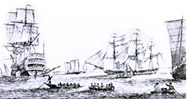
 It is essential to educate our populace about the immense contribution of our Maritime Icons, so as to increase our maritime awareness
Air Cmdr R S Dhankar
The maritime heritage of a country can be defined as the overall resources of a nation derived from the oceans around it.
India has more than 7,500 km of coastline studded with more than 200 major and minor ports with a rich hinterland. A terracotta amulet found in Mohenjo-Daro depicts a double masted boat which has two steering rudders in the stern. Harappan trade networks were also well established which included use of compass, ocean faring ships and crew adept at seamanship and navigation. In addition to internal trade, there’s plenty of evidence that the Harappans had strong economic relations with the West Asia.
The merchant ships from erstwhile Gujarat made their way along the Makran coast, trading along the way. They may have stopped near Gwadar to visit their outpost at Sutkagen-Dor (near Pak-Iran border). A bit further west, they would have interacted with the people of Jiroft civilisation (recently discovered in south eastern Iran). Archaeologists have found seals like those of Harappan civilisation and signs of close cultural links. The coastline from Gujarat to southern Iran was a well populated continuum with strong economic and cultural links.
Some of the Harappan sailing vessels to Iran would venture across the narrow strait to Oman. Archaeologists digging at Ras-al-Junayz, on the eastern tip of the Arabian Peninsula, found that over 20 per cent of objects were of Harappan origin. Many of these merchants would then have made their way further into the Persian Gulf and sailed into Bahrain where plenty of Harappan seals, pottery and beads have been found.
Further west, Harappan origin artifacts have also been found in Mesopotamian cities like Kish, Nippur and Ur. The records of Akkadian king Sargon I (2334-2279 BC) referred to ships from Dilmun, Magan and Meluha (Bahrain, Oman and Gujarat/Sindh).
Sardar K M Pannikar (1895-1963), India’s first ambassador to China did pioneering work on India’s maritime history in his book India and the Indian Ocean, first published in 1945.
Language is the best repository of a society’s culture and heritage. Vedic Sanskrit is said to be the oldest ancient language which has endured to modern times. Vedic people had rich maritime traditions, thriving trade networks, advanced ship building and navigation and seamanship practices. The Rig Veda itself has 150 references to the oceans (samudra), as well as ocean travel, and crossing rivers.
The earliest Harappan site is at Bhirana in Haryana on the banks of Ghaggar which has been carbon dated to 7000 BC. Interestingly, from recent
satellite imagery and ground surveys, it has been established that the dry river bed of Ghaggar is same, as of Saraswati, old mighty river mentioned in the Vedas.
By about 3200 BC, a large number of Harappan settlements had come up in the river basins and cities like Mohenjo-Daro, Harappa, Dholavira and Kalibangar developed. Rann of Kutch and island of Saurashtra had two most important port sites, Lothal and Dholavira, which established the maritime traditions and culture of Harappans.
Lothal city dates back to 3700 BC and provides the largest collection of antiquities in archaeology of Harappan and pre-Harappan times. The city is unique because the world’s first tidal dock is said to have been built here around 2300 BC.
The people of Lothal worshipped a sea Goddess – Vanuvati Sikotari Mata cognate with the Indus era Mother Goddess, suggesting a connection with the ancient port tradition and historical past as an access to the sea.
Mesopotamian inscriptions mention that the Meluhhans were numerous enough to have their own villages or exclusive enclaves in and around Sumerian towns and had their own copper mines near Khettri at the Haryana-Rajasthan border.
Harappan weights and measures became the standard across the region. The locals also copied Harappan seals. Till as recently as 1960’s, the Indian rupee was used as legal tender in Oman, Qatar, Bahrain and UAE.
The Harappans and Vedic people had rich maritime traditions, thriving trade networks, advanced ship building and navigation and seamanship practices. Prakash Charan Prasad in his book, Foreign Trade and Commerce in Ancient India (p 131) mentions “big ships were built, they could carry anywhere upwards of 500 men on the high seas. The Rajavallia says that the “ships in which King Sinhaba of Bengal (600 BC) sent Prince Vijaya, could carry almost 700 passengers; and the ship in which his Pandyan bride was brought over to Lanka could carry 800 people.”
In Kautilya’s Arthashastra we find information on the complete arrangements of the boats maintained by the navy and State. It also contains duties of various personnel on a ship. For example, the Navadhyaksha is the superintendent of the ship, Niyamaka is the steerman and Datragrahaka is the holder of the needle (compass). Differences in the ships were also described regarding the location of the cabins and purpose of ships themselves. (Brihat Samhita by Varahamihira 500 AD and Yukti Kalpa Taru by Narapati Raja Bhoj, 1100 AD give type, size, purpose of ships with details of building and maintenance).
The Periplus of the Erythrean (Arabic sea) written by an Alexandrian in 1st century BC describes sea going traditions between coast of Africa and up to the east coast of India . It mentions two masted ships with dual rudders mounted on the sides. Chinese chronicles of the same era describe seven masted Hindu vessels 160 feet in length carrying more than 700 passengers and 1000 tons of merchandise.
Pannikar places Indians firmly alongside the Greeks and Arabs as ancient sea farers and claims that “Hindus had already in use a magnetic compass (macha yantra) for accurate navigation, and had acquired the skills to build ocean going ships of great strength and durability which ventured into distant waters of the Arabian Sea”.
Invention of this ‘Macha- Yantra’ has also been ascribed to Indian navigators in ancient Egyptian texts.
Important ports of India during this period were Bharukachcha (Baroch), Supara, Kalyana and Muzeris on the western coast and Tamralipti (Bengal), Arikamedu (Tamil Nadu) on the eastern coast, which were engaged in extensive trade with Romans and South East Asia. An interesting 2nd century document called the Vienna Papyrus, records an agreement regarding transportation of goods between two merchants based in Alexandria and Muzeris.
Harappan port sites have revealed that the coastal populace had very well developed traditions which included organised cities, multi story brick buildings, vast irrigation networks, sophisticated sewage drainage systems, advanced metalwork, well developed docking and ship support infrastructure including knowledge of tides. They also had well established maritime trade links with their contemporary civilisations in the West Asia.
Vedic literature has ample references to their ship building and sea faring capabilities including advanced knowledge of astronomy, which was used for navigation at sea. Mention of Magnetic Compass and crude Sextant for Navigation have also been made.
Mauryans had a fully organised Navy with a thriving trade with the Romans and South East Asia, so did their contemporary kingdoms of the south. There was massive influx of Gold as trade for our spices, fine cloth, wood, precious and semi precious finished stones, jewelry and iron products. Implying that ancient India was a very advanced civilisation.
Mauryan maritime trade during their reign flourished. In his treatise Arthashastra, Kautilya had emphasised greater use of ‘dakshinpatha’ which was connected to Baroch for sea trade. Bindusara had remained in touch with Alexander’s successors in the West Asia and Ashoka had maintained this practice. His 13th edict mentions “The conquest of Dharma has been done here, on the borders, and even six hundred yojanas (5400-9600 km) away, where the Greek king Antiochus rules, beyond there where the four kings named Ptolemy, Antigonus, Magas and Alexander rule, likewise in the south among the Cholas, the Pandyas and as far as Tamraparni (Sri Lanka).” It is suggested that Ashoka’s son Mahindra and daughter Sanghamitra set sail for a mission to Sri Lanka from Tamralipti.
The Mauryan Empire ended when the last king, Bradhratha was killed by his military commander in 187 BC.
Pandyas of Tamil territory were also actively engaged with Romans and South East Asia. As per Roman inscriptions, Tamil Pandya embassies were received by Augustus Caesar. Pliny famously mentions expenditure of 1 million sestertii every year on goods such as pepper, fine cloth and gems from southern India. He also mentions 10 thousand horses shipped to this particular region per year. Tamil and Sanskrit name inscriptions have been found in Luxor in Egypt, in turn, Sanhgam Tamil literature describes foreign ships arriving for trade and paying in gold for products.
Cholas maintained an efficient navy. In 2nd century BC, Chola king Ellara had conquered Sri Lanka and ruled it for 50 years. Chola king Karikala founded the port city of Kaveripattnam which was a great centre of trade and commerce and had a large dock.
Cheras had an important and prosperous kingdom owing to their trade with Romans, who had set up two garrisons at Muzeris/Muchri (near Kochi) to protect their interests and also build a temple of Augustus.
It can be concluded with a fair degree of certainty that ancient India had a rich Maritime heritage commencing much before recorded history.
(The writer is Retd. Naval Officer)