Expansion for social transformation
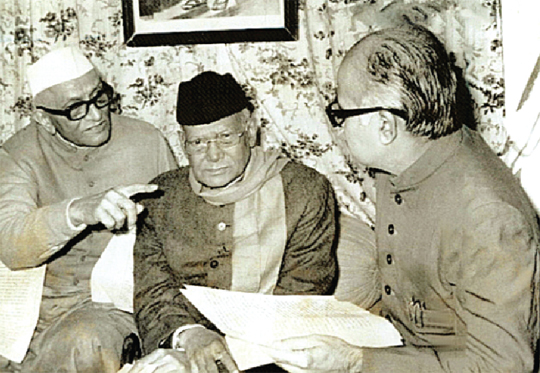 With growing acceptability and importance beyond traditional quarters, RSS provided content for social change and service activities. This led to a series of Mass Movements
 Te period from 1977 to 2005, has been historically an eventful era for Bharat. It was a testing time for the alternate born of the womb of non-Congressism that had emerged after defeating the disaster unleashed by the dictatorship of emergency. The story of non-Congressism had begun a decade before 1977 when after the 1967 elections, the one party domination was domination was broken and the era of coalition governments started. Non-Congressism was a negative thought and evolving a constructive and creative alternative out of it was almost impossible. Pt Deendayal Upadhyaya had warned the then leadership about this time and again. Deendayalji was articulating the same ideology in the realm of politics that was propagated by the Sangh. Socialist leader Dr Ram Manohar Lohiya also came closer to Bhartiya Jan Sangh and RSS. He attended the day long self-study camp of Bhartiya Jan Sangh and also stayed in a Sangh Siksha Varg. A joint declaration on ‘Bharat-Pak Maha Sangh (Confederation)’ was also also released by Deendayal and Lohia. Unfortunately both these great figures passed away in a short span of time. The period from 1967-1977 was struggling with the vacuum created by the departure of two great leaders. The Congress was also broken by Mrs Indira Gandhi and a new Congress was formed.
After the miraculous victory of Smt Indira Gandhi in 1971, the old Congress also became a part of non-Congressism. The character of non-Congressism became more negative. The national politics was searching for leadership among non-political figures. This vacuum was filled by the Akhil Bhartiya Vidhyarthi Parishad and Chatra-Yuva Sangharsh Vahini. Samajwadi Yuva Jan Sabha also played its little role. In 1973-74 a non-political name, Shri Jayaprakash Narayan, became the leader of the student struggle. People also realised the strength of RSS in this movement. The then Sarsanghchalak Shri Balasaheb Deoras honoured JP with the title of Saint. Jayaprakash Narayan said that ABVP is the powerful squad of my struggle. This non-political, anti-corruption movement was named as Samagra Kranti (Complete Revolution) by JP. The chair of Smt Indira Gandhi was shaken. She imposed the Emergency on the nation.
The fight against Emergency compelled the political leadership of NonCongressism to organize themselves in the form of a party. The crisis made them into political group called ‘Janta Party’ but negativity resurfaced once the calamity was over. Old JP passed away. The experiment of Janta Party failed and it was broken. Mrs Gandhi again came to power. In this entire episode, RSS emerged as an important factor. It played a decisive role in the fight against the Emergency. In 1973, after the death of Shri Guruji, Balasaheb Deoras became the Sarsanghchalak. That was a transition period. The first Sarsanghchalak Dr Hedgewar was the product of freedom struggle and the voice of this era was political. Second, Sarsanghchalak Sri Guruji was a spiritual and cultural figure, during his tenure, the values of devotion, loyalty and patriotism gained currency. The leadership character of the third Sarsanghchalak was social. Under his leadership ‘Seva Bharti’ and Samajik Samrasta got prominence. In the historical lecture series, popularly known as Vasant Vyakhyan Mala at Pune, he exhorted the ‘Roti-Beti (inter-community dining and marriages) interaction for the entire Hindu society’. Balasaheb said ‘if untouchability is not a sin, then nothing is sin in this world.’ Samajik Samrasta Manch got prominence. The Sangh thought became a mainstream with this trio of political, social and cultural thinking and action. But in the name of same Sangh, new politics of untouchability emerged which led to the fragmentation of Janata party. In 1980, a new political party was formed in the form of Bhartiya Janta Party. After the venturing with ‘Gandhian Socialism’, it came back to the core ideology of Ekatma Manav Darshan. Resultantly, BJP emerged as a number two party in the Parliament in 1989.
All the organisations with presence of RSS workers obtained a decisive role in their respective fields. ABVP is the biggest student’s movement while BMS has marched in the labour movement ahead of socialists and communists. In 1980s and 90s, Ram Janmabhoomi Andolan completely trembled the national psyche.
On the backdrop of Ram Janmabhoomi Movement itself, a new world order was knocking our national politics. The winds of globalisation and the process to establish World Trade Organisation (WTO) was initiated. The so-called socialist and mixed economy died down during Prime Minister Narasimha Rao’s period. Finance Minister in his cabinet Dr Manmohan Singh, Globalisaon and the process of selling Indian companies to the foreign multinational corporations (MNCs) was started by the then Finance Minister Dr Manmohan Singh much before the creation of WTO. Country reacted very sharply. Shri Bala Saheb Deoras exhorted Swadeshi. Communist ideologue Nikhil Chakravarty and Chandrashekhar type leaders boldly supported Balasaheb. Under the guidance of Shri Dattopant Thengadi ‘Swadeshi Jagran Manch’ was established to raise strong voice against globalisation.
On the backdrop of Ram Janmabhoomi Movement and growing sentiments of Swadeshi, General Elections of 1996 took place. Congress was defeated and BJP emerged as the single largest party in the Parliament. Shri Atal Behari Vajpayee became the Prime Minister, but his government lasted only for 13 days. For next two year a coalition government functioned under the leadership of H D Deve Gawda and IK Gujaral on the premise of Non-BJPism. In 1998 another round of General elections was held. Once again BJP emerged as the single largest party and Atal ji became the Prime Minister. First time a non-Congressi and a Swayamsevak became the Prime Minister and completed the full tenure. It was the government of National Democratic Alliance (NDA). The tenure of Shri A B Vajpayee was the milestone in the evolution of Indian history. As it was not a single party government, key issues such as Ram Janmabhoomi and Swadeshi were missing from the agenda. But an important issue of RSS-Jan Sangh which was not rejected in the NDA programme was nuclerisation of Bharat. Under the leadership of Shri Vajpayee, India became a nuclear-capable nation. All the Indians felt proud of this achievement.
This period of 1990 to 2004 was full of upheaval. In this era of uncertainty, Sangh remained committed to the principles and values of organising the society. It continued to play a constructive role in all critical situations. The national discourse was centered on nationalism versus pseudo-secularism. In this, the dynamic persona of Balasaheb Deoras, the academic temperament of Rajju Bhaiyya and all round experience of Sudarshanji played a critical role. The collective decision making and commitment to core values made RSS thinking as the mainstream thinking of the nation in this period.
The writer is a prominent thinker and director of Ekatma Manav Darshan Pratisthan