Kid’s Org : The Millennium of Successful Resistances
December 9, 2025
  • Read Ecopy
  • Circulation
  • Advertise
  • Careers
  • About Us
  • Contact Us
Android AppiPhone AppArattai
Organiser
  • ‌
  • Bharat
    • Assam
    • Bihar
    • Chhattisgarh
    • Jharkhand
    • Maharashtra
    • View All States
  • World
    • Asia
    • Europe
    • North America
    • South America
    • Africa
    • Australia
  • Editorial
  • International
  • Opinion
  • RSS @ 100
  • More
    • Op Sindoor
    • Analysis
    • Sports
    • Defence
    • Politics
    • Business
    • Economy
    • Culture
    • Special Report
    • Sci & Tech
    • Entertainment
    • G20
    • Azadi Ka Amrit Mahotsav
    • Vocal4Local
    • Web Stories
    • Education
    • Employment
    • Books
    • Interviews
    • Travel
    • Law
    • Health
    • Obituary
  • Subscribe
    • Subscribe Print Edition
    • Subscribe Ecopy
    • Read Ecopy
  • ‌
  • Bharat
    • Assam
    • Bihar
    • Chhattisgarh
    • Jharkhand
    • Maharashtra
    • View All States
  • World
    • Asia
    • Europe
    • North America
    • South America
    • Africa
    • Australia
  • Editorial
  • International
  • Opinion
  • RSS @ 100
  • More
    • Op Sindoor
    • Analysis
    • Sports
    • Defence
    • Politics
    • Business
    • Economy
    • Culture
    • Special Report
    • Sci & Tech
    • Entertainment
    • G20
    • Azadi Ka Amrit Mahotsav
    • Vocal4Local
    • Web Stories
    • Education
    • Employment
    • Books
    • Interviews
    • Travel
    • Law
    • Health
    • Obituary
  • Subscribe
    • Subscribe Print Edition
    • Subscribe Ecopy
    • Read Ecopy
Organiser
  • Home
  • Bharat
  • World
  • Operation Sindoor
  • Editorial
  • Analysis
  • Opinion
  • Culture
  • Defence
  • International Edition
  • RSS @ 100
  • Magazine
  • Read Ecopy
Home General

Kid’s Org : The Millennium of Successful Resistances

Archive ManagerArchive Manager
Dec 7, 2015, 12:00 am IST
in General
Follow on Google News
FacebookTwitterWhatsAppTelegramEmail

Islam had begun to flourish from the era of Muhammad Saheb (570-632 AD). He had participated in a lot of battles. He tried to make Medina the National state. Soon after his death in 632, his followers went on a religious frenzy to acquire political power across the world. In the next hundred years or so, Islam rapidly spread in many parts of the world. But it took them about 500 years to win over Bharat.
Before Mohammad Bin Kasim attacked Bharat, she was already attacked 14-15 times. Although the country was economically prosperous and culturally enriched at this time, there was a decline in stability and unity after the death of King Harshavardhan. In 711 AD, Mohammad Bin Kasim attacked the brave ruler of Indus region, Dahir (679-711), captured Dewal (Karachi) and shrewdly removed the saffron flag from top of a temple. This dampened the spirits of the Bharateeyas and he succeeded in his objective. There was a massacre that followed. Legend has it that the refusal to adopt Islam led to the slaying of young seventeen-years old men. Women and children were enslaved. According to a scholar –“This kind of bloodshed and carnage was never witnessed before.” The King sacrificed his life. Queen performed jauhar and the two young princesses jumped off the walls of the fort in order to protect their chastity.
But Muhammad bin Qasim’s conquest didn’t last for more than 45 days. This episode was regarded as ‘ordinary and insignificant’. But Arab, which was otherwise known for vandalism and ignorance was enlightened by Bharat. A lot of our literary works were taken to Baghdad. It became our cultural legacy. The second most important invasion was that of Mahmud Ghazni. He attacked Bharat 17 times. The objective of these attacks was jihad. His attacks primarily centred around the temples of Nagarkot, Thanesar, Mathura and Somnath which were the focal point of our religious faith. Many brave sons of the nation sacrificed their lives for the protection of Somnath.
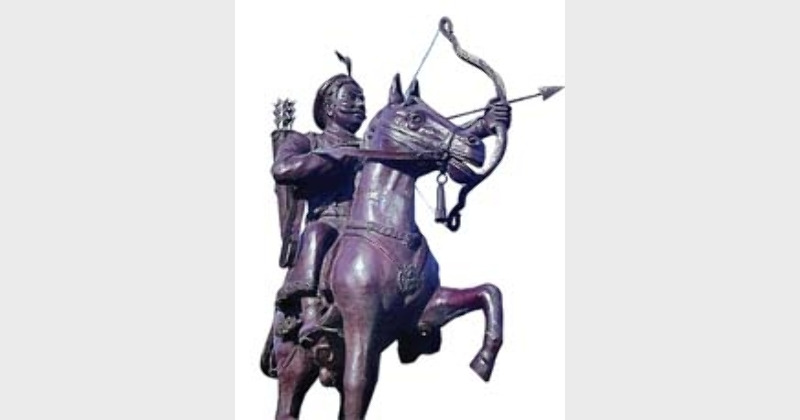
According to the Persian book, Meerat-E-Masood, Salaar Masood, who was the nephew of Mahmud Ghazni was so much allured by the immense wealth of Bharat that he attacked Bharat with over three hundred and fifty thousand men which was the first attack of such magnitude. 17 Hindu rulers surrounded this huge army around Behraich. On  June  14  1033, Salaar Masood was defeated in this fierce battle and Bharat achieved victory under the leadership of Raja Suhail Dev. Salaar Masood was killed in this battle and so was every Muslim who gave the news. In true sense it was a ‘national battle.’ For the next 175 years, no Muslim ruler dared to attack Bharat.
It was during the period between 1176 to 1206 AD that Muhammad Ghori attacked Bharat. He met humiliating defeat in Anhilwara in Gujarat. The very first dreadful battle of Muhammad Ghori was with Prithviraj Chauhan (1179-1192) who was then the ruler of Ajmer and Delhi. This battle took place in 1191 in Tarain when Ghori’s army was chased for 40 miles. But it was the Second Battle of Tarain  in 1192 where Ghori emerged victorious. He was accompanied by the king of Kanauj, Raja Jaichand. This defeat brought forth for the first time, the lack of nationality amongst Bharateeyas as well as the consequences of the internal conflicts of the Rajputs.
The 320 years from 1206-1526 saw the reign of Pathans and Afghans on the throne of Delhi, and witnessed about 35 rulers. This period also saw the emergence and the downfall of 5 different royalties. The rulers of Ghulam, Khilji, Tughlak, Syed and Lodi dynasties ruled in this period respectively. But on the other side, great kingdoms of Southern Bharat like the Bahamani and Vijayanagar also emerged during this time. Simultaneously the fierce and outrageous attacks of the Mongols and the Taimurlang (1380-1405) horrified the Delhi Sultanate.
The very first royal dynasty of Delhi was the Ghulam (Slave) Dynasty because its major rulers, Qutb-ud-din Aibak, Shams-ud-din Iltutmish and Ghiyas-ud-din  Balban were previously slaves. All these rulers were foreigners, anti-Hindu and cruel tormentors. Their policies towards Bharateeyas were rather stringent. They destroyed several temples and educational institutes in the name of art and used the dismantled remains to construct the Qutab Minar in Delhi and the Adhaai din ka Jhopra in Ajmer. This lineage lasted from 1206 to 1290.
The second dynasty was the Khilji Dynasty which reigned the throne of Delhi from 1290 to 1320 AD. Alauddin Khilji of the Khilji Dynasty, who ascended to the throne after killing his uncle expanded his empire in Northern and Southern Bharat by attacking their rules. He acquired a lot of wealth from these parts of India. He attacked Chittor in 1303 with the sole intention of capturing Rani Padmawati. Several Rajputs died in this battle and as a result of this many women performed jauhar. Countless temples were destroyed. It must be mentioned in this regard that owing to the weak character of Allauddin’s descendents, in 1320 Hindu rule resumed on the throne of Delhi although for a few months. Notable amongst these rulers were Dewal Rani, daughter of Karnadeva 2nd (1297-1304) and Khusro Khan.
Dr Satish Chandra Mittal (The writer is Professor (Retd.) History Department Kurukshetra University,Kurukshetra) (To be concluded)


ShareTweetSendShareSend
✮ Subscribe Organiser YouTube Channel. ✮
✮ Join Organiser's WhatsApp channel for Nationalist views beyond the news. ✮
Previous News

Book Review : The Entrapment of Bharateeya Civilisation

Next News

Vacancies

Related News

Sanskrit teachings on Doordarshan’s Suprabhatam inspire modern India: PM Narendra Modi

A representative image

Govt steps up drive for edible oil Atmanirbharta; Oil palm acreage hits 6.20 lakh hectares under NMEO

‘Rs 500 crore suitcase for CM post’: Navjot Kaur Sidhu tears open the deep-rooted rot of Congress

Defence Minister Rajnath Singh addressing the parliament

“National song not given equal space, marginalised”: Rajnath Singh slams Congress for not giving Vande Mataram its due

Karnataka mineral discoveries in Koppal and Raichur face hurdles over protected forest zones

Matter of immense joy": PM Modi as UNESCO's 20th Intangible Cultural Heritage session commences in India

“Matter of immense joy”: PM Modi as UNESCO’s 20th Intangible Cultural Heritage session commences in India

Load More

Comments

The comments posted here/below/in the given space are not on behalf of Organiser. The person posting the comment will be in sole ownership of its responsibility. According to the central government's IT rules, obscene or offensive statement made against a person, religion, community or nation is a punishable offense, and legal action would be taken against people who indulge in such activities.

Latest News

Sanskrit teachings on Doordarshan’s Suprabhatam inspire modern India: PM Narendra Modi

A representative image

Govt steps up drive for edible oil Atmanirbharta; Oil palm acreage hits 6.20 lakh hectares under NMEO

‘Rs 500 crore suitcase for CM post’: Navjot Kaur Sidhu tears open the deep-rooted rot of Congress

Defence Minister Rajnath Singh addressing the parliament

“National song not given equal space, marginalised”: Rajnath Singh slams Congress for not giving Vande Mataram its due

Karnataka mineral discoveries in Koppal and Raichur face hurdles over protected forest zones

Matter of immense joy": PM Modi as UNESCO's 20th Intangible Cultural Heritage session commences in India

“Matter of immense joy”: PM Modi as UNESCO’s 20th Intangible Cultural Heritage session commences in India

India's Prime Minister Narendra Modi, Chinese President Xi Jinping, Russian President Vladimir Putin and U.S. President Donald Trump

Trump turns tariff weapon on New Delhi ahead of trade talks; China hails India Russia ties as pillar of global South

“What Modi Ji has done is good”: Great-grandson of Bankim Chandra Chatterjee on Vande Mataram

India-Nepal Cultural Festival's 3rd edition held in Lumbini, celebrates shared Buddhist heritage

India-Nepal Cultural Festival’s 3rd edition held in Lumbini, celebrates shared Buddhist heritage

Suvendu Adhikari hits out at Mamata Banerjee over absence from Bhagavad Gita event

Mamata Banerjee is anti-Hindu: Suvendu Adhikari after West Bengal CM skips mass recital of Bhagavad Gita in Kolkata

Load More
  • Privacy
  • Terms
  • Cookie Policy
  • Refund and Cancellation
  • Delivery and Shipping

© Bharat Prakashan (Delhi) Limited.
Tech-enabled by Ananthapuri Technologies

  • Home
  • Search Organiser
  • Bharat
    • Assam
    • Bihar
    • Chhattisgarh
    • Jharkhand
    • Maharashtra
    • View All States
  • World
    • Asia
    • Africa
    • North America
    • South America
    • Europe
    • Australia
  • Editorial
  • Operation Sindoor
  • Opinion
  • Analysis
  • Defence
  • Culture
  • Sports
  • Business
  • RSS @ 100
  • Entertainment
  • More ..
    • Sci & Tech
    • Vocal4Local
    • Special Report
    • Education
    • Employment
    • Books
    • Interviews
    • Travel
    • Health
    • Politics
    • Law
    • Economy
    • Obituary
  • Subscribe Magazine
  • Read Ecopy
  • Advertise
  • Circulation
  • Careers
  • About Us
  • Contact Us
  • Policies & Terms
    • Privacy Policy
    • Cookie Policy
    • Refund and Cancellation
    • Terms of Use

© Bharat Prakashan (Delhi) Limited.
Tech-enabled by Ananthapuri Technologies