The Millennium of  Victories
June 6, 2026
  • Read Ecopy
  • Circulation
  • Advertise
  • Careers
  • About Us
  • Contact Us
Android AppiPhone AppArattai
Organiser
  • ‌
  • Bharat
    • Assam
    • Bihar
    • Chhattisgarh
    • Jharkhand
    • Maharashtra
    • View All States
  • World
    • Asia
    • Europe
    • North America
    • South America
    • Africa
    • Australia
  • Editorial
  • International
  • Opinion
  • RSS @ 100
  • More
    • Op Sindoor
    • Analysis
    • Sports
    • Defence
    • Politics
    • Business
    • Economy
    • Culture
    • Special Report
    • Sci & Tech
    • Entertainment
    • G20
    • Azadi Ka Amrit Mahotsav
    • Vocal4Local
    • Web Stories
    • Education
    • Employment
    • Books
    • Interviews
    • Travel
    • Law
    • Health
    • Obituary
  • Subscribe
    • Subscribe Print Edition
    • Subscribe Ecopy
    • Read Ecopy
  • ‌
  • Bharat
    • Assam
    • Bihar
    • Chhattisgarh
    • Jharkhand
    • Maharashtra
    • View All States
  • World
    • Asia
    • Europe
    • North America
    • South America
    • Africa
    • Australia
  • Editorial
  • International
  • Opinion
  • RSS @ 100
  • More
    • Op Sindoor
    • Analysis
    • Sports
    • Defence
    • Politics
    • Business
    • Economy
    • Culture
    • Special Report
    • Sci & Tech
    • Entertainment
    • G20
    • Azadi Ka Amrit Mahotsav
    • Vocal4Local
    • Web Stories
    • Education
    • Employment
    • Books
    • Interviews
    • Travel
    • Law
    • Health
    • Obituary
  • Subscribe
    • Subscribe Print Edition
    • Subscribe Ecopy
    • Read Ecopy
Organiser
  • Home
  • Bharat
  • World
  • Operation Sindoor
  • Editorial
  • Analysis
  • Opinion
  • Culture
  • Defence
  • International Edition
  • RSS @ 100
  • Magazine
  • Read Ecopy
Home General

The Millennium of  Victories

Archive ManagerArchive Manager
Nov 9, 2015, 12:00 am IST
in General
Follow on Google News
FacebookTwitterWhatsAppTelegramEmail

Kid’s Org : Indus-Saraswati Civilisation

Bharat has been constantly involved in battles with foreign invaders, winning successfully over each one of them. All foreign invaders were either driven out of the country or they themselves blended with our culture and became a part of us.

During 1921-1922, the excavations done at Mohenjo-Daro-Harappa brought to the forefront remains of urban civilisation which startled scholars worldwide. Hence, it was known as the Mohenjo-Daro-Harappa civilisation and the Indus Valley Civilisation. The remains of these two civilisations were also found along the banks of River Saraswati. Therefore, it is only fair to call it Indus-Saraswati Civilisation. We get a glimpse of the urban life from this civilisation, which is characterised by broad roads, concrete houses with kitchen, living room, bed room and staircase. The town had proper drainage system and common baths. From these we get an idea about the social and cultural life of the people. People worshipped Lord Shiva and Mother Goddess alongside nature. Historians have given us information about the expansion and later about the destruction of these civilisations. These civilisations were spread across vast expanse of land and primarily floods and other natural calamities have been known to be reasons of their destruction. Hence, it will be wrong to say that Aryans had conquered and destroyed these civilisations.
The growth of political bodies had started in the Vedic age itself. Districts (Janpads) had also started developing in this era. Districts were basically cultural modules. Panini has referred to rural communities of different groups of people in specific sections of the land as districts. During the time of the Mahabharat, many small districts were formed. In the 6th century BC, there were 16 main districts, namely, Angad, Magadh, Kashi, Kaushal, Vrij, MalIa, Chedi, Satv, Kuru, Panchal, Matsya, Sursen, Assam, Avantika, Gandhar and Kamboj. Apart from these there were several small districts. Later Magadh became the most popular district (maha janpad).
To sum it up, the entire period starting from the Vedic era upto 6th century BC, the era of Districts spanning for thousand years can be termed as the glorious and grand period of our history, when Bharat had emerged as a spiritual, religious and moral example spreading the message of peace, prosperity, equality and individuality throughout the world and had benefitted them with our culture and civilisation. But history witnesses the fact that we have never attempted to attack other countries.                              

From time to time, several foreign nomadic tribes, caravans and groups, came to Bharat from its north-west frontiers looking for wealth or a livelihood or even in some cases, to get rid of their local living conditions. The most famous among them were the Greeks, Iranians, Shakyas, Kushans and the Huns. The Iranians had cultural and trade relations with Bharat since the beginning. But they also were our very first invaders. This invasion happened during the rule of the founder and the first ruler of Hakamani Dynasty (Cyrus 1,550-529 BC). Pukkusati was then the ruler of Gandhar and his influence spread from Kashmir to Multan and from Indus to Ravi. The king of Iran had sought help from Pukkusati and in the process cheated him of some part of it. The King of Iran sent his troops to free his land from the King. The King in turn sent troops from both sides. The first troop of army approached from Gedrishiya which got defeated and only seven people from the whole army were left alive. The second troop achieved partial success which conquered a place called Kapisa (currently Begram) in Afghanistan. This was countered by people of Massag and Dwarva who attacked with an army of elephants. In the battle one soldier from an elephant injured the thigh of Cyrus and killed him. Apart from this, the Queen of Massag, Tomaris (approx. 530 BC) defeated Cyrus along with his 12,000 horse-riders and 6,000 men on foot. This was our first victory against foreign invaders.
Like Iran, Greeks have also had a long-standing cultural association with Bharat. Socrates, Plato (Aflatoon) and Aristotle were well aware of Bharateeya scholars. Socrates (469-399 BC) was once asked by an Bharateeya scholar – “What are you doing?” Socrates replied- “Learning about human life.” To this, the Scholar asked- “knowledge about Humans is incomplete without the knowledge of God.” Similarly, Plato (428-347 BC) was told by an Bharateeya scholar that most of the diseases occur because of 'Cuff (diQ), Pitta (fiÙk) and Vata (okr)' and also was suggested remedies for many a diseases for women. Alexander’s teacher, Aristotle (384-322 BC) also knew certain things about Bharat, but they were incomplete.
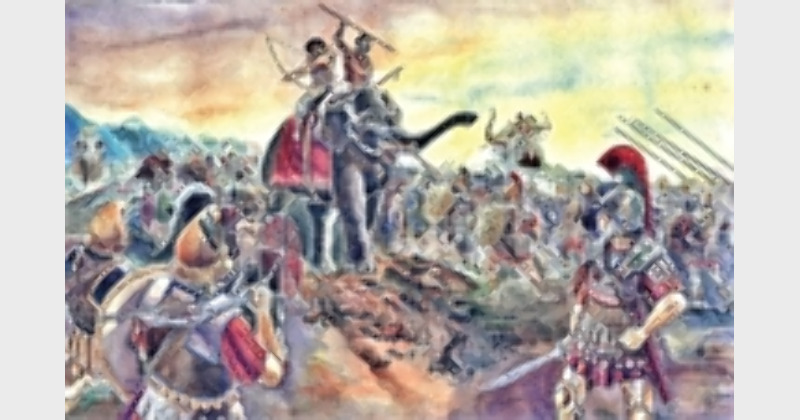
Alexander (336-323 BC) marched towards Bharat after defeating and crushing down Iran. He got injured on his shoulders across River Atak and on the Chitral River. He massacred people in large scale in Bajour and reached Massag, where he got injured for the second time. He crossed River Jhelum by guile and this is where he met the king of Punjab, Puru. According to a lot of scholars from Greece and Rome, Puru’s empire expanded after the war between Alexander and Puru and Greeks were disappointed. The latter was not ready to proceed any further. In the battle between the Malavas and the Shudrakas, Alexander got hurt for the third time and he was carried smeared with blood in an unconscious state by a few soldiers. Alexander had to stop his war with the Malavas where he welcomed around 100 Malav representatives.
    
 Dr Satish Chandra Mittal   (To be concluded)( The writer is Professor (Retd), History Department, Kurukshetra University, Kurukshetra)


 

ShareTweetSendShareSend
✮ Subscribe Organiser YouTube Channel. ✮
✮ Join Organiser's WhatsApp channel for Nationalist views beyond the news. ✮
Previous News

Kerala : God’s Own Country Or Godless Country?

Next News

Book Review : Ambedkar: The Economist

Related News

The Vedic age saw remarkable women sages, known as Rishikas, who composed hymns and shaped India's spiritual and philosophical heritage

Rishikas of Vedic Age: How Gargi, Maitreyi & other women shaped ancient India’s spiritual and philosophical tradition

Police in AAP-Ruled state of Punjab lathi charge sit-in protesters

Punjab: ITI candidates seeking jobs lathi-charged outside PSPCL HQ; opposition slams AAP Govt over police action

From constables to DGP, India's police system follows a structured chain of command that governs law enforcement across the country

From Constable to DGP: Understanding India’s police hierarchy, powers & recruitment system

The terracotta dice that challenges historical assumptions and highlights India's millennia-old civilisational heritage

How a 4,500-year-old terracotta dice is reviving the debate on India’s civilisational continuity & Vedic heritage

The Porumamilla inscription and the ancient science behind a reservoir that survived 650 years

India’s 655-Year-Old Water Policy: The Porumamilla inscription that turned stone into a manual of hydrology

India’s Permanent Representative to the United Nations Ambassador Harish Parvathaneni

India slams Pakistan at UNSC for peddling false narratives on Jammu & Kashmir

Load More

Latest News

The Vedic age saw remarkable women sages, known as Rishikas, who composed hymns and shaped India's spiritual and philosophical heritage

Rishikas of Vedic Age: How Gargi, Maitreyi & other women shaped ancient India’s spiritual and philosophical tradition

Police in AAP-Ruled state of Punjab lathi charge sit-in protesters

Punjab: ITI candidates seeking jobs lathi-charged outside PSPCL HQ; opposition slams AAP Govt over police action

From constables to DGP, India's police system follows a structured chain of command that governs law enforcement across the country

From Constable to DGP: Understanding India’s police hierarchy, powers & recruitment system

The terracotta dice that challenges historical assumptions and highlights India's millennia-old civilisational heritage

How a 4,500-year-old terracotta dice is reviving the debate on India’s civilisational continuity & Vedic heritage

The Porumamilla inscription and the ancient science behind a reservoir that survived 650 years

India’s 655-Year-Old Water Policy: The Porumamilla inscription that turned stone into a manual of hydrology

India’s Permanent Representative to the United Nations Ambassador Harish Parvathaneni

India slams Pakistan at UNSC for peddling false narratives on Jammu & Kashmir

Keralam: Pathanamthitta temple property occupied beyond lease period reclaimed by devotees

A series of high-level engagements signals New Delhi's growing focus on building interoperable security networks across the Indo-Pacific

India strengthens Indo-Pacific security architecture with new defence and maritime partnerships

Prime Minister Narendra Modi

“Makes every Indian proud”: PM Modi hails India’s 7.7 per cent GDP growth in FY 2025-26

Once known for maoist violence, Minpa now leads healthcare revolution with telemedicine services in Sukma

From Maoist Stronghold to Healthcare Hub: How Chhattisgarh’s Minpa is transforming through telemedicine & development

Load More
  • Privacy
  • Terms
  • Cookie Policy
  • Refund and Cancellation
  • Delivery and Shipping

© Bharat Prakashan (Delhi) Limited.
Tech-enabled by Ananthapuri Technologies

  • Home
  • Search Organiser
  • Bharat
    • Assam
    • Bihar
    • Chhattisgarh
    • Jharkhand
    • Maharashtra
    • View All States
  • World
    • Asia
    • Africa
    • North America
    • South America
    • Europe
    • Australia
  • Editorial
  • Operation Sindoor
  • Opinion
  • Analysis
  • Defence
  • Culture
  • Sports
  • Business
  • RSS @ 100
  • Entertainment
  • More ..
    • Sci & Tech
    • Vocal4Local
    • Special Report
    • Education
    • Employment
    • Books
    • Interviews
    • Travel
    • Health
    • Politics
    • Law
    • Economy
    • Obituary
  • Subscribe Magazine
  • Read Ecopy
  • Advertise
  • Circulation
  • Careers
  • About Us
  • Contact Us
  • Policies & Terms
    • Privacy Policy
    • Cookie Policy
    • Refund and Cancellation
    • Terms of Use

© Bharat Prakashan (Delhi) Limited.
Tech-enabled by Ananthapuri Technologies