The Astrosat, Bharat’s first space observatory is a well dedicated astronomy satellite. It is a miniature version of the Hubble, the US-European joint space observatory that has discovered new galaxies and improved understanding of the universe.
The Launch of first space observatory, the Astrosat, by the Indian Space Research Organization (ISRO) on the September 28, 2015 has placed Bharat in the elite club of four advanced countries of the world, who have a space observatory of their own, for probing heavenly objects from the space-orbit into the open space. It is almost a unique feat because, unlike similar missions of Europe and the US, it is a multi-wavelength platform which affords a simultaneous observation of celestial objects across different wavelengths, giving it a total perspective.
Another Related Story : Another Feather in the Cap
Hitherto, the Bharateeya astronomers had to rely on alien resources for X-ray and ultraviolet data for want of our own space observatory. But, now with the launch of the ISRO’s ASTROSAT-telescope on September 28, it would provide a shot in the arm of the Bharateeya astronomers for such space observations. It is all more rejoicing for us in Bharat, as the ASTROSAT-telescope is quite unique. Unlike most other telescopes, the five instruments (payloads) of ASTROSAT can observe a wider variety of wavelengths—from visible light to the ultraviolet and X-ray bands. Even in the X-ray band as well, it can study both low and high energy X-ray regions of the electromagnetic spectrum. Most other satellites are capable of observing only a narrow range of wavelength band. Besides, the capability to cover the full spectrum of wavelength simultaneously is another unique feature of the ASTROSAT.
 Through it has took nearly 20 years in the making of it, from the day the idea of such a satellite was put forward, and about 15 years since the idea was given a concrete shape, the final realisation of what promises to be a true astronomical observatory in the sky, is almost so unique in its concept and operation that, it is expected to make a significant and niche contribution to the important field of X-ray astronomy and the study of the X-ray universe. The Astrosat is a well dedicated astronomy satellite and a miniature version of the Hubble, the US-European joint space observatory that has discovered new galaxies and improved understanding of the universe. Indeed this first and unique space observatory of Bharat, the Astrosat is the fourth in space, after the Hubble, Russia’s Spektr R and Suzaku of Japan. It was initially planned for 2005, has been delayed by a decade, but, our scientific community has struggled hard to build it up to date with utmost precision which such instruments need for such operations. So, delay does not matter.
The Astrosat, which is Bharat’s astronomical satellite with telescopes is meant for studying objects in the deep sky. It can make observations in ultraviolet, optical, visible, low and X-ray wavelengths simultaneously. It will study stars, quasars, pulsars, supernova remnants, black holes and active galactic nuclei. The instruments on board and spreading across ultraviolet and X-ray wavelengths, will be capable to study black holes, neutron stars, quasars, white dwarfs and pulsars in the space.
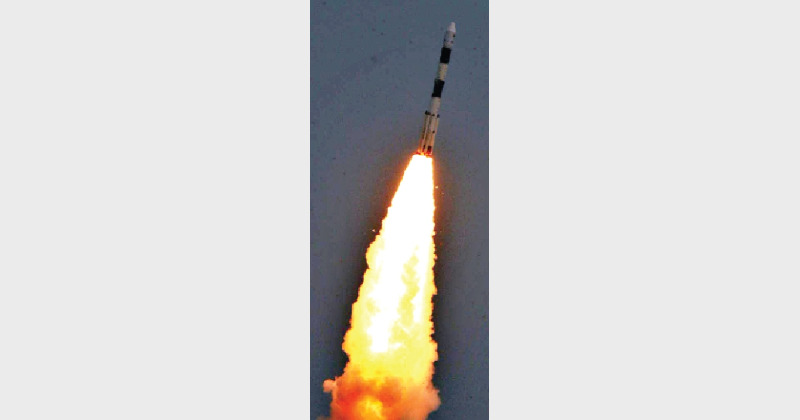
ISRO’s most trusted rocket and workhorse launch vehicle the PSLV-C30 has indeed carried this satellite in the space to place it into a 650-km orbit and is following its tak-eoff from the Satish Dhawan Space Centre, Shriharikota, at 10 am on Sept 28, 2015. As the Astrosat is a major space-science feat of the ISRO and its mission, which envisages an earth-orbiting scientific satellite with payloads capable of simultaneously observing the universe in the visible, ultraviolet and X-ray regions of the electromagnetic spectrum. The satellite is a multi-wavelength space observatory of Bharat, which make it the unique in the world in space research. It carries five payloads including, Ultraviolet Imaging Telescope (UVIT), Large Area Xenon Proportional Counter (LAXPC) Soft X-ray Telescope, Cadmium Zinc Telluride Imager and Scanning Sky Monitor SSM.
The ISRO has also achieved a significant milestone in commercial satellites launch segment as its trusted workhorse launch vehicle PSLV-C30 has launched not only the Astrosat to be operated as a Space Observatory by ISRO but, along with that six other foreign satellites have also been put into space from SHAR Range on September 28.
With this launch, ISRO would be crossing the half-century mark in terms of launch of commercial satellites ever since it launched the first ever satellite for a foreign customer on May 26, 1999 by using the PSLV-C2. It is for the first time that Bharat has launched a US satellite. The US satellites are the first from that country to be launched from Bharat since the two countries signed a technology safeguards agreement in 2009. The scientific objectives of ASTROSAT mission are: (i) To understand high energy processes in binary star systems containing neutron stars and black holes. (ii) Estimate magnetic fields of neutron stars. (iii) Study star birth regions and high energy processes in star systems lying beyond our galaxy. (iv) Detect new briefly bright X-ray sources in the sky. (v) Perform a limited deep field survey of the Universe in the Ultraviolet region.
The five payloads of ASTROSAT are chosen to facilitate a deeper insight into the various astrophysical processes occurring in the various types of astronomical objects constituting our universe. These payloads rely on the visible, Ultraviolet and X-rays coming from distant celestial sources.
- The Ultraviolet Imaging Telescope, capable of observing the sky in the Visible, Near Ultraviolet and Far Ultraviolet regions of the electromagnetic spectrum
- Large Area X-ray Proportional Counter is designed for study the variations in the emission of X-rays from sources like X-ray binaries, Active Galactic Nuclei and other cosmic sources.
- Soft X-ray Telescope is designed for studying how the X-ray spectrum of 0.3-8 keV range coming from distant celestial bodies varies with time.
- Cadmium Zinc Telluride Imager, functioning in the X-ray region, extends the capability of the satellite to sense X-rays of high energy in 10-100 keV range.
- Scanning Sky Monitor (SSM), is intended to scan the sky for long term monitoring of bright X-ray sources in binary stars, and for the detection and location of sources that become bright in X-rays for a short duration of time.
Moreover, the Astrosat is a truly multi-institutional project, invoking collaborations even with foreign institutions and agencies. Apart from ISRO, four other Bharateeya institutions involved in payload development are: Tata Institute of Fundamental Research (TIFR), Indian Institute of Astrophysics (IIA), Inter-University Centre for Astronomy and Astrophysics (IUCAA) and Raman Research Institute (RRI). Two of the payloads were developed in collaboration with the Canadian Space Agency (CSA) and University of Leiscester (UoL), UK. About the International customer satellites that have gone piggyback, along with the Astrosat, are the LAPAN-A2 – a microsatellite from National Institute of Aeronautics and Space-LAPAN, Indonesia. LAPAN-A2 is meant for providing maritime surveillance using Automatic Identification System (AIS), supporting Indonesian radio amateur communities for disaster mitigation and carrying out Earth surveillance using video and digital camera. Second one is NLS-14 (Ev9) is a Nan satellite from Space Flight Laboratory, University of Toronto Institute for Advanced Studies (SFL, UTIAS), Canada. It is a maritime monitoring Nan satellite using the next generation Automatic Identification System (AIS). Four LEMUR nano satellites from Spire Global, Inc. (San Francisco, CA), USA, are non-visual remote sensing satellites, focusing primarily on global maritime intelligence through vessel tracking via the Automatic Identification System (AIS), and high fidelity weather forecasting using GPS Radio Occultation technology. The Bharateeya Astrosat is special due to the choice of instruments to study in multi-wave lengths — UV rays, visible and X-rays — which even the Hubble don’t have. The instruments allow simultaneous observation of cosmic sources, an area in which other observatories currently have limitations. The diameter of Astrosat’s optical mirror is around 30 cm, compared with 2.4 m in the case of Hubble. It is expected the US space agency will launch the James Webb observatory, a successor to the Hubble, in 2018.
The Rs 178-crore Astrosat has hurled into space at lowest cost. It is a miracle that barely a year has passed since its first interplanetary mission, Mangalyaan, entered the orbit of Mars, and ISRO has crossed yet another important milestone. Thus, scientifically the ASTROSAT is a very different mission for ISRO as well from its other major missions and will add a new dimension to its scientific capabilities. There are several advantages in having a sky observatory. The atmosphere around the earth interferes with the signals from space and changes their
characteristics. So, what the instruments at earth observatories receive are modified signals. These have to be adjusted to bring in accuracy. But this space observatory would give us a more true picture.
Bhagwati Prakash (The writer is Vice-Chancellor of Pacific University, Rajasthan)