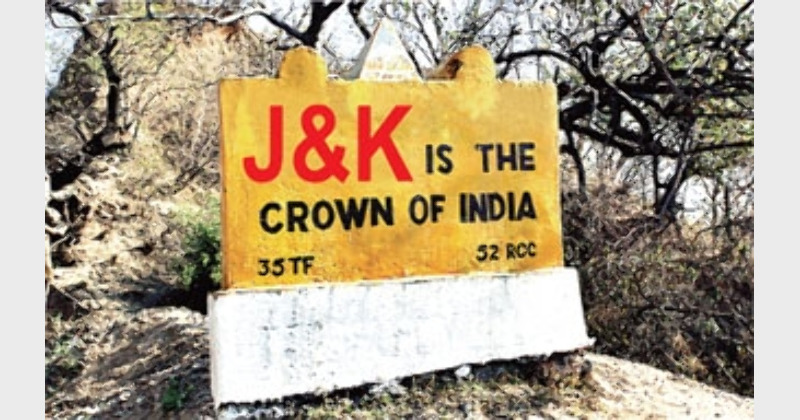
Intro: Since Independence, Jammu-Kashmir has been a victim of external accesses and internal neglect and opportunism. 2014 assembly Elections seems to be a decisive diversion from the politics of blackmailing, separatism and divisiveness. If we take a clue from the voting pattern of the 2014 general elections and link it to the current development, one can really hope that the position of India’s crown will be restored through the agenda of inclusive governance and development; subsequently assimilating the ‘Kashmiri’ mindset with changing India.
We all have been listening so much about the state of J&K in terms of separatism and terrorism that most of us have not paid much attention to its political equations, especially electioneering. Even in the age of 24 X 7 electronic media, very few people bothered to actually gauge the mood of masses in J&K. But 2014 assembly elections are different and calm on the security front is allowing us to grasp the micro-factors working in the only Muslim majority state of India. If we go by data of 2014 general elections and connect it to the present trends, one can surely make three conclusions; first, BJP is entering into power position of the State in some way or the other, second, tacit fueling of separatism by Congress-National Conference politics is exposed and it can be the end of dynastic politics in J&K, and third, complete decimation of open separatist forces like Hurriyat in the valley. 
It is evident from the ground reports that, all the major tones and tamper of parties in J&K including Peoples' Conference leader, Sajjad Lone, have changed perceptions about the BJP and therefore, it is no longer an untouchable political force, may be perhaps for NC and PDP too. Smaller Parties in the valley which are representing the local aspirations are now coming close to BJP. Parties like Awami Ittehad Party, Peoples Democratic Front, Democratic Nationalist Party,  Kashmir Development Front and Peoples Conference have started thinking beyond traditional issues and are trying to identify themselves with the nationwide wave of the 'Youths Aspiration'. All these factors may go long way in coming months to prove this election in the State, not only historic at the national level but having far reaching impact for India at the international level.
 There are 87 Assembly constituencies and 6 Parliamentary constituencies across main three regions( Jammu, Kashmir, Ladakh). These regions are different from each other in many ways, demographically, geographically and culturally. But at the political level, Kashmir (valley) region has more weightage because it has 46 Assembly constituencies inspite of having the same numbers of seats as Jammu region. So, politically, a Party will need to win seats in the Valley to come to power.
Among all the 6 Parliamentary constituencies (PCs), Jammu has mo re numbers of Assembly constituencies (ACs). In 2014 Lok Sabha election, BJP won three PCs, Congress and NC were rejected but PDP won three because of BJP's weak political and organisational base. However, it seems, the 2014 LS election results in J&K has given an impetus to the Party to correct its courses and think beyond the traditional approach to enter valley in a mopre focused manner.
The dominance of Congress-NC politics in the State has been due to weak peoples’ mandate and dependency on Congress power center, New Delhi. In 1987 Assembly elections, NC-Congress combine took 45.2% votes and the opposition Muslim United Front (MUF) and People’s Conference won only four seats. After 1989, the mainstream power politics became difficult in the valley due to skepticism over NC-Congress combine mandate and governance. But after 1996 Assembly election, the urge for normalcy after a prolonged period of militant violence led to some change of attitude towards the process of governance. With the emergence of People’s Democratic Party (PDP) as yet another Kashmir-based party, the electoral competition became quite intense in the valley. Before the emergence of PDP, National Conference (NC) had hegemonised the politics of Kashmir region.
Finally, in the 2008 Assembly election which gave a fragmented verdict, both the PDP and BJP gained success. PDP was able to increase its share of seats from 16 in 2002 to 21 with a voter turnout of 15.3% in its favour. BJP, however, emerged as the biggest gainer since it could increase its share of seats from one to eleven. Its vote share increased from 8.6% to 12.4%, and in Jammu region only, its vote share increased from 17.80% to 22.94%. 2014 Lok Sabha election proved to be a major watershed because BJP took more support than others in Jammu and Ladakh regions. BJP got 32% votes against 23% of Congress and 20% of PDP. NC got marginalized to 11% votes. BJP won in three Parliamentary constituencies by taking leads in 25 Assembly segments. It won 15 seats in Jammu, 9 seats in Udhampur and 1 seat in Ladakh.
It has challenge to make its position strong for Assembly election. For this purpose, BJP has to consolidate its support base where it has base in real sense, while keeping its focus on good performance. In Ladakh, out of four Assembly segments, it took lead in one segment, came second in one, third in other and fourth in the last segment. In Kashmir region, it did not win any Assembly seat. In the valley, it manged third position in the three seats where polling percentage was very low.
In Jammu region, BJP won 24 Assembly seats out of total 37 seats, but most importantly, in Jammu Parliamentary constituency, it won 15 Assembly segments and lost in five. In all the three Parliamentary constituencies where BJP won in 2014 Lok Sabha election, there are 41 Assembly segments. The major challenge before BJP now is how will it consolidate support for all the seats in Jammu and Ladakh regions.
The buzz in J&K and around reveal that BJP may mark the historic punch because it has scope in 41 seats in Jammu and Ladakh regions and that, it may take some seats in the valley too. In case it faces loss in Jammu and Ladakh reigon, it may compensate by taking support of other parties of valley except PDP and NC. As in case of Sajjad Lone’s People's Conference, it has good support base in 5 seats in Kupwara district of north Kashmir.
Now there is a growing consensus that the communal and divisive politics is no solution to the problems in the state. It is on the basis of these minimums that a process of consensus building has to be attained. Beginning therefore has to be made through a really inclusive process of politics, and by giving a sense of ownership to all the stakeholders. Though still unofficial, to take smaller Parties’ support will be a very good starting point for for BJP for buildingconsensus on more intricate issues. However, the scope for BJP will be emerge if it focuses on nurturing two crucial facts of demographic divisions of the State and manage the leads of it own Muslim candidates. In Kashmir region where there are more than 97% Muslims, it has to get seats to nullify all so-called charges based on religion and community. The Party has given 20 tickets to Muslims-13 in Kashmir region, one in Ladakh and 6 in Jammu region. The major challenge that lies ahead is to nominate strong candidates and get more Muslim candidates win elections in the State. It is the only Force Majeure for BJP”s Mission 44+.
Naveen Kumar (The writer is a senior political analyst and VP of Viplav Communication Pvt. Ltd.)