The forgotten legacy of Azad Hind
September 6, 2026
  • Read Ecopy
  • Circulation
  • Advertise
  • Careers
  • About Us
  • Contact Us
Android AppiPhone AppArattai
Organiser
  • ‌
  • Bharat
    • Assam
    • Bihar
    • Chhattisgarh
    • Jharkhand
    • Maharashtra
    • View All States
  • World
    • Asia
    • Europe
    • North America
    • South America
    • Africa
    • Australia
  • Editorial
  • International
  • Opinion
  • RSS @ 100
  • More
    • World Hindu Congress 2026
    • Op Sindoor
    • Analysis
    • Sports
    • Defence
    • Politics
    • Business
    • Economy
    • Culture
    • Special Report
    • Sci & Tech
    • Entertainment
    • G20
    • Azadi Ka Amrit Mahotsav
    • Vocal4Local
    • Web Stories
    • Education
    • Employment
    • Books
    • Interviews
    • Travel
    • Law
    • Health
    • Obituary
  • Subscribe
    • Subscribe Print Edition
    • Subscribe Ecopy
    • Read Ecopy
  • ‌
  • Bharat
    • Assam
    • Bihar
    • Chhattisgarh
    • Jharkhand
    • Maharashtra
    • View All States
  • World
    • Asia
    • Europe
    • North America
    • South America
    • Africa
    • Australia
  • Editorial
  • International
  • Opinion
  • RSS @ 100
  • More
    • World Hindu Congress 2026
    • Op Sindoor
    • Analysis
    • Sports
    • Defence
    • Politics
    • Business
    • Economy
    • Culture
    • Special Report
    • Sci & Tech
    • Entertainment
    • G20
    • Azadi Ka Amrit Mahotsav
    • Vocal4Local
    • Web Stories
    • Education
    • Employment
    • Books
    • Interviews
    • Travel
    • Law
    • Health
    • Obituary
  • Subscribe
    • Subscribe Print Edition
    • Subscribe Ecopy
    • Read Ecopy
Organiser
  • Home
  • Bharat
  • World
  • Operation Sindoor
  • Editorial
  • Analysis
  • Opinion
  • Culture
  • Defence
  • International Edition
  • RSS @ 100
  • Magazine
  • Read Ecopy
Home General

The forgotten legacy of Azad Hind

Archive ManagerArchive Manager
Oct 19, 2013, 12:00 am IST
inGeneral
Follow on Google News
Facebook
Twitter
WhatsAppTelegramEmail

Saluting efforts to free India in 1943

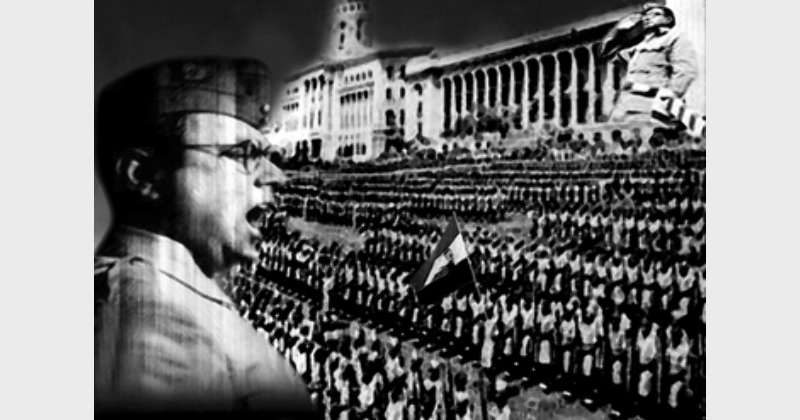
October 21, 2013 will be marked as the 70th year of the declaration of the provisional Government of Free India by Netaji Subhash Chandra Bose at Cathay Hall, Singapore. Which subsequently led to the Independence of Bharat on August 15, 1947. This is an occasion to celebrate.

Dr Bhagwati Prakash Sharma

On October 21, 1943 Netaji Subhash Chandra Bose formally announced the establishment of the Provisional Government of Free India at a crowded meeting in Cathay Hall in Singapore. Azad Hind was used to be recognised, as a legitimate state by a few countries. It had diplomatic relations with nine countries: Germany, the Empire of Japan, Italy, the Independent State of Croatia, Wang Jingwei’s Government in Nanjing, Thailand, the State of Burma, Manchukuo and the Second Philippine Republic. On the declaration of its formation in Singapore the Taoiseach of Ireland, Éamon de Valera sent a note of congratulations to Bose. Vichy France, government participated as an observer in the Greater East Asia Conference in November 1943.

While defining the tasks of this new political establishment, Subhas declared: “It will be the task of the Provisional Government to launch and conduct the struggle that will bring about the expulsion of the British and their allies from the soil of India.”

Bose, taking formal command of the Indian National Army from Rash Behari Bose, turned it into a professional army with the help of the Japanese. He recruited Indian civilians living in Japanese-occupied territories of South-east Asia, and incorporated vast numbers of Indian POWs from British forces in Singapore, Malaya and Hong Kong to man the brigades of the INA.

Founded on October 21, 1943, the government was inspired by the concepts of Subhas Chandra Bose who was also the leader of the government and the Head of State of this Provisional Indian Government in Exile. The government proclaimed authority over Indian civilian and military personnel in Southeast Asian British colonial territory and prospective authority over Indian territory to fall to the Japanese forces and the Indian National Army during the Japanese thrust towards India during the Second World War. The government of Azad Hind had its own currency, court and civil code, and in the eyes of some Indians its existence gave a greater legitimacy to the independence struggle against the British.

 Captain Doctor Lakshmi Swaminathan (later married as Lakshmi Sehgal) was the Minister in Charge of Women’s Organisation. She held this position over and above her command of the Rani Jhansi Regiment, a brigade of women soldiers fighting for the Indian National Army. For a regular Asian army, this women’s regiment was quite visionary; Dr. Lakshmi was one of the most popular and prosperous gynaecologists in Singapore before she gave up her fabulous practice to lead the troops of the Rani of Jhansi Regiment.

Rani Velu Nachiyar an 18th-century Indian Queen (born 1730-Died 1790 AD) from Sivaganga, Tamilnadu was the first ruler in the modern world to have raised an exclusive army of women. She was also the first Queen to fight against the British in India. She is the one and only Indian ruler who won the battle against British. Velu Naachchiyaar is also the first to have introduced the Guerrilla Warfare! first to Introduce Human Bomb.

 Immediately after the formation of the government-in-exile, Azad Hind declared war against the Anglo-American allied forces on the Indo-Burma Front. Its army, the “Azad Hind Fauj”, (Indian National Army or the INA) went into action against the British Indian Army and the allied forces. The government assumed control of the Andaman and Nicobar Islands from Japan in 1943.  The INA had its first major engagement at the battle of Imphal where it breached the British defences in Kohima, reaching the salient of Moirang. But soon it suffered a castastrophic defeat as the Allied forces held, and Allied air dominance and compromised supply lines forced both the Japanese and the INA to retreat.

The existence of Azad Hind was essentially coterminous with the existence of the Indian National Army. While the government itself continued until the civil administration of the Andaman Islands was returned to the jurisdiction of the British towards the end of the war, the limited power of Azad Hind was effectively ended with the surrender of the last major contingent of INA troops in Rangoon. The supposed death of Bose is seen as the end of the entire Azad Hind Movement. Some historians contend that the Azad Hind was a free and independent government. 


Contributions to India's Independence

The legacy of Azad Hind is far bigger than what is perceived. After the war, the British Raj observed with alarm the transformation of the perception of Azad Hind from traitors and collaborators to “the greatest among the patriots”. Given the tide of militant nationalism that swept throughout India and the resentment and revolts it inspired, it is arguable that its overarching aim, to germinate public resentment and revolts within the Indian forces of the British Indian Army to overthrow the Raj, was ultimately successful. 

Views of British Prime Minister Clement Attlee

The true extent to which the INA’s activities influenced the decision of British Raj to leave India is mirrored by the views of Clement Attlee, the British prime minister at the time of India’s Independence. Attlee cites several reasons, the most important of which were the INA activities of Subhas Chandra Bose, which weakened the very foundation of the British Empire in India, and the Royal Indian Navy Mutiny which made the British realise that the support of the Indian armed forces could no longer be relied upon.


Share
Tweet
SendShareSend
✮ Subscribe Organiser YouTube Channel. ✮
✮ Join Organiser's WhatsApp channel for Nationalist views beyond the news. ✮
Previous News

Chinese proxy attacks should be responded adequately: BJP

Next News

Justice done is justice won

Related News

New Delhi, Sep 06 (ANI): People remove debris during a rescue operation at the site of a building collapse near Satya Niketan in South-West Delhi, in New Delhi on Sunday. (ANI Video Grab)

Building collapse in Delhi: ABVP expresses grief over PG building collapse in Satya Niketan; Rescue operation underway

Arrested accused Manjit Singh Bedi

From US grocery store to FBI wanted list: Who is Manjit Singh Bedi, arrested in Punjab in 600000 dollar fraud case?

Prakriti Gyan Dham: A Living Classroom of Indian Botanical Legacy

Prakriti Gyan Dham: Where Indian heritage meets modern plant science

Barun, a teacher at Mitra Institution, was shot dead by assailants near Gobardanga railway station on July 5, 2012

When the left ruled Bengal, how did Sutia become a ‘Rape village’? Do you know the story of Barun Biswas

NIT Rourkela’s Indigenous EV Battery: Hybrid energy storage architecture & extended life lead lasting mobility

MEA backs UNGA resolution on cartographic representation

MEA backs UNGA resolution on cartographic depiction; Reaffirms India’s non-negotiable sovereignty over J&K and Ladakh

Load More

Latest News

New Delhi, Sep 06 (ANI): People remove debris during a rescue operation at the site of a building collapse near Satya Niketan in South-West Delhi, in New Delhi on Sunday. (ANI Video Grab)

Building collapse in Delhi: ABVP expresses grief over PG building collapse in Satya Niketan; Rescue operation underway

Arrested accused Manjit Singh Bedi

From US grocery store to FBI wanted list: Who is Manjit Singh Bedi, arrested in Punjab in 600000 dollar fraud case?

Prakriti Gyan Dham: A Living Classroom of Indian Botanical Legacy

Prakriti Gyan Dham: Where Indian heritage meets modern plant science

Barun, a teacher at Mitra Institution, was shot dead by assailants near Gobardanga railway station on July 5, 2012

When the left ruled Bengal, how did Sutia become a ‘Rape village’? Do you know the story of Barun Biswas

NIT Rourkela’s Indigenous EV Battery: Hybrid energy storage architecture & extended life lead lasting mobility

MEA backs UNGA resolution on cartographic representation

MEA backs UNGA resolution on cartographic depiction; Reaffirms India’s non-negotiable sovereignty over J&K and Ladakh

Gaurav Bhatia (L) and Saurav Das (R)

Fact-Check: CJP’s Saurav Das shares AI-generated quote attributed to Gaurav Bhatia, deletes after 24-hour ultimatum

Jordanian journalist Abdullah Ibhais, who exposed Qatar’s Kafala system and was released in March 2025 after serving three years of a five-year sentence

Who Is Abdullah Ibhais? Qatar’s Kafala slavery whistleblower abducted ahead of US testimony on 2022 football world cup

Representative image

Rising cases of ‘Love Jihad’: Ten disturbing cases reported across Bharat in one week

Bridging generation gap in the information age!

Load More
  • Privacy
  • Terms
  • Cookie Policy
  • Refund and Cancellation
  • Delivery and Shipping

© Bharat Prakashan (Delhi) Limited.
Tech-enabled by Ananthapuri Technologies

  • Home
  • Search Organiser
  • Bharat
    • Assam
    • Bihar
    • Chhattisgarh
    • Jharkhand
    • Maharashtra
    • View All States
  • World
    • Asia
    • Africa
    • North America
    • South America
    • Europe
    • Australia
  • Editorial
  • Operation Sindoor
  • Opinion
  • Analysis
  • Defence
  • Culture
  • Sports
  • Business
  • RSS @ 100
  • Entertainment
  • More ..
    • Sci & Tech
    • Vocal4Local
    • Special Report
    • Education
    • Employment
    • Books
    • Interviews
    • Travel
    • Health
    • Politics
    • Law
    • Economy
    • Obituary
  • Subscribe Magazine
  • Read Ecopy
  • Advertise
  • Circulation
  • Careers
  • About Us
  • Contact Us
  • Policies & Terms
    • Privacy Policy
    • Cookie Policy
    • Refund and Cancellation
    • Terms of Use

© Bharat Prakashan (Delhi) Limited.
Tech-enabled by Ananthapuri Technologies