Arjun Subramanian P
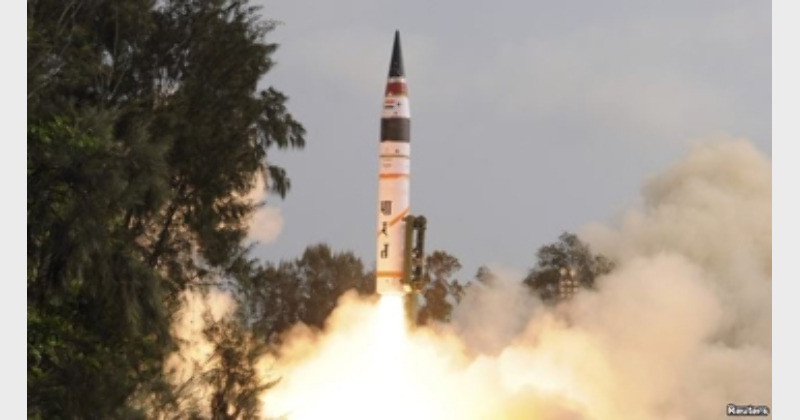
 The second successful test launch of the Agni V has further proved the effectiveness and the reliability of the missile and the technological capability of DRDO. DRDO’s ballistic missile project stands out among other complex weapons development programme. The Agni missile incorporates some new and advanced technology; it uses a combination of Ring laser gyro Inertial Navigation System (RINS) and a Micro Inertial Navigation System (MINS). For the first time, a redundant micro-navigation system was used in the Agni series. DRDO has declared that the three stage solid fuelled missile could reach to a distance of 5000 to 5500 km. The missile uses carbon composite to reduce its weight which improves its range. The Agni V enhances the reach of our nuclear strike capability.
It is a confirmed ICBM
This test confirms our place among the countries with the capability to develop Inter-continental Ballistic Missile (ICBM). Unlike after the first test, when DRDO termed the missile as Long Range Ballistic Missile (LRBM), the organisation’s chief Dr Avinash Chander openly admitted that the missile is an ICBM after the second successful launch. However, he mentioned the range to be just 5000-5500 km. Generally, an ICBM should have a minimum range of at least 5500 km. It is to be noted that after the 2012 test, some Chinese analysts claimed that the actual range of the missile is around 8000 km. Usually, ballistic missiles are launched in the Minimum Energy Trajectory (MET) to extract the maximum range out of the velocity imparted to the missile at burnout. In a minimum energy trajectory the apogee is approximately twenty per cent of the total range. If we observe one key parameter of the test launch – the apogee of the missile was just 600 km, which is just twelve percent of the tested range. This indicates that the trajectory was depressed. Hence, if the missile is launched in the MET the actual range would be much more than 5500 km and hence the Chinese analyst’s claim could be true.
Why was the trajectory depressed?
Firstly, a depressed trajectory achieves a Short Time of Flight (STOF) over the loss of some range. In this trajectory the missile emerges above the horizon and comes into the radar’s Field of View (FOV) much later compared to when launched in the MET. This reduces the reaction time of the enemy missile defence systems thereby defeating it. Secondly, the tested range conveys India’s intent to the international community on the role the missile would play and alongside that, India’s technological capability to develop longer range ballistic missile is also well advertised.
Coming Full Circle: Operationalising the Missile
The DRDO chief has said that the missile will now go into production, followed by further four to five tests and will be ready for induction in two years time. He has further said that the missile would be fired from a canister based launcher next year. A canister based launcher will enhance its storage, operational readiness, transportability, response time and shelf life. The system mounted on a truck will add operational flexibility.
Employment of the System
A study of the Chinese nuclear force structure shows that their nuclear assets are spreaded over a vast area and also they have built an extensive hardened underground tunnel, which runs into around 5000 km covering several provinces in China. The facility is reportedly hundreds of meters deep which make it exceptionally hard against even nuclear counter-force strikes. Hence, it would be wiser for India to structure the Agni V units to take on high value political and economic targets.
The Logic of Agni V
From the Indian perspective it is understood that the Agni V is primarily for enhancing India’s nuclear deterrence against China. However, both India and China have a declared No First Use (NFU) policy.
Agni V has just initiated the evolution of the future nuclear equation between India and China. It is for the first time India has attained parity with the Chinese nuclear force in having the potential to strike any part the other’s territory. Though India has a No First Use policy (NFU) policy, the Indian capability will certainly be seen as a threat and will be an important influencing factor in the future threat perception of Beijing.
The absence of parity in nuclear strike capability might possibly lead to nuclear blackmail in the future. Now, the Agni V has levelled the nuclear playground.
Further, India is almost close to deploying its sea leg of deterrence. The present SLBM- the K-15 has range limitations and reduces the SSBN’s operational flexibility (700 km), but DRDO is already working on the 3500 km range K-4 Submarine Launched Ballistic Missile (SLBM), which when operational might further alter the nuclear equation between the two countries.
India’s newly acquired long range nuclear strike capability may not produce immediate change in the India-China nuclear equation, but will evolve gradually with time as the Indian nuclear strike systems mature. The Change in the dynamics might start to become visible once India operationalises its sea leg of deterrence.
(The writer is Associate Fellow at Centre for Air Power Studies)