Jesus closer to market or Marx ?
July 3, 2026
  • Read Ecopy
  • Circulation
  • Advertise
  • Careers
  • About Us
  • Contact Us
Android AppiPhone AppArattai
Organiser
  • ‌
  • Bharat
    • Assam
    • Bihar
    • Chhattisgarh
    • Jharkhand
    • Maharashtra
    • View All States
  • World
    • Asia
    • Europe
    • North America
    • South America
    • Africa
    • Australia
  • Editorial
  • International
  • Opinion
  • RSS @ 100
  • More
    • Op Sindoor
    • Analysis
    • Sports
    • Defence
    • Politics
    • Business
    • Economy
    • Culture
    • Special Report
    • Sci & Tech
    • Entertainment
    • G20
    • Azadi Ka Amrit Mahotsav
    • Vocal4Local
    • Web Stories
    • Education
    • Employment
    • Books
    • Interviews
    • Travel
    • Law
    • Health
    • Obituary
  • Subscribe
    • Subscribe Print Edition
    • Subscribe Ecopy
    • Read Ecopy
  • ‌
  • Bharat
    • Assam
    • Bihar
    • Chhattisgarh
    • Jharkhand
    • Maharashtra
    • View All States
  • World
    • Asia
    • Europe
    • North America
    • South America
    • Africa
    • Australia
  • Editorial
  • International
  • Opinion
  • RSS @ 100
  • More
    • Op Sindoor
    • Analysis
    • Sports
    • Defence
    • Politics
    • Business
    • Economy
    • Culture
    • Special Report
    • Sci & Tech
    • Entertainment
    • G20
    • Azadi Ka Amrit Mahotsav
    • Vocal4Local
    • Web Stories
    • Education
    • Employment
    • Books
    • Interviews
    • Travel
    • Law
    • Health
    • Obituary
  • Subscribe
    • Subscribe Print Edition
    • Subscribe Ecopy
    • Read Ecopy
Organiser
  • Home
  • Bharat
  • World
  • Operation Sindoor
  • Editorial
  • Analysis
  • Opinion
  • Culture
  • Defence
  • International Edition
  • RSS @ 100
  • Magazine
  • Read Ecopy
Home Bharat

Jesus closer to market or Marx ?

Through the Eye of a Needle: Wealth, the fall of Rome, and the Making of Christianity in the West, 350-550 AD, Peter Brown, Princeton University Press, Pp 806 (HB), $ 39.95OVER the past few centuries the West, almost all of them Christian nations, has generated a huge amount of wealth. And yet, Jesus preached that for the wealthy the doors of heaven are closed. So how does the dichotomy sit? In an amazingly in-depth inquiry, Peter Brown, an antiquities scholar, goes through the history of Rome during 200

Archive ManagerArchive Manager
Oct 6, 2012, 04:09 pm IST
in Bharat
Follow on Google News
FacebookTwitterWhatsAppTelegramEmail

Christianity and wealth generation: A study
Dr R Balashankar
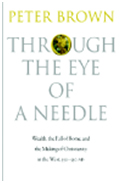
 
$img_titleThrough the Eye of a Needle: Wealth, the fall of Rome, and the Making of Christianity in the West, 350-550 AD, Peter Brown, Princeton University Press,  Pp 806 (HB), $ 39.95
OVER the past few centuries the West, almost all of them Christian nations, has generated a huge amount of wealth. And yet, Jesus preached that for the wealthy the doors of heaven are closed. So how does the dichotomy sit? In an amazingly in-depth inquiry, Peter Brown, an antiquities scholar, goes through the history of Rome during 200 hundred years between 350 and 550 AD to lay the foundation of an answer to this.
Through the Eye of a Needle – Wealth, the fall of Rome, and the Making of Christianity in the West, 350-550 AD is an account of the emergence of the new religion of Christ, the fading Roman culture, the rise of a new class of people in terms of the hierarchy in the church, who began interpreting Christianity in ways that were convenient, contemporary and appeared correct.
Peter Brown has effectively argued that other than totally renouncing wealth, faithful and believing Christians have given away a part of their wealth to the poor and needy and that act of donation needs to be seen as living up to the ideals of the faith. “To treat renouncers of wealth as the heroes and heroines of a “true” Christianity and to view all other forms of religious giving as somehow a betrayal of the essential radicalism of the Christian movement is to merely echo the high-minded language of the ascetic movement.”
Tracing the growth of Christianity through the early centuries after Christ, Brown says, “This book has traced a long process. We began with a hesitant age. As a result of conversion of Constantine in 312 AD, the Christian churches of the West had become privileged. But they had not become wealthy. The majority of the upper-class inhabitants of the Roman West were still encouraged by long tradition to show generosity to their cities and to their fellow citizens—not to the churches and still less to the poor. Only in the last quarter of the fourth century did the wealthy enter the church in growing numbers, often stepping into leadership roles as bishops and as Christian writers. It was the entry of new wealth and talent into the churches from around the year170 onward, rather than the conversion of Constantine in 312, which marks the turning point in the Christianization of Europe. From then onward, as members of a religion that had been joined by the rich and powerful, Christians could begin to think the unthinkable—to envision the possibility of a totally Christian society.” 
There is this interesting account of lighting in the churches. In the sixth century, the mosaic artists created a world where “the day remains through art.” To this, the devotees added lights, in the form of oil lamps and candles. Light was identified with Paradise and the lit churches turned into little heavens. With time, from the fourth to sixth century, the nature of donors mentioned in the mosaic outside the church also changed, with minor figures giving way to leaders of local society. Where there was ‘the teacher of children’ as a donor, now there were the names of local elite. “This shift in donors and in what they paid for is the measure of the changing of an age.”
Brown goes through the two-hundred years with the thoroughness that is amazing and at times heavy. In conclusion, he notes “Last, but not least, the greatest surprise of all occurred in the last fifth century. The leaders of the churches realized that they—and not the great lay landowners whose fortunes had previously dwarfed the wealth of the churches—were, at last, truly wealthy. The collapse of the traditional aristocracies left the church in a unique position… It was the weight of this new collective wealth, combined with the support of a new constituency of lay donors—drawn from many levels of society but most prominently from the new aristocracies of the post-imperial West—that exerted a discreet and continuous pressure on the churches of Latin Europe around 600 AD.
Peter Brown is the Philip and Beulah Rollins Professor of History Emeritus at Princeton University and has authored several books. Thoroughly researched, making use of the new materials that have emerged in the recent years, The Eye of the Needle is a scholarly work not just on early Christianity but relates its growth to the later developments and offers a new reading of the old sayings. It definitely is a source book for readers on religion and society.
(Princeton University Press, 41, William Street, Princeton, New Jersey 08540)

ShareTweetSendShareSend
✮ Subscribe Organiser YouTube Channel. ✮
✮ Join Organiser's WhatsApp channel for Nationalist views beyond the news. ✮
Previous News

His life was one that personified his mission and message ?Bhaiyaji Joshi

Next News

Guruji?s non-conflicting formula for minority assimilation

Related News

Raja Raghuvanshi Murder Case: Supreme Court refuses to stay bail granted to Sonam Raghuvanshi

The Madras HC dismisses DMK leader Ponmudi plea in hate speech case

Tamil Nadu: Madras HC refuses to hear Ponmudi’s plea over disparaging remarks on saivite, vaishnavite religious symbols

Tamil Nadu: Nilgiris’ Swayambhu Mahalingeswarar temple preserves centuries-old Badaga traditions

Japan's Prime Minister Sanae Takaichi and Prime Minister Narendra Modi (Photo: X@PressSec_JP)

‘Namaste’ reflects respect and trust: Japan highlights Indian greeting after Modi-Takaichi meeting

Amarnath Yatra Begins: PM Modi appeals devotees to adopt 5 sankalp; HM Amit Shah outlines extensive security measures

Balochistan: 40 dead, 8 injured as overloaded bus plunges into ravine; Exposes fragile infrastructure of Pakistan

Load More

Latest News

Raja Raghuvanshi Murder Case: Supreme Court refuses to stay bail granted to Sonam Raghuvanshi

The Madras HC dismisses DMK leader Ponmudi plea in hate speech case

Tamil Nadu: Madras HC refuses to hear Ponmudi’s plea over disparaging remarks on saivite, vaishnavite religious symbols

Tamil Nadu: Nilgiris’ Swayambhu Mahalingeswarar temple preserves centuries-old Badaga traditions

Japan's Prime Minister Sanae Takaichi and Prime Minister Narendra Modi (Photo: X@PressSec_JP)

‘Namaste’ reflects respect and trust: Japan highlights Indian greeting after Modi-Takaichi meeting

Amarnath Yatra Begins: PM Modi appeals devotees to adopt 5 sankalp; HM Amit Shah outlines extensive security measures

Balochistan: 40 dead, 8 injured as overloaded bus plunges into ravine; Exposes fragile infrastructure of Pakistan

Rajasthan Police's CID (Intelligence) has arrested alleged ISI funding agent Rafiq Sheikh of Aurangabad

Rajasthan CID arrests Rafiq Sheikh in Pakistan-linked ISI spy funding network case spanning multiple states

Union Petroleum Minister Hardeep Singh Puri

Petroleum Minister hints at fuel price cut if global crude stabilizes; Says, PSUs shielded consumers from energy shocks

80 Years of Organiser: How India’s impactful weekly redefined nationalism through civilisational lens

Japan Prime Minister Sanae Takaichi & Prime Minister Narendra Modi

India & Japan condemn cross-border terrorism & geopolitical aggression in South China Sea; Leaders uphold UNSC reforms

Load More
  • Privacy
  • Terms
  • Cookie Policy
  • Refund and Cancellation
  • Delivery and Shipping

© Bharat Prakashan (Delhi) Limited.
Tech-enabled by Ananthapuri Technologies

  • Home
  • Search Organiser
  • Bharat
    • Assam
    • Bihar
    • Chhattisgarh
    • Jharkhand
    • Maharashtra
    • View All States
  • World
    • Asia
    • Africa
    • North America
    • South America
    • Europe
    • Australia
  • Editorial
  • Operation Sindoor
  • Opinion
  • Analysis
  • Defence
  • Culture
  • Sports
  • Business
  • RSS @ 100
  • Entertainment
  • More ..
    • Sci & Tech
    • Vocal4Local
    • Special Report
    • Education
    • Employment
    • Books
    • Interviews
    • Travel
    • Health
    • Politics
    • Law
    • Economy
    • Obituary
  • Subscribe Magazine
  • Read Ecopy
  • Advertise
  • Circulation
  • Careers
  • About Us
  • Contact Us
  • Policies & Terms
    • Privacy Policy
    • Cookie Policy
    • Refund and Cancellation
    • Terms of Use

© Bharat Prakashan (Delhi) Limited.
Tech-enabled by Ananthapuri Technologies