Transcending tradition: The Asian context?
Manju Gupta?
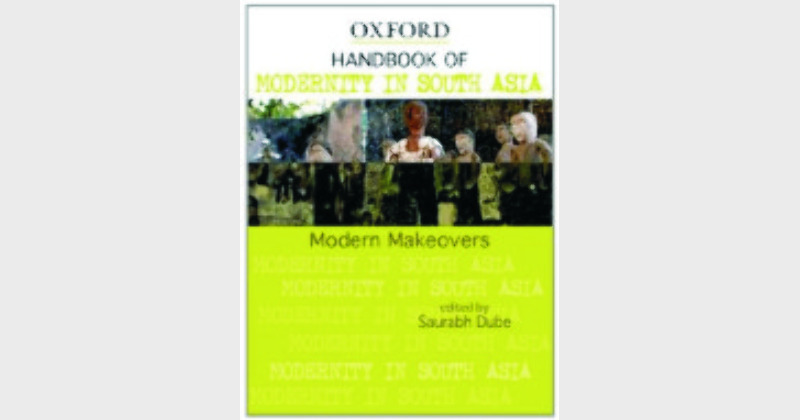
 Handbook of Modernity in South Asia: Modern Makeovers, Saurabh Dube (Ed.), Oxford University Press, Pp 276, Rs 750?
Before commenting on the book, let us try to find out the meanings of words like ‘modernity’ and ‘modern’. ‘Modernity’ and ‘modern’ imply transcending of tradition, a break with what has existed before. For instance, in the architectural sector, adobe huts have given way to high-rise buildings and this is called modernity. Though these are very simplistic explanations as stated above, the book under review gives more advanced, technical and sophisticated explanations by publishing a compilation of papers by different experts drawn from various fields where the concept of modernity and modern exists.
Divided into four sections, the chapters in the first section cast a new light on the linkages between the empire and the nation, the metropolis and the margins, the colony and the post-colony. On the other hand, they acutely unravel the unfamiliar implications of an imperial modernity and the critical contentions of a colonial modern.
Mrinalini Sinha focuses on the notion of civis Britannicus or British subjecthood, in order to query familiar projections of the linear trajectory of the nation-state. Arguing that in its more politicised forms, civis Britannicus stands for imperial citizenship, Sinha shows that in the pre-World War II scenario, there were a number of multinational and supranational polities that rivalled the nation-state. This shows expansive political aspirations towards supranational British subjecthood on the one hand and on the other, the innate difficulty and the refusal of the British government to fulfil such aspirations of its subjects.
Bodhisatttva Kar talks of Bengali racism that crucially unravelled during the Partition of Bengal in 1905 and the Swadeshi movement that ensued in its wake. This, he said, led to a fight between the civilised modern culture of the Bengali ‘self’ and the uncivilised, pre-modern barbarism of Assamese ‘other’. Until imperial rule, Assam had not formed part of India. Thus Assam being part of India is said to be the modern version of British imperialism because Assam was originally considered as des (country) rather than as pradesh (province).
Rohan Deb Roy shows the connection between medicine, modern and modernity and says that the promotion of quinine as a panacea for malaria “endangered nothing less that the disease itself.”
Atig Ghosh tracks the life and career of ‘Kangal’ Harinat Majumdar who had to close down his paper due to zamindar opposition and who became a mystic and songster, singing baul songs. It was his baul over the real bauls, which gave way to articulation of the romanticised and modern Tagorean baul.
In a similar vein, concepts like Ambedkar’s policy for Dalit emancipation, Mahatma Gandhi’s views of religion and religious equality and other many topics are explained to show the checkered routes that have characterised the ongoing process of the making of modernity and articulations of the modern in South Asia, particularly in India, and their past and their present.
The book is meant for subject-specific readers and not laymen.
(Oxford University Press, 1st Floor, YMCA Library Building, 1, Jai Singh Road, New Delhi-110 001; www.oup.com)?
Essays on Sikhism?
 Some Precious Pages of the Sikh History, Dr Jasbir Singh Sarna, Unistar, Pp 208, Rs 495?
This book is a compilation of articles which were published during various periods in magazines and journals. The author begins the book by talking about the birth of Prince Dalip Singh in 1838 when his father Maharaja Ranjit Singh’s glory had begun to vane. It is said at the royal banquet arranged by Maharaja Ranjit Singh for the British, the English officers mixed some poisonous substance in his drink because of which his health began to deteriorate gradually. Dalip Singh did not partake of pahul (consecrated drink) which all Sikh children took as a commitment to take to arms or the sword in defence of Sikhism and Sikh power. As he was too young to take over power, the British converted him to Christianity, sent him to England but Dalip Singh began to dislike the religion when he found himself being treated badly by the British. He returned to India to reach Pondicherry when he shifted his headquarters to Paris. He took over khanda’s pahul much to the pleasure of the Sikhs and staked his claim over Punjab. But he soon fell ill and died after getting paralysed in Paris.
In another article, the author talks about the Koh-i-noor diamond, which was taken from King Vikramaditya of Gwalior by the Mughals. Humayun took it and gave it to Babur and then it changed many hands till it reached Maharaja Ranjit Singh from whom the British took it to use in the crown of the Queen of England.
The next article talks of Guru Gobind Singh’s kalgi or the crest on his turban. This too found its way into the British empire when it was taken over from Maharaja Dalip Singh in London.
It is said that in Kashmir, during Guru Nanak’s time, two historic volumes of the Guru Granth Sahib were present there.
The subsequent articles relate to the importance of kesh (unshorn hair), kirtan or devotional songs, the holy shrines of Sikhs in Kashmir, jhatka meat, the Dabistan-i-Mazahib in Persian language, the use of metaphors in Guru Granth Sahib, Guru Nanak’s visit to Baghdad, Guru Gobind Singh’s visit to Jammu and history of the Sikh Students’ Federation.
(Unistar Books Pvt Ltd, 26-27, Top Floor, Sector 34A, Chandigarh, [email protected])—MG?