An authentic account of West”s quest in Afghan?
By MV Kamath?
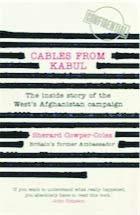 Cables From Kabul; The Inside Story of the West’s Afghanistan Campaign, Sherard Cowper-Coles; Harper Press; Pp312 (HB), £25.00?
Sherard Cowper-Coles, belonging to the British Foreign Service, in his time held a series of high-profile diplomatic posts both in the United Kingdom itself as well as overseas but he made probably his greatest contribution to the formulation of British Foreign policy as first his country’s Ambassador to Kabul and later as the Foreign Secretary’s Special Representative for Afghanistan and Pakistan. Not that he was always listened to. But that is another story.
As a second rate power Britain had to bow down to the dictat of Washington. He learnt that quite early enough after he took over the assignment as Ambassador. At the first meeting he had with his Embassy staff, he told its senior intelligence representative that his top priority would be building a relationship with Afghanistan’s President Hamid Karzai. “Oh no, it won’t” he was told by the officer rather bluntly, “your key relationship will be with the American Ambassador. It matters most to us!” Notes Cowper-Coles in this revealing book: “In this, he (the officer) was not implying that my job wasn’t to influence President Karzai and his government, but that I would have a much better chance of doing so with the Ambassador of the Predominant foreign power in Afghanistan” – obviously, the United States. As he put it. “We stuck at it (as part of the US-led NATO coalition) because Britain couldn’t and wouldn’t let down its coalition partners, especially the United States… We stuck at it because we wanted to believe our Generals”. Speaking for himself, he knew that “politicians, Generals, diplomats and officials struggling with successive strategies which never seemed to deliver what we wanted and with military tactics which – we all knew – could not, without a credible political strategy resolve Afghanistan’s underlying problems”. It was all very sad and frustrating.
Cowper-Coles was only too well aware of the wars which his own country during its imperial days fought against Afghanistan at tremendous cost. It was his conviction that the “Afghanistan Project cold be brought to a successful conclusion, but only once America was prepared to talk directly to its enemies and then to devote unprecedented political and diplomatic resources to leading an international effort to devise and deliver an internal and regional political process. He was aware that this was not likely to be. And practically the whole book reflects his efforts to convince his superiors of this. It is interesting that while Cowper-Coles had his views on his coalition partners, he had something positive to say about India.
As he saw it, “India is also a key factor in the conflict and an essential ingredient for success and stability”. He was aware of how “profoundly pro-Indian” President Karzai was while being “viscerally anti-Pakistan”. Coaper-Coles knew two Indian Ambassadors to Kabul – he doesn’t mention their names – of whom he has nothing but high praise. They were, as he saw them “Indian Foreign Service officers of the highest calibre, utterly professional representatives of the best of their country’s public service”, “very active, keeping in touch with politicians of all parties, having excellent access to President Karzai and his circle”. As he saw the situation “Wherever the truth lay, it was clear to me that a stable Afghanistan would require India’s consent and, probably, its active support” – and no better tribute could have been paid to India’s Foreign Service (IFS). The truth was that though Cowper-Coles does not mention India by name, or, for that matter any other neighbouring country, according to him “neither the United States, nor the United Nation had made any effort seriously or systematically to engage Afghanistan’s “neighbours in solving a problem which was, in the end, their problem”. And there was the rub. What he obviously meant was that both the US and the UN would be wise to take the advice of India in resolving the problem that was Afghanistan.
For one thing, Afghanistan was in poor state. During the time Cowper-Coles was the Ambassador, Afghanistan raised revenues of its own every year of about 800 million US dollars, while receiving at least forty times that in civil aid alone from the international community. It was almost a scandal – except that it was then in a position where it needed the Afghan government almost as much as the Afghan Government needed its western paymasters. The question was, as Cowper-Coles put it: “How long would it last once western forces left and what would happen in the many areas where there wasn’t a western presence and wouldn’t be one?” Even as things were, the situation was one of “a kind of military colonialism”. But, as the British Ambassador saw it, “to have a chance of making and enduring an positive impact on the host society, it would need to be done with much money and many men, for many years. And that was without even asking what the host society really wanted and might be willing to accept”. The Ambassador sought India’s assessment but was disappointed to learn that Delhi felt that security – and not talks with the Taliban – was “the only answer”. Each time he talked with Indian diplomats in Delhi he felt that talking to the Taliban “was appeasing Islamist terrorists”.
As he saw it, “it was a question of India’s worried heart overcoming its political brain” except that he also felt “there could be no question denying that, for all sorts of reasons of history and geography, India had a large and legitimate stake in a stable Afghanistan”. Reading this book one comes to understand how a British mind sees the situation in all its nuances and range, how, in such circumstances he feels and thinks and how both London and Washington respond to his occasionally unorthodox views. All that he had in mind was to help the “Obama Administration devise and implement Afghan policies that would reverse the downward trends” he had observed on the ground. This is a frank assessment of the situation in Afghanistan and deserves full attention not only in western capitals, but, just as importantly, in Delhi. We can’t let Afghanistan slide once again into chaos and anarchy.
(HarperCollins Publishers, 77-85, Fulham Palace Road, Hammersmith, London W6 8JB, www.harpercollins.co.uk, [email protected])?