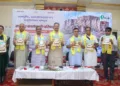
Addressing a function held in Colombo on October 28 when he was awarded the Best Journalist of Asia Prize by the Sri Lanka Mass Media Society ( a government supported NGO to promote excellence in the media world), N.Ram, editor-in-chief of The Hindu made some very relevant observations. One was that the time has come for the media in South Asia ?to seriously introspect on its role on how it could improve its performance in betterment of the welfare of the people and the peace processes in society?. Another was that it was ?high time media personalities evolved an accountable code of conduct? to deal with issues related to peace and issues that have a direct hearing on the lives of people. A third point he raised was that the main role of the media is not only to ensure deliverance of credible information but also to provide ?a context?. As he put it ?it is necessary that the reader believes in what is being conveyed but also has the benefit of knowing the full background of the information?.
Ram added: ?We need to go below the surface in a critical and constructive way?. And no wiser words were said. As The Hindu reported the event (October 29), Ram said that ?we need to go below? giving ?the context in which (events) have been happening or have happened?. Let this be stressed: there has been hardly any backgrounding in reports on the communal tensions whether in Orissa or in Karnataka. Reporting was often one-sided and anti-Hindu. Why were certain groups behaving in the way they were behaving? What was the reason behind the violence? Was there any logic involved? How come the percentage of Christians had been starkly increasing in parts of Orissa? How many foreign evangelists are there in India? How much money do they get from outside? How is it spent? Who are the foreign financiers? Have the evangelists been saying most outrageous things about Hindu gods and Hinduism in general? Hardly any paper of importance provided any information on these and other subjects. The television channels were the most irresponsible. It was ?breaking news? all the time. That is only one example. Another example was the terrorism initiated in Mumbai by the Maharashtra Navnirman Sena (MNS) against North Indian Labour in general and Bihari labour in particular. The Thackerays have been rightly criticised but again, hardly any daily made any effort to provide the background. The Hindu (October 26) carried an article by Dilip Chitre, the well-known Marthi poet translator and film-maker who said how the MNS must have dared to indulge in terrorism against the background of three Congress government looking the other way when it went on a rampage. Chitre notes that ?by 1968 the Shiv Sena received the secret support and encouragement of Vasantrao Naik, Maharashtra'sChief Minster appointed by Indira Gandhi?. Following the 1993 riots even after the Shrikrishna Commission made its recommendations the Government of Maharashtra ?let the Sena and its official and unofficial co-conspirators off the hook for sheer political reasons?. When the Shiv Sena announced its decision not to let Morarji Desai enter the city of Mumbai, according to Chitre (and it is a well-known fact, anyway) ?Naik advised his cops to look away while the Shiv Sena took the law into own hands, felled trees and electric poles to barricade the roads from the airport to the city and then went on a rampage for the next three days destroying street furniture, milk-vending boots, attacking restaurants and looting small shop as well as big department stores?. What can any one do when a government backs rioters? It seems it is a repetition of the case in the recent anti-north Indian labour riots in Mumbai and its suburbs. Another aspect of rioting is provided by Parag Rabade writing in Deccan Herald (November 2). Rabade draws attention to the fact that ?the unrestricted influx of migrants mostly from Bihar from Bihar and Uttar Pradesh into Mumbai in the past two decades in search of livelihoods has begun to put enormous pressure on the metropolis, its neighborhood and civil infrastructure (and) there is hardly any vacant space left which is not occupied by slums?. Rabade adds! ?If this ?rape? of the city by unmindful political class had angered the local people, the frequent visits by Samajwadi Party leaders Mulayam Singh Yadav and Amar Singh, BSP supreme Mayawati and RJD Chief Lalu Prasad to build their own respective ?vote banks? here, with the support of those very migrants had unsettled them?. Rabade makes a good point. In the first place the influx of migrants should have been controlled a long time before. (Incidentally), in China, the influx of rural people into the cities is strictly controlled). It wasn?t. In the second place, the large presence of north Indians in Mumbai was being politically exploited by the likes of Mulayam Singh Yadav and Lalu Prasad. In the third place, if Rabade is to be believed, any where in Maharashtra, ?even on the 15?year old Konkan railway route? one will find? a majority of the rail-way staff such as TCs, station masters, booking clerks, signalmen and guards and engine-drivers? are non-Marathi and that ?there is a general perception among people?right or wrong?that the railway jobs are being manipulated in favour of candidates from Bihar and UP.? If this is indeed true, the MNS should have done three things: It should have obtained statistics of how many living in slums are from Uttar Pradesh and Bihar, two, it should have obtained statistics on how many north Indians are serving on the Konkan Railway and three, asked why is it that Marathi manoos are not in the taxi business or the restaurant business and, in fact, most other businesses and produced a White Paper to support the cause of the Marathi manoos. If that proved convincing, then the MNS would have had a sound reason to agitate. The MNS and the Shiv Sena as well, did nothing of the sort but resorted to violence in an extremely uncivilised way bringing Maharashtra into disrepute. The media must share the blame. It provided very little background to the rage of the Marathi manoos who probably feels cheated. In a way Shobha De was right when she said in a TV programme that she understood the rage of the MNS. The major question remains: who is running the media? Intelligent editors or mindless advertisement mangers? N.Ram raised an important point in describing what constitutes good reporting. A tip to reporters: Friends, kindly do some homework; nothing is more informative than backgrounding news. That tells us not just what happened but why something happened.