Hindu religion and its many Gods
December 7, 2025
  • Read Ecopy
  • Circulation
  • Advertise
  • Careers
  • About Us
  • Contact Us
Android AppiPhone AppArattai
Organiser
  • ‌
  • Bharat
    • Assam
    • Bihar
    • Chhattisgarh
    • Jharkhand
    • Maharashtra
    • View All States
  • World
    • Asia
    • Europe
    • North America
    • South America
    • Africa
    • Australia
  • Editorial
  • International
  • Opinion
  • RSS @ 100
  • More
    • Op Sindoor
    • Analysis
    • Sports
    • Defence
    • Politics
    • Business
    • Economy
    • Culture
    • Special Report
    • Sci & Tech
    • Entertainment
    • G20
    • Azadi Ka Amrit Mahotsav
    • Vocal4Local
    • Web Stories
    • Education
    • Employment
    • Books
    • Interviews
    • Travel
    • Law
    • Health
    • Obituary
  • Subscribe
    • Subscribe Print Edition
    • Subscribe Ecopy
    • Read Ecopy
  • ‌
  • Bharat
    • Assam
    • Bihar
    • Chhattisgarh
    • Jharkhand
    • Maharashtra
    • View All States
  • World
    • Asia
    • Europe
    • North America
    • South America
    • Africa
    • Australia
  • Editorial
  • International
  • Opinion
  • RSS @ 100
  • More
    • Op Sindoor
    • Analysis
    • Sports
    • Defence
    • Politics
    • Business
    • Economy
    • Culture
    • Special Report
    • Sci & Tech
    • Entertainment
    • G20
    • Azadi Ka Amrit Mahotsav
    • Vocal4Local
    • Web Stories
    • Education
    • Employment
    • Books
    • Interviews
    • Travel
    • Law
    • Health
    • Obituary
  • Subscribe
    • Subscribe Print Edition
    • Subscribe Ecopy
    • Read Ecopy
Organiser
  • Home
  • Bharat
  • World
  • Operation Sindoor
  • Editorial
  • Analysis
  • Opinion
  • Culture
  • Defence
  • International Edition
  • RSS @ 100
  • Magazine
  • Read Ecopy
Home General

Hindu religion and its many Gods

Archive ManagerArchive Manager
Apr 27, 2008, 12:00 am IST
in General
Follow on Google News
FacebookTwitterWhatsAppTelegramEmail

Why there are so many Gods in Hindu religion? I keep getting this question from several quarters. Actually there is not much complexity involved in explaining this aspect, if we understand some basic principles of Hinduism. We do not need to be a very big Hindu philosopher for this.

My opinion is that there are not many Gods in Hindu religion as is usually perceived by people of other religions. Actually there is only one god. There is only one god generally called ?Brahman or Bhagawan?. The God has been given several names and several forms by the people following the Hindu religion.

The question is why the Hindus created so many names and forms of God if they believe in only one god?

I think there could be a few interpretations or reasons that could have prompted Hindu people to think of several forms and names.

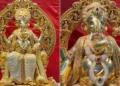
One of such interpretation is that the god as an all capable entity, can take any form and will be available to help common people in the form that they wish to see him. Hence, whenever common people wanted see the god as creator, they created a form called ?Brahma? and called him god of creator. Similarly, ?Vishnu? is the god representing the sustenance of the world and ?Shiva? the Destroyer. Where as ?Ganapati? represents the ?solver of all the troubles?, ?Lakshmi? became goddess of ?Wealth?, so on and so forth. God is one but can take any form, when people genuinely wish to see him in such a form. My understanding is that the Hinduism has not put any restrictions on the thinking process of individuals on which way they want to realise the existence of the God and the ultimate unification with the god, the eternal energy of this world. It is not improper, in Hindu religion, to think that the god being all powerful, can manifest into any of the myriad of ?Sakara? forms including gods and goddesses.

As Prof. Jeaneane Fowler of the University of Wales College, Newport beautifully puts it in his book ?Hinduism: Beliefs, Practices and Scriptures?, the relationship between the many manifest deities and the unmanifest Brahman is rather like that between the sun and its rays. One cannot experience the sun itself but one can experience its rays and the qualities, which those rays have. And, although the sun'srays are many, ultimately, there is only one source, one sun. So the gods and goddesses of Hinduism amount to thousands, all representing the many aspects of Brahman.

Hindu thought teaches humankind to see god in every aspect of life. Thus they tried to see divinity in every force of nature they came across?the rain (Indra), the wind (Vayu), the water (Varuna), the fire (Agni) etc. By seeing themselves as a minuscule part of the infinite Brahman and by seeing the Brahman all around them, Hindu people tried to establish a divine, devout, righteous and selfless society.

Several schools of Hinduism believe that individual soul has to undergo several cycles of birth and death to reach the pest form and be ready to achieve the constant companionship (or oneness) with the god. The soul that thus undergoes several rebirths slowly attains spiritual elevation in each of those births and slowly becomes closer and closer to the supreme lord.

Rigveda says ?Ekam Sat, Viprah Bahudha Vadanti? which means, ?Truth is one but learned men describe it differently?. Hence this forms the theoretical basis of allowing the people or society at large to have and form their own form and name of that one supreme god.

Since Hindu scriptures consider god as one true, eternal, infinite, transcendent and omnipotent ?Energy? or ?Supreme Cosmic Spirit?, theoretically it represents God without any form and without any beginning and an end. It is one formless, timeless and all pervasive entity. It is the truth that is ?Beyond Description? as stated by few great individuals.

Since the common man can not understand and appreciate any thing without a form, for the sake of common folk, there could be a god who has some specific form such as Ganesha, Hanuman, Vishnu etc, but for the individuals with higher order of thinking, there need not be any form to god and god might be simply an entity which is so complex, and endless that can not be understood. For some other individuals, god could simply be a concept to create an orderly social life. Thus, in Hinduism, it is perfectly acceptable that every individual?whether he is a simple ignorant common man or whether he is a well studied philosopher, to have his own form of ?God?.

Hence Hinduism sets itself apart from any other religion in two very important conceptual differences discussed above, that is: God is one, but can be described by several ways and that there could be many ways to attain the unity / constant companionship of god.

It is important to note that the Hindu thought has been developed for more than 5000 years in the past and there were several significant contributions to this thought by many knowledgeable human beings.


ShareTweetSendShareSend
✮ Subscribe Organiser YouTube Channel. ✮
✮ Join Organiser's WhatsApp channel for Nationalist views beyond the news. ✮
Previous News

Countrywide celebration of New Year

Next News

Play & Learn A Bird

Related News

Defence Minister Rajnath Singh(File Photo)

Defence Minister unveils Galwan War Memorial; Hails border connectivity as key to suucess in Operation Sindoor

UMEED Portal

UMEED Portal deadline ends: Logs 5.17 lakh Waqf properties, with 2.16 lakh approved, 2.13 lakh pending, 10,869 rejected

R. Sreelekha IPS (Retd.)

Kerala: Interview with R. Sreelekha IPS (Retd.) — BJP’s Thiruvananthapuram Municipal Corporation Candidate

How Nehru Torpedoed Vande Mataram: The Untold Story

Bangladeshi army officer and senior BNP leader Col Abdul Haque

A former Bangladeshi army officer & BNP leader urges youth to get army training to sever Northeast from India

PM Narendra Modi on Vande Bharat

“Removal of significant verses in Vande Mataram sowed seeds of partition”: PM Modi

Load More

Comments

The comments posted here/below/in the given space are not on behalf of Organiser. The person posting the comment will be in sole ownership of its responsibility. According to the central government's IT rules, obscene or offensive statement made against a person, religion, community or nation is a punishable offense, and legal action would be taken against people who indulge in such activities.

Latest News

Defence Minister Rajnath Singh(File Photo)

Defence Minister unveils Galwan War Memorial; Hails border connectivity as key to suucess in Operation Sindoor

UMEED Portal

UMEED Portal deadline ends: Logs 5.17 lakh Waqf properties, with 2.16 lakh approved, 2.13 lakh pending, 10,869 rejected

R. Sreelekha IPS (Retd.)

Kerala: Interview with R. Sreelekha IPS (Retd.) — BJP’s Thiruvananthapuram Municipal Corporation Candidate

How Nehru Torpedoed Vande Mataram: The Untold Story

Bangladeshi army officer and senior BNP leader Col Abdul Haque

A former Bangladeshi army officer & BNP leader urges youth to get army training to sever Northeast from India

PM Narendra Modi on Vande Bharat

“Removal of significant verses in Vande Mataram sowed seeds of partition”: PM Modi

West Bengal: Sanatan Sanskriti Sansad’s Gita Path Sees 6.5 Lakh Hindus Recite the Gita in Kolkata

(L) Panakkad Munavarali Shihab Thangal (R) Fathima Nargese

Kerala: Muslim League leader’s 16 years old daughter Fathima Nargese backs women entry into Mosques, father disputes

Pakistani traders protest mounting losses as prolonged border closures disrupt regional commerce and strain ties with Kabul

Taliban strike back as Pakistan border shutdown with Kabul choke trade routes and trigger protest at home

The doctrine of Geeta diplomacy

The Doctrine of Gita Diplomacy: Culture, strategy and the evolving global connect of India

Load More
  • Privacy
  • Terms
  • Cookie Policy
  • Refund and Cancellation
  • Delivery and Shipping

© Bharat Prakashan (Delhi) Limited.
Tech-enabled by Ananthapuri Technologies

  • Home
  • Search Organiser
  • Bharat
    • Assam
    • Bihar
    • Chhattisgarh
    • Jharkhand
    • Maharashtra
    • View All States
  • World
    • Asia
    • Africa
    • North America
    • South America
    • Europe
    • Australia
  • Editorial
  • Operation Sindoor
  • Opinion
  • Analysis
  • Defence
  • Culture
  • Sports
  • Business
  • RSS @ 100
  • Entertainment
  • More ..
    • Sci & Tech
    • Vocal4Local
    • Special Report
    • Education
    • Employment
    • Books
    • Interviews
    • Travel
    • Health
    • Politics
    • Law
    • Economy
    • Obituary
  • Subscribe Magazine
  • Read Ecopy
  • Advertise
  • Circulation
  • Careers
  • About Us
  • Contact Us
  • Policies & Terms
    • Privacy Policy
    • Cookie Policy
    • Refund and Cancellation
    • Terms of Use

© Bharat Prakashan (Delhi) Limited.
Tech-enabled by Ananthapuri Technologies