
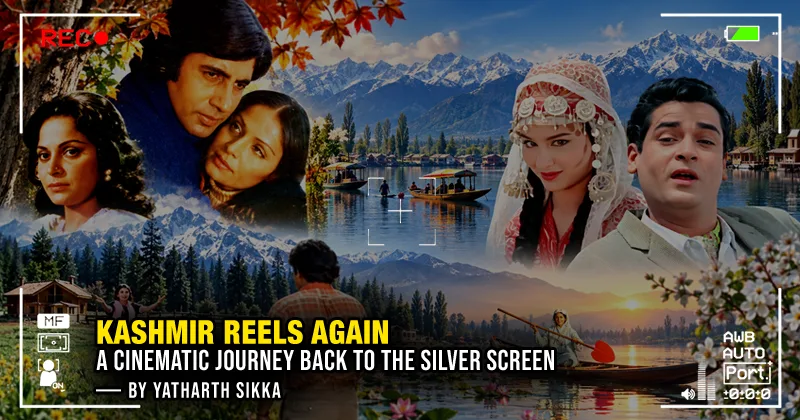
For generations, Jammu and Kashmir was first experienced by Indians through the silver screen. The shikaras moving gently on Dal Lake, snow-covered mountains, colourful Kashmiri attire, the meadows of Gulmarg and Pahalgam and songs filmed in the breathtaking Himalayan landscapes became part of India’s collective cinematic memory.
Long before foreign destinations became a regular feature of Hindi cinema, Kashmir was among the most favoured locations for filmmakers. The Valley became the setting for some of the most memorable songs and films in Indian cinema.
However, this relationship between Kashmir and cinema was severely disrupted by terrorism in the 1990s. Cinema halls were shut down, film screenings stopped, theatres were attacked and threatened, and film crews gradually stopped coming to the Valley.
Against this historical background, the first International Film Festival of Jammu and Kashmir, being organised from September 7 to 10, 2026, assumes special significance. The festival brings cinema back to a land that has a much older relationship with storytelling and theatre than the history of modern films.
Kashmir: A civilisational centre of learning
Kashmir’s connection with storytelling and the performing arts did not begin with the arrival of cinema. The civilisational history of Kashmir is traditionally associated with Rishi Kashyap. Ancient texts and traditions describe Kashmir from the ancient lake known as Satisar, associated with the goddess Sati. According to this tradition, Rishi Kashyap played a central role in making the Valley habitable.
Over centuries, Kashmir developed into one of the major centres of learning, philosophy and literature in the Indian civilisational tradition.
The Valley’s contribution to India’s intellectual and cultural history also has an important connection with theatre. The Natyashastra by Bharata Muni is among the foundational texts of Indian drama, theatre, dance, music and Kashmir played a significant role in preserving, interpreting and expanding this legacy.
One of the greatest scholars associated with this tradition was Abhinavagupta. He wrote the Abhinavabharati, one of the most important commentaries on the Natyashastra. His interpretation of rasa, created through art and performance, remains central to the study of Indian aesthetics and beauty.
In this sense, Kashmir was not merely a land of natural beauty that later attracted filmmakers. It was also an important centre in India’s long intellectual tradition of understanding drama, performance and artistic expression.
Kashmir’s association with knowledge was also reflected in institutions such as Sharada Peeth, which historically emerged as an important centre of learning in the Indian subcontinent. Centuries before cameras and cinema arrived, Kashmir had already made its contribution to intellectual understanding of storytelling and performance.
From intellectual tradition to the silver screen
When cinema emerged in India, Kashmir’s natural geography made it an obvious attraction for filmmakers. The Valley offered landscapes that could not easily be recreated in a studio. Dal Lake and its shikaras, Srinagar’s gardens, Gulmarg’s snow-covered slopes, Sonamarg’s mountains and Pahalgam’s meadows soon became familiar to audiences across India.
Hindi cinema played a major role in introducing Kashmir’s landscapes to millions of people. For many Indians, the first visual image of Kashmir came through films. The Valley became synonymous with romance, music and scenic beauty.
Films such as Junglee, Kashmir Ki Kali and Jab Jab Phool Khile turned Kashmir into one of the most recognisable cinematic landscapes of India. A romantic song in the snow, a shikara on Dal Lake or actors walking through the green meadows of Kashmir could immediately transport audiences to the Valley.
The popular expression that Kashmir is India’s “Switzerland” reflects this cinematic imagination. For an earlier generation of Indian filmmakers and audiences, Kashmir was the original dream destination before international locations became easily accessible for film productions.
When Kashmir became a film’s identity
Kashmir was not only used as a shooting location. The Valley became part of the identity of films themselves. The most famous example remains Kashmir Ki Kali. The name Kashmir was itself enough to create an image in the minds of audiences. The film, starring Shammi Kapoor and Sharmila Tagore, became one of the most memorable cinematic representations of the Valley.
The way cinema represented Kashmir changed with time. Earlier films largely presented Kashmir through romance, music and natural beauty. Later films increasingly explored terrorism, security and the 1990s Hindu exodus.
The relationship between Kashmir and cinema became so deep that, in one instance, a film gave a popular identity to a geographical location. The famous Betaab Valley near Pahalgam derives its name from the 1983 Hindi film Betaab, starring Sunny Deol and Amrita Singh, which was shot in the area. Before the film was released, the scenic meadows were known as Hajan Valley, also referred to as Hagan Valley.
Following the release of Betaab, the location became popularly known as Betaab Valley and gradually emerged as one of the major tourist attractions of Pahalgam. It remains one of the examples of the close relationship between Kashmir’s landscape and cinema.
Kashmir beyond Hindi Cinema
Kashmir’s attraction has not been limited to Bollywood. Its landscapes have been used by filmmakers, singers and artists from different parts of India.
Punjabi cinema and Punjabi music videos have also frequently used Kashmir as a shooting location. Snow-covered mountains, roads cutting through the Himalayas, meadows and lakes have provided a visual setting for songs and films.
Kashmir’s relationship with cinema was not limited to film shooting. The Valley also had an active cinema-going culture. Srinagar had several cinema halls where local residents regularly watched films. Going to the cinema was part of the social and cultural life of the city.
This changed dramatically with the rise of terrorism in the late 1980s. As terrorism intensified, cinema halls increasingly faced threats and attacks. Terrorist organisations opposed film screenings and it made increasingly difficult to operate theatres.
By 1990, cinema halls across the Valley had closed. For a generation that had grown up watching films in theatres, the disappearance of cinema halls marked a major cultural disruption.
On September 24, 1999, Srinagar’s Regal Cinema was attacked with a grenade during its first day and maiden show after reopening. The blast killed one civilian and injured around 12 others, abruptly halting government-backed efforts to revive movie theatres in the Kashmir Valley.
The effect of terrorism was also visible in the film industry. As the situation deteriorated, filmmakers found it increasingly difficult to organise large-scale shoots in Kashmir. Production units gradually shifted to other locations, including foreign destinations.
Kashmir continued to appear in films, but the actual shooting increasingly took place elsewhere. One of the most striking examples was Roja. The story was closely associated with Kashmir and its situation. However, the situation made filming in Kashmir difficult and other locations were used to recreate the required setting.
This reflected a wider change. Kashmir was still present in the imagination of Indian filmmakers, but the Valley itself was no longer easily accessible as a regular shooting location. The region that had once been known for romantic songs and outdoor shoots increasingly became associated with stories of terrorism.
With the rise of terrorism, tourism was also affected, public spaces came under threat and cultural activities were severely disrupted. The same region that had welcomed some of India’s biggest film productions gradually became increasingly difficult for filmmakers and cinema exhibitors to operate in.
Beyond Valley: Jammu in India’s visual culture
The cinematic and cultural association of Jammu and Kashmir is not limited to the Valley. Jammu’s religious and cultural landscape has also found representation in Indian films and popular music.
The Mata Vaishno Devi shrine has inspired many devotional films, bhajans, songs and visual productions over the decades. The journey to the shrine and the wider landscape of the Jammu region have become familiar to audiences through religious and popular visual culture. Thus, while the snow-covered mountains, lakes and meadows of Kashmir became synonymous with romance in popular cinema, Jammu developed its own association with devotional and Indian dharmic culture. Together, these diverse landscapes and traditions made Jammu and Kashmir a distinctive space for filmmakers and storytellers.
Return of Cinema in Kashmir
Following the abrogation of 35-A and amendment in the Article 370 in August 2019, efforts were initiated to promote the Union Territory as a destination for film production. The government introduced policies aimed at encouraging film shootings and developing infrastructure related to the film industry. Gradually, film crews began returning.
In 2022, cinema returned to Srinagar with the opening of a multiplex. The development marked an important moment in the restoration of cinema exhibition. At the same time, Jammu and Kashmir increasingly began appearing again as an actual shooting location rather than simply as a setting recreated elsewhere. Production units returned to the Valley.
A Festival for India
It is against this historical background that the first International Film Festival of Jammu and Kashmir assumes importance.
The four-day event featured 135 films from 41 countries, selected from more than 1,100 international submissions. Hosted at the scenic Sher-i-Kashmir International Convention Centre (SKICC), the festival aimed to revive local film culture, empower youth and boost tourism.
The festival also brought together filmmakers, artists, cinema enthusiasts and audiences from Jammu and Kashmir, different parts of India and other countries. Through screenings and interactions, it provided a platform for different forms of cinema, including feature films, documentaries and short films.
A standout attraction was a unique floating cinema on Dal Lake, allowing audiences to watch screenings from traditional shikaras. The event also provided an opportunity for local filmmakers and young artists to engage with filmmakers and cinema traditions from outside the region and bring Jammu and Kashmir’s own stories into a wider cinematic conversation.
For decades, Kashmir had been one of the most favoured locations in Indian cinema. Then came a period when terrorism shut cinema halls and forced filmmakers away from the Valley.
Today, films are once again being screened, cinema halls have returned and production units are gradually coming back. The organisation of an international film festival adds another dimension to this revival. The significance of the event can be understood by looking at Kashmir’s journey across centuries. The International Film Festival of Jammu and Kashmir is now another chapter in that long journey.