VARANASI: According to the ancient legend, Bhagirath, the ancestor of the Ikshvaku lineage, did a tapasya to bring the Ganga down from the heavens and onto Indian soil, so that the ashes of his forefathers could find peace. The river arrived not as water alone, but as a life-giver, where the civilisation would care for what had been given to it. The Rigveda’s Nadistuti Sukta, among the oldest hymns to name a nation’s rivers in a single breath, treats the Ganga and her sisters not as resources but as living presences deserving invocation. For millennia, villages grew along her banks, poets summoned her in verse, and pilgrims measured their lives against her ghats. Rapid urbanisation, industrial effluent and the sheer press of a growing population placed a weight on the Ganga that no single monsoon could wash away.
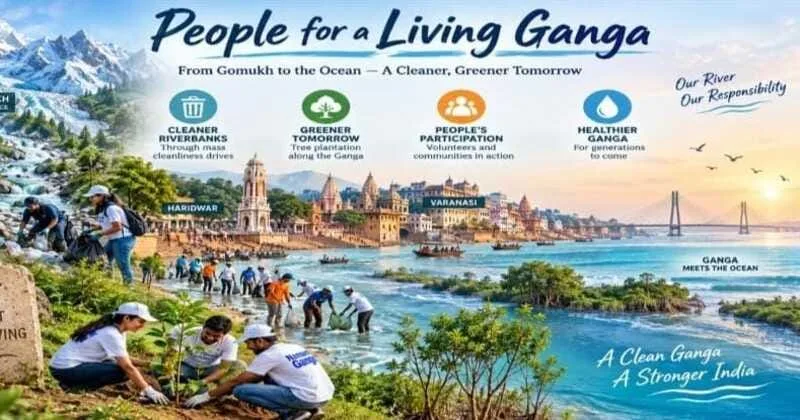
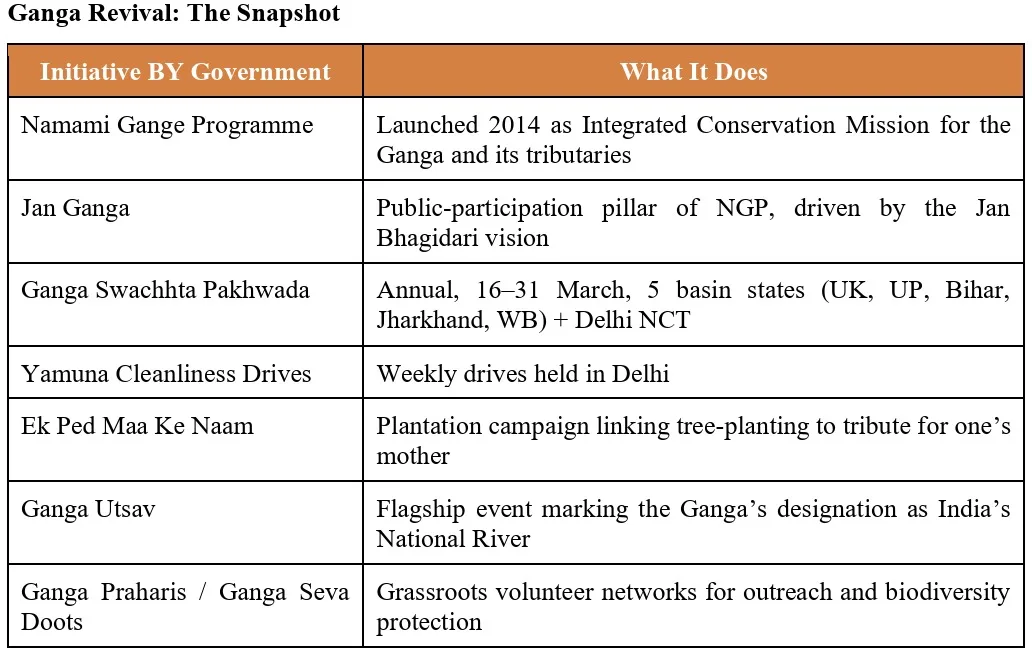
Reviving her India has come to understand was never going to be a matter of engineering alone. It would require something closer to what first brought her here: collective will. That understanding sits at the heart of the Namami Gange Programme, launched in 2014 and more specifically of the initiative built to carry its spirit into everyday life, Jan Ganga.
A Civilisational Inheritance Renewed
Long before “conservation” entered India’s policy vocabulary, the relationship between a river and her people carried the weight of dharma. Jal seva, service to water, sat alongside other everyday duties as a marker of a life well lived and the great river-cities. From Varanasi to Prayagraj to Haridwar, pilgrimage grew over the Ganga because of an unbroken civic instinct to gather at her banks. Kumbh gatherings, still among the largest peaceful assemblies of human beings anywhere on earth, are themselves evidence that reverence for a river can mobilise millions without a single order being issued from above; the instinct has always been there, waiting for institutions capable of channelling it usefully.
Namami Gange did not invent this relationship; it sought to recover it under modern conditions, where distance from the river, physical and psychological, had allowed neglect to set in. Jan Ganga is best understood, then, not as an add-on to an engineering project but as an attempt to re-thread a civilisational instinct through the institutions of a contemporary state.
An Integrated Mission Takes Shape
Namami Gange was conceived not as a single clean-up drive but as an Integrated Conservation Mission for the Ganga and her tributaries. Its mandate runs where wide sewage treatment infrastructure, riverfront development, afforestation along vulnerable stretches and a scientific monitoring architecture to track water quality over time. Public awareness campaigns run alongside this technical work, feeding back into it so that citizens are not merely informed of progress but drawn into shaping it. But the programme’s architects recognised early that infrastructure could purify water without restoring a river’s place in the life of a people. A treatment plant does not by itself rebuild the instinct to protect. For that, something more participatory was needed: a pillar of the mission built entirely around people rather than pipelines.
Jan Ganga and the Idea of Jan Bhagidari
That pillar is Jan Ganga, and its guiding philosophy is Jan Bhagidari, a citizen partnership. It is not as a slogan but as an operating principle of governance. The premise is straightforward a river cleaned by the state alone remains, in the public imagination, the state’s responsibility. Jan Ganga has been built to move people along with the awareness of the river’s condition, to active participation in restoring it and finally to a sense of ownership over its future. Each stage feeds the next, and each is anchored in activities that ordinary citizens, not specialists, can undertake. In this sense, Jan Ganga functions less like a campaign with a start and end date; it is more like a civic habit that the programme is trying to make permanent.
Cleanliness as a Civic Ritual
The cleanliness more visible than in the rhythm of organised cleanliness drives. The Ganga Swachhta Pakhwada, observed every year from the 16th to the 31st of March, has grown into a fortnight during which thousands of citizens across the five main-stem Ganga basin states, Uttarakhand, Uttar Pradesh, Bihar, Jharkhand and West Bengal, along with the National Capital Territory of Delhi and towns strung along the river’s tributaries, turn out for coordinated cleaning efforts. Students, community volunteers and local institutions participate together to transform what could easily have remained a bureaucratic calendar entry into a shared civic occasion, not unlike the periodic gatherings that have long drawn Indians to their rivers for reasons older than any government programme. The momentum does not pause once the fortnight ends. In Delhi, weekly cleanliness drives along the Yamuna have become a fixture, ensuring that river stewardship is treated as an ongoing civic practice rather than an event confined to a designated window each year.
Greening What the Water Touches: Building Custodians across Society
Attention to river health has naturally extended to its banks. Healthy vegetation stabilises soil, reduces erosion and strengthens the resilience of the wider riparian ecosystem, and plantation drives have become one of the most visible forms of public participation under Namami Gange.
The Ek Ped Maa Ke Naam campaign has given this activity a personal dimension, inviting citizens to plant a tree as a tribute to their mothers. In doing so, it fuses an intimate, emotional gesture of gratitude toward one mother- with an act of ecological responsibility toward another, the river long addressed in Indian tradition as Ganga Maa. The campaign has drawn families, not only individuals, into sustained participation, turning what could have been a purely administrative afforestation target into something closer to a household ritual. World Environment Day observances add to this rhythm each year, layering plantation drives, awareness walks and community initiatives onto the wider calendar of river-linked civic action.
A movement sustains itself only if it reaches the generation that will inherit its outcomes, and Jan Ganga’s youth engagement component reflects that understanding. Schools, colleges and universities across the basin states now offer students structured avenues to explore river conservation, through essays, paintings, posters, debates and interactive awareness programmes that turn an abstract policy goal into something young people can express creatively. University Ganga Clubs extend this further, organising lectures, field visits and outreach activities that connect classroom learning to the river’s real, observable condition.
Eco-clubs and National Cadet Corps units provide additional institutional support by ensuring that engagement with the river is not a one-time school project but a recurring part of student life across multiple platforms. The intention is long-term: a generation raised to see the river as an ordinary civic duty, not an occasional cause. There is a quieter transmission at work here too, not unlike the guru-shishya tradition of passing on a duty rather than merely a fact: a student who has planted a sapling on the Ganga’s bank or debated her future in a classroom carries that memory into whichever profession they eventually choose.
A River in the National Calendar
Namami Gange has also woven river conservation into the Indian calendar of public observances. Ganga Utsav, held to commemorate the Ganga’s recognition as India’s National River, has become a flagship gathering for cultural and civic expression, performances, exhibitions, art contests and public dialogues that treat the river as a living presence in national life rather than a policy subject. Other occasions, including Swachhta Hi Seva and International Day of Yoga, reinforce at regular intervals a cultural relationship between citizens and their rivers that predates the modern conservation vocabulary by centuries. Taken together, these observances ensure that the Ganga’s place in public consciousness is renewed not once in a policy cycle but repeatedly throughout the year.
Some of the programme’s most striking moments have come from initiatives designed to create direct, physical experience of the river rather than awareness at a distance. An all-women river rafting expedition was done by the Border Security Force through a journey along the Ganga from her upper reaches all the way to the sea. It was in its own way a modern echo of Bhagirath’s long journey behind the river, this time undertaken by women charting her course rather than summoning it. Beyond its logistical achievement, the expedition became a travelling point of contact, where the team’s interactions with students, residents and young volunteers along the route turned a demonstration of courage and endurance into an extended public conversation about the river’s condition and future, carried from the mountains to the delta. The expedition was undertaken entirely by women, adding a further register to its symbolism, given how often the Ganga herself has been invoked in feminine terms across Indian tradition, as mother, goddess, as the one who sustains rather than the one who is merely used.
The Foot Soldiers of Jan Bhagidari : A Legacy Beyond Engineering
Underpinning all of this is a grassroots volunteer architecture that rarely makes headlines but does much of the sustained, unglamorous work. Ganga Praharis work directly with riverside communities, spreading awareness, encouraging responsible practices and helping safeguard local biodiversity, functioning as something close to a citizen sentry along the river’s length. Ganga Seva Doots complement this effort with outreach across schools, institutions and neighbourhoods, extending the movement’s reach into spaces that centralised campaigns cannot easily touch on their own. Together, protecting aquatic life, restoring degraded habitats and maintaining ecological balance, these volunteer networks embody Jan Bhagidari in its most literal form: citizens acting, day after day as the river guardians.
Infrastructure can restore a river’s water quality. Scientific intervention can strengthen its ecosystems. Technology can monitor its health with a precision no earlier generation possessed. Each of these is necessary and sufficient. A river monitored but not loved will drift back toward neglect the moment attention moves elsewhere, which is precisely the failure mode that decades of purely technical intervention were unable to escape. But none of these on their own can rebuild a relationship, and it is that relationship, ultimately, that determines whether a river’s revival endures. Through Jan Ganga, the Namami Gange Programme has treated this insight not as an afterthought but as its organising idea: that river conservation is at its core. It is a story that began in India’s oldest telling, with one king’s penance bringing a river down to earth. Today, it continues through the far less mythic but no less demanding penance of a nation choosing again to show up for the river that made it, one plantation drive, one cleanliness fortnight and one classroom debate at a time.