Kathmandu: As rescue and relief operations continue in Nepal in the wake of the devastating flash floods of August 26, the Nepal Police said on September 5, Saturday that the death toll has risen to 1,344. The aftermath of the devastating floods has affected several aspects of life in Nepal, with authorities also grappling with concerns over the contamination of drinking water sources and the possible spread of communicable diseases in flood-hit areas.
The Kathmandu Post reported that five of the 15 drinking water sources in flood-hit Bidur were found to be contaminated with E. coli. Officials are now considering cholera vaccination for around 1,00,000 vulnerable people and measles vaccination for more than 75,000 children. Bidur is among the areas worst affected by the Bhote Koshi floods. Beyond the casualties, the floods has swept away entire settlements and damaged or destroyed vital infrastructure, including roads, bridges and drinking water systems.
Public health experts have warned that the risk of communicable, non-communicable and vector-borne diseases could increase in the aftermath of the disaster. They have advised authorities to step up preventive and relief measures, with particular attention to young children, elderly people and those living with non-communicable diseases.
India sends specialised tunnel rescue & medical teams
Indian specialised tunnel rescue and medical teams continue their complex search operations in flood-hit Nepal along with the Nepali army, according to the Ministry of External Affairs (MEA). This comes as two people have been rescued alive from a tunnel at the Trishuli 3A hydropower project, the Nepalese Army said on September 4, Friday. The tunnel was sealed by flooding triggered by the Bhotekoshi River in Rasuwa on August 26.
The Indian tunnel rescue team working alongside with Nepali Army dug deeper into Chilime tunnel yesterday draining out water. A temporary track is also being made to allow more heavy equipment to reach tunnel; and doctors with the team held a health camp for the local community.… pic.twitter.com/gwZHbMLvD5
— Naveen Srivastava, Ambassador of India in Nepal (@navsri6619) September 5, 2026
Rescue workers have established communication with people believed to be trapped inside the tunnel of the Trishuli 3A hydropower project, nine days after the disaster struck the Himalayan nation.
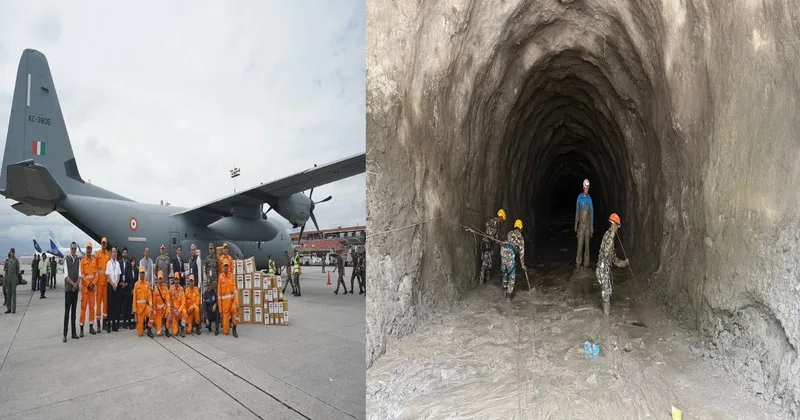
In a major push to advance operations at Nepal’s Chilime tunnel, the Indian tunnel rescue team worked in close coordination with the Nepal Army to drain accumulated water and dig deeper into the shaft, following severe flooding and landslides that swept through Rasuwa district in Nepal. The joint effort underscored active cross-border disaster response and technical collaboration between Indian specialists and Nepalese defence forces.
India continues humanitarian assistance to Nepal.
India dispatched two more aircrafts (C-130 Js) with 21.5 tonnes of relief assistance for Nepal, including forensic kits and medical supplies.
The additional assistance will further strengthen ongoing relief and rescue efforts… pic.twitter.com/OlnzGekFow
— Randhir Jaiswal (@MEAIndia) September 3, 2026
The Tunnel Rescue team from India carried forward its work in Chilime, in coordination with Nepali Army, even in face of extremely restricted access space, terrain limitations including a swamp like marshy tunnel floor. They used improvised floats to explore deep into the… pic.twitter.com/w4ssUE0BK2
— Naveen Srivastava, Ambassador of India in Nepal (@navsri6619) September 1, 2026
Sharing the details in a post on X, the Indian Ambassador to Nepal, Naveen Srivastava, highlighted India’s commitment to supporting Nepal through both technical expertise on-site and humanitarian aid for surrounding communities. Specialist personnel successfully drained water logged inside the subterranean passages, allowing workers to dig deeper and secure vulnerable sections of the Chilime tunnel.
Visited our technical team now stationed in Syabrubesi near Chilime. They continue their operations in excavating Chilime power house tunnel for rescue operations. The Indian technical team working alongside Nepali Army has already explored 100 metres inside the tunnel using… pic.twitter.com/C2zesnnX2y
— Naveen Srivastava, Ambassador of India in Nepal (@navsri6619) September 3, 2026
Engineering teams are constructing a temporary access track to facilitate the movement of heavy machinery and high-capacity equipment directly to the tunnel mouth.
169 Indian nationals rescued; 275 missing
A total of 169 Indian nationals have been successfully rescued from flood-affected regions in Nepal to date, while 275 are still missing in the disaster, the Ministry of External Affairs confirmed. Three more Indian citizens were pulled to safety from Trishuli Bazaar, identified as Abhijit Suresh Pawar, Dipika Abhijit Pawar and five-year-old Samarth Abhijit Pawar, MEA spokesperson Randhir Jaiswal informed in a post on X.
Confirming the ongoing efforts to facilitate their journey home, Jaiswal stated, “Our Embassy in Nepal is assisting in their return to India by air”. The Indian team’s operations continue in close coordination with Nepalese disaster management authorities to locate stranded citizens and secure their safe evacuation.
Special Control Room in MEA for Nepal Floods Situation
Details below ⬇️
🔗 https://t.co/hKxz6iIJTP pic.twitter.com/hwR8eFlcGE
— Randhir Jaiswal (@MEAIndia) August 27, 2026
India steps up relief & humanitarian assistance
India’s humanitarian assistance to flood-hit Nepal continues as the sixth and seventh relief flights carrying a combined 21.5 tonnes of relief material arrived in Kathmandu on September 3, Thursday night, with supplies including forensic kits and medical equipment for ongoing rescue and recovery operations. The Ministry of External Affairs, in a post on X, said both C-130J aircraft carrying the assistance landed in Kathmandu and the relief material was handed over to Nepal’s Minister for Science, Technology and Innovation Mahabir Pun.
Both C-130J aircraft carrying 21.5 tonnes of humanitarian assistance have landed in Kathmandu, Nepal. The relief material was handed over to Mr. Mahabir Pun, Minister for Science, Technology and Innovation.
The assistance will support ongoing relief and rescue efforts in… pic.twitter.com/tk3k0X9Eum
— Randhir Jaiswal (@MEAIndia) September 3, 2026
Indian Ambassador to Nepal Naveen Srivastava also said the latest consignments were part of India’s continuing support for Nepal’s response to the Rasuwa flash floods. He said that the material was handed over to Nepal and would support ongoing relief and rescue efforts and communities affected by the floods. Alongside technical operations, medical officers accompanying the Indian delegation organised a medical health camp for residents in the local community, offering health check-ups and essential supplies.
MEA spokesperson Jaiswal reiterated India’s commitment to assisting Nepal following widespread flood devastation, pledging to dispatch further essential supplies, including forensic kits and Bailey bridges as requested by the Nepal government. Speaking at an official press briefing, Jaiswal outlined India’s ongoing humanitarian and disaster relief operations in close coordination with Nepalese authorities.
“Beyond material aid, India has deployed specialised personnel on the ground to assist local authorities.
“In addition to the relief material, we have also sent 54 personnel to support relief and rescue efforts in Nepal. This comprises 30 tunnel rescue experts, 19 forensic experts, and a five-member medical team. Our rescue and forensic teams are deployed on the ground, and they are working closely with the Nepalese authorities”, Jaiswal added.
(With Inputs from ANI)