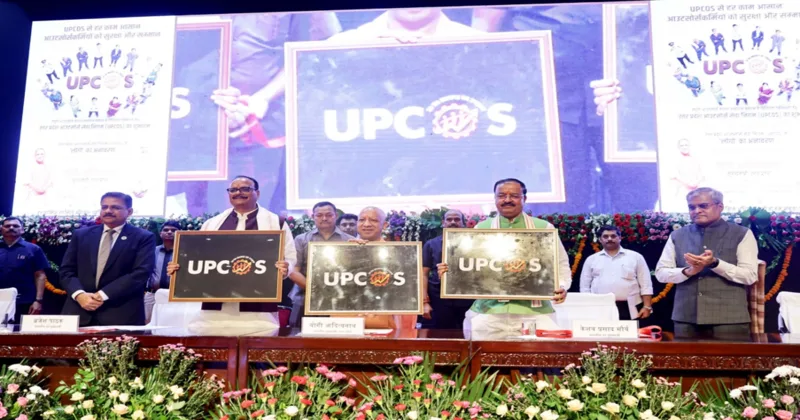
Chief Minister Yogi Adityanath launched the Uttar Pradesh Outsource Service Corporation (UPCOS) at Lok Bhavan in Lucknow, unveiling the corporation portal, website and logo before an audience of officials and outsourced personnel. The launch was symbolically mirrored in Varanasi, where cheques and PPE kits were distributed to beneficiaries of the Kanya Vivah Sahayata Yojana, and the Maternity, Shishu and Balika Madad Yojana schemes run under the Labour Department’ Building and Other Construction Workers programme, while district-level proceedings were livestreamed from the Commissioner’s Auditorium.
At the Lucknow event, the Chief Minister handed cheques reflecting increased remuneration to outsourced staff, among them Rohit Kumar, a farrash in the Secretariat Administration Department, Kasin Khan, a night watchman in the same department and Sarita a safai karmi. The government describes UPCOS as a state-level, non-profit body created to regulate and safeguard the rights of outsourced workers across government establishments, promoting transparent hiring, timely direct payments and statutory social-security benefits.
From directive to delivery; Organised, skilled, secure and dignified
On April 25, Chief Minister had directed officials to set up the corporation, flagging the problems that had long dogged outsourced employment in the state: salary deductions, delayed payments, denial of EPF and ESI benefits, opaque recruitment and workplace harassment. By August 3, he announced that an outsourcing commission would follow within one to two weeks to guarantee a minimum honorarium.
That same month, the government made budgetary provision to raise honoraria for Anganwadi and Asha workers, cooks, village watchmen and kotedars, while outsourced staff of the state road transport corporation received a five percent honorarium increase effective from July, according to Minister of State for Transport (Independent Charge) Dayashankar Singh. The September 2 launch was the culmination of that build-up, positioned by the government as being carried out under the guidance of Prime Minister Narendra Modi and the leadership of Chief Minister Yogi Adityanath.
Addressing the gathering, the Chief Minister described the objective of UPCOS as converting the state’s outsourced workforce into an “organised, skilled, secure and dignified workforce.” He situated the initiative within the government’s wider economic outreach, observing that farmers, artisans, street vendors, MSME entrepreneurs, government employees and outsourced workers all contribute to Uttar Pradesh economy and pointed to the One District One Product scheme as an example of the support extended to traditional artisans since 2017.
The SBI Partnership: Security beyond the pay slip
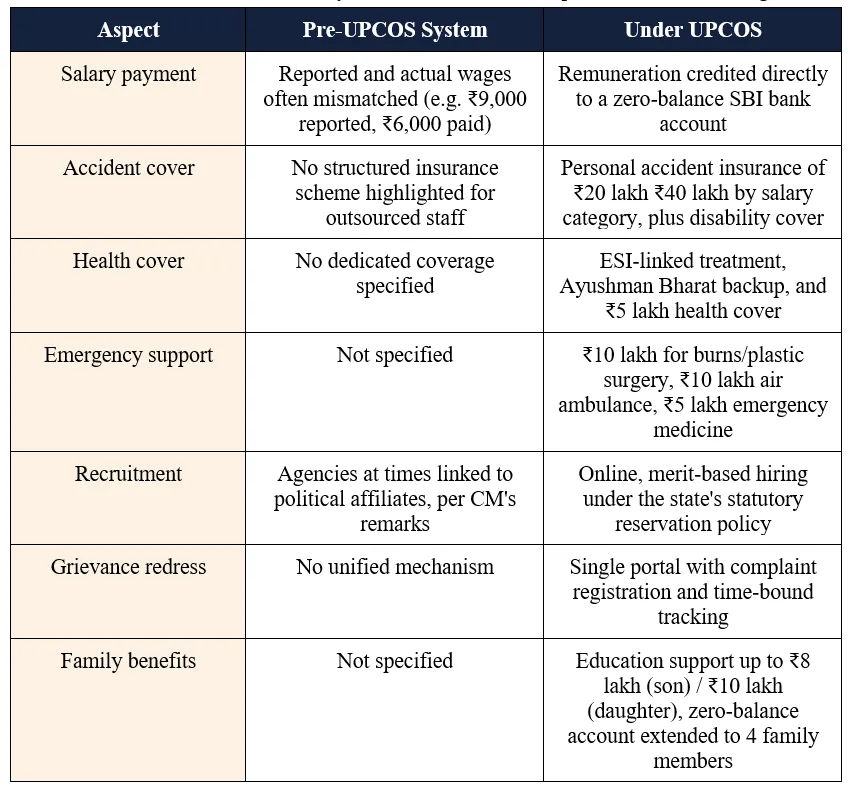
The corporation most tangible innovation lies in its Memorandum of Understanding with the State Bank of India, under which an outsourced employee’s remuneration will be credited directly to a zero-balance bank account, with select benefits extended to up to four family members. Depending on the prescribed salary category, the MoU provides personal accident insurance of ₹20 lakh to ₹40 lakh, along with cover for permanent partial disability.
Additional provisions include up to ₹10 lakh for plastic surgery following burns, ₹5 lakh for emergency medicines, ₹10 lakh for air ambulance services, and education support of up to ₹8 lakh for a son and ₹10 lakh for a daughter. ESI contributions will be paid so that workers can access free treatment at ESI hospitals, with cases outside ESI network linked to Ayushman Bharat; this extends a further ₹5 lakh in health cover to workers and their families, alongside statutory entitlements such as maternity leave. Through the corporation, the government has stated its aim of extending this security net to 20 lakh outsourced personnel across the state.
The Chief Minister pointed to the inconsistency that had long plagued the outsourcing system where workers had reported salaries ranging from ₹8,000 to ₹11,000, while those who cited ₹9,000 were often found to be receiving only ₹6,000 in hand, with no reliable record to verify the gap.
The new digital framework is meant to close it, covering the entire employment cycle, from workforce assessment and vacancy forecasting to recruitment, attendance, payment and grievance redress, on one platform accessible to departments, agencies and employees alike. Workers will be able to view their service records, bank details, attendance and payment history in one place, register complaints and track them through a time-bound resolution mechanism.
Outsourced staff who spoke at the launch welcomed the change. Raju Kannaujiya, a pump operator with the Lucknow Municipal Corporation, said the portal would bring transparency, with salaries now reaching bank accounts directly and insurance cover in place for security. A gardener working on outsourcing terms at the Secretariat recalled managing a household on ₹10,000-11,000 a month and said the revised wages, running up to ₹20,000, would ease the cost of his children’s education.
A political reckoning with the past; Merit, transparency and reservation
The Chief Minister was pointed in contrasting the initiative with the pre-2017 era, when, he said, outsourced employees were treated as a burden and outsourcing contracts often went to companies linked to ruling-party functionaries, leaving workers exposed to exploitation over recruitment and uniforms. He said we have considered them an asset to the state, framing UPCOS as part of the government’s broader claim to have restored dignity to labour across sectors. On social media, he summed up the initiative intent as transparency through technology, security through system, describing it as the identity of the New Uttar Pradesh.
Recruitment under UPCOS is designed to be conducted online, on qualification and merit, following the state existing reservation policy for Scheduled Castes, Scheduled Tribes, Other Backward Classes, persons with disabilities, women, the Economically Weaker Sections and dependents of freedom fighters.
The framing the government has chosen for UPCOS, organised, skilled, secure and dignified, echoes a theme that runs through much of the Yogi government welfare messaging that no category of worker, however informal or invisible their employment, sits outside the state responsibility. Safai karmis, night watchmen, pump operators and gardeners rarely feature in headline economic indicators, yet they staff the secretariats, municipal bodies and public institutions on which daily governance depends.
By formalising their employment through a dedicated corporation rather than leaving it to individual departments and private agencies, UP is attempting to close a long-standing gap between the organised and unorganised segments of its own government workforce, a gap that had allowed wage discrepancies and unverified intermediaries to persist for years.