

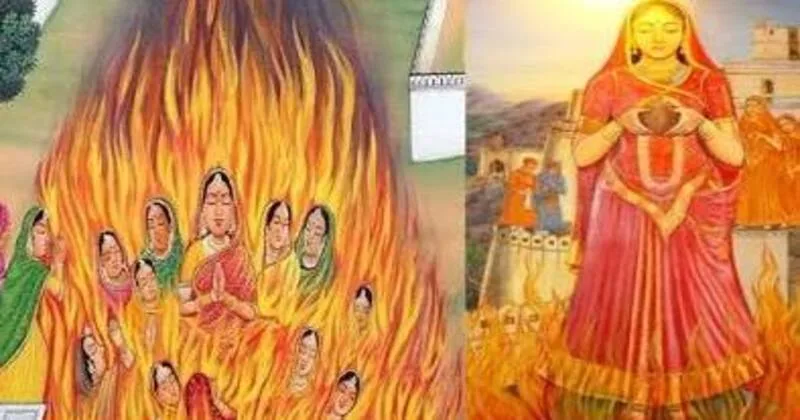
More than 1,300 years after the Battle of Aror in Sindh, the memory of jauhar has once again become the subject of a contemporary culture war. A recent comment by a Bollywood actress, that the depiction of jauhar in a historical film demonstrated how the practice denied a rape victim the right to life, triggered predictable divisions online.
The argument sounds compelling if history is reduced to a morality play: powerful men, powerless women and an oppressive patriarchal custom. But history is rarely so convenient.
To understand jauhar, one must first understand the world that produced it. Medieval India was not a world of modern constitutional rights, institutional policing or international humanitarian law. It was a world of conquest, sieges, dynastic warfare, slavery and the violent transfer of power. A defeated kingdom did not merely lose territory. Its people could lose their freedom, its temples could be plundered, its political order destroyed, and its women and children taken captive.
Jauhar emerged from this brutal reality.
It was not a blanket declaration that women had no right to live. Nor was every woman necessarily forced into the flames by some anonymous patriarchal authority. In the historical memory of the communities that practised it, jauhar was a vrat, a vow, undertaken in the face of catastrophic defeat.
That distinction matters.
The broader martial culture surrounding jauhar involved both men and women. The suta-jauhar tradition, for instance, contains the idea of complementary vows: men would return only victorious, while women would remain alive only if their men returned victorious. The underlying principle was not simply female obedience. It was a shared conception of honour in which surrender to an enemy could be considered worse than death.
Modern India may reject that conception of honour. Indeed, it should not be imported into contemporary society. But rejecting a historical value system does not give us the right to pretend that it never existed.
Medieval societies across the world possessed traditions in which warriors and rulers chose death rather than captivity or humiliation. Indian traditions were no exception. Rajput rulers and warriors are associated with acts of ritual sacrifice such as jal-samadhi in moments of catastrophic defeat.
The essential point is that sacrifice was understood as an assertion of honour and sovereignty, not merely as punishment imposed upon women.
And then there was the question of what happened after a fortress fell.
The history of warfare is full of evidence that women and children could become spoils of conquest. Captivity could mean enslavement, forced displacement, sexual exploitation or incorporation into the household of a victorious ruler. In that environment, the fear motivating jauhar was not imaginary.
The story of Raja Dahir’s daughters, Suryadevi and Parmaldevi, is often cited in this context. The Chachnama describes their capture following Muhammad bin Qasim’s conquest of Sindh and their subsequent dispatch to the Caliph’s court. The historical reliability and interpretation of the Chachnama have themselves been debated by scholars, but the story became an enduring part of the historical memory of the conquest.
Dahir’s widow, Rani Bai, is likewise associated with a jauhar when her stronghold was surrounded.
Whatever one’s ultimate judgment of the episode, it is difficult to describe such women simply as passive victims of patriarchy. They were confronting an invading military power in circumstances where defeat could mean captivity and the loss of control over their own bodies.
That is not meek surrender.
It is a tragic form of resistance.
The same complexity appears in the story of Rani Durgawati, the Gond queen who resisted the Mughal expansion under Akbar. Historical accounts associated with Abul Faz’l and Ferishta portray her as a ruler unwilling to accept dishonour or captivity. When defeat became inevitable during the Battle of Narai, she is traditionally said to have taken her own life rather than be captured.
Her decision was followed by the fall of Chauragarh, where a jauhar vrat is also associated with the women of the kingdom.
There is another fascinating detail that modern ideological narratives often overlook. Abul Faz’l records that the final defence of honour at Chauragarh involved two officers of the kingdom, Bhoj Kayesth and Mian Bukhari Rumi. One was Hindu; the other was Muslim.
That detail alone should make us suspicious of simplistic attempts to turn every episode of medieval Indian history into a neat Hindu-versus-Muslim morality tale.
Yet the opposite simplification is equally misleading: the idea that jauhar can be dismissed as nothing more than patriarchal oppression.
The historical record associates jauhars with several major sieges. Ranthambore is remembered for the jal-jauhar associated with Rani Ranga Devi. Jaisalmer witnessed multiple episodes. Chittorgarh became synonymous with repeated jauhars across different periods. Other episodes are connected in historical traditions with conflicts involving rulers such as Alauddin Khilji, Bahadur Shah of Gujarat, Sher Shah Suri, Babur and Akbar.
The fact that jauhar occurred during the reign of Akbar is particularly instructive. Akbar is conventionally presented as one of the most liberal rulers of medieval India. Yet the Chauragarh and Chittorgarh episodes demonstrate that the underlying phenomenon cannot simply be reduced to the personal character of one ruler.
Jauhar belonged to the terrifying logic of siege warfare.
It was the final calculation of a society that believed the approaching conqueror presented a fate more terrible than death.
That does not make jauhar morally desirable. Nor should anyone today ever tell a survivor of rape that she has lost her honour. Quite the opposite: the survivor has committed no dishonour. The criminal bears the shame.
But applying that modern moral principle retrospectively does not require us to deny the agency of women who lived in radically different circumstances.
This is where contemporary commentary often goes wrong.
There is a tendency to assume that if a woman makes a choice that modern feminism would reject, she could not possibly have been exercising agency. If she chooses resistance through means we find abhorrent, then someone else must have made the decision for her.
That is an extraordinarily patronising view of historical women.
Agency does not mean making choices that twenty-first-century observers approve of. Agency means possessing the capacity to make consequential choices within the constraints of one’s circumstances.
The women who entered the jauhar fire did not control the invading army. They did not control the outcome of the siege. They could not determine whether their kingdom would survive. But they could determine whether they would surrender themselves to the conqueror.
Their choice may horrify us.
It may disturb us.
It may be impossible for modern society to endorse.
But it was still a choice understood by its practitioners as an act of defiance.
And perhaps that is the uncomfortable truth contemporary discourse struggles to accommodate: not every historical woman needs to be rescued from her own understanding of courage.
The task of history is not to manufacture heroes and villains according to today’s ideological preferences. It is to reconstruct the world in which people lived and understand why they acted as they did.
Jauhar should therefore be remembered neither as a social ideal nor as a cartoonish symbol of patriarchal oppression. It was a terrible response to terrible circumstances, a phenomenon born from the collision of invasion, siege, slavery, sexual violence, political defeat and an uncompromising conception of honour.
We can mourn the circumstances that made such a choice conceivable without insulting the women who made it.
We can affirm the sanctity of life today without pretending that medieval women shared our assumptions.
And we can condemn the brutality of conquest without turning history into propaganda.
The women of Sindh, Chittorgarh, Jaisalmer, Ranthambore and Chauragarh did not live in our world. They faced dangers most modern societies can scarcely imagine. They confronted armies at their gates and captivity beyond them.
If they chose death rather than surrender, we may debate that choice endlessly.
But to erase the courage, conviction and agency behind it by simply shouting “patriarchy” is not historical scholarship.
It is historical amnesia.
The past deserves criticism where criticism is warranted. But it also deserves the dignity of being understood on its own terms.
And the women who chose jauhar deserve at least that much.