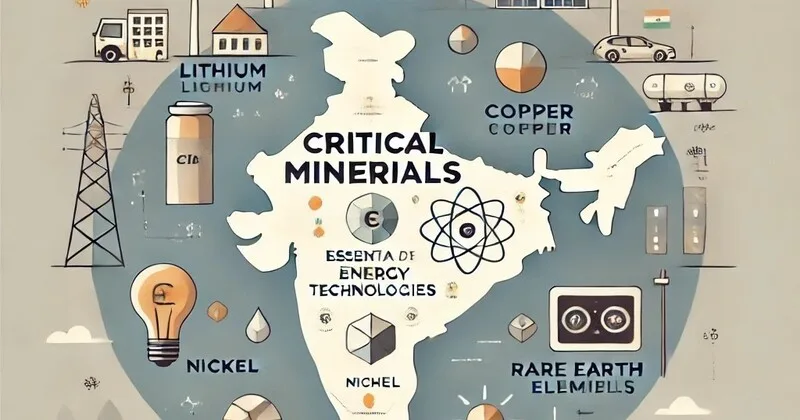
The defining resource race of the 20th century was fought over oil. It powered industries, moved armies, transformed transportation and gave nations enormous geopolitical influence. In the 21st century, another group of resources is assuming a comparable strategic importance: critical minerals. Lithium, cobalt, nickel, graphite, rare earth elements, copper and other minerals are becoming the foundations of clean energy, advanced manufacturing, defence technologies, electronics and digital infrastructure.
Countries that secure reliable access to these resources will possess economic advantage and strategic leverage. The contest for critical minerals is therefore rapidly becoming one of the central geopolitical and economic stories of our time.
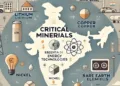
Unlike oil, critical minerals are not consumed primarily as fuels. Their importance lies in their physical and chemical properties. Lithium and graphite are essential to batteries; rare earth elements are indispensable to high-performance magnets used in electric vehicles, wind turbines and precision defence systems; cobalt and nickel contribute to several battery chemistries; copper is fundamental to electricity networks, motors, data centres and renewable infrastructure.
Gallium, germanium and other specialised minerals are vital to semiconductors and advanced electronics. As countries electrify transport, expand renewable energy and build digital infrastructure, demand for these materials is expected to rise sharply. The energy transition is therefore creating a new dependence: reducing fossil-fuel use requires greater access to minerals.
Their strategic significance is determined not only by geological availability but also by where they are mined, processed, refined and manufactured into usable components. A country may possess mineral deposits and still remain vulnerable if it lacks refining capacity or depends on another country for technology and processing.
This is precisely where the current global competition becomes complicated. Mining is only the first stage of the supply chain. Processing, separation, refining, component manufacturing and recycling can create equally important chokepoints. The country controlling these stages can exercise influence far beyond the value of the raw ore itself.
China’s position illustrates this reality. Over the past several decades, China has invested heavily in mining, processing, refining and manufacturing capacity across several critical mineral supply chains. Its dominance in rare earth processing and its major role in battery materials have given it considerable strategic weight. This demonstrates how industrial policy, infrastructure, technology and long-term investment can turn mineral resources into geopolitical power. Recent export restrictions on selected critical materials have also reminded the world that supply chains can become a geopolitical weapon.
For India, the critical-minerals question is especially important. India’s ambitions for electric mobility, renewable energy, semiconductor manufacturing, defence modernisation, telecommunications and advanced industry will require dependable supplies of minerals across the decades immediately ahead, too.
India cannot afford to replace one strategic dependence with another. A future in which India reduces its oil import vulnerability but becomes heavily dependent on imported lithium, cobalt, rare earths or processed battery materials would represent only a partial transformation. Energy security in the coming decades will therefore have to be understood as mineral security as well.
India has begun responding to this challenge by identifying a list of critical minerals, encouraging exploration, opening selected mineral resources to commercial mining and seeking overseas supplies. The establishment of a national critical minerals mission also reflects a broader recognition that mineral security requires coordinated action rather than isolated mining projects. Yet policy must go beyond extraction.
India needs investment across the entire value chain, including exploration technologies, processing and refining, advanced materials, battery manufacturing, permanent magnets, recycling and research. The objective should be to create an ecosystem in which minerals extracted domestically or obtained abroad can be converted into high-value industrial products within India.
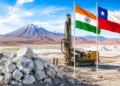
International partnerships will be equally important. No country possesses all the minerals necessary for its technological and energy ambitions, and even resource-rich nations often lack some processing capabilities. India must therefore diversify its sources through partnerships with mineral-rich countries in Africa, Latin America, Australia and elsewhere, while strengthening cooperation with trusted partners in the Indo-Pacific and beyond. Such diversification is not merely commercial. It is a hedge against geopolitical shocks, trade disruptions and the weaponisation of supply chains. India’s diplomatic engagement must increasingly include mineral diplomacy alongside energy, defence and technology diplomacy.
At the same time, critical-mineral security cannot become an excuse for environmentally destructive extraction. Mining can impose serious costs on landscapes, forests, water systems and local communities. Some mineral-rich regions are already experiencing tensions over land, ecological degradation and resource governance.
A sustainable mineral strategy must therefore combine economic ambition with environmental responsibility, transparent regulation and meaningful community participation. Recycling will become particularly important. The minerals contained in batteries, electronics, electric motors and other products should be treated as an urban resource rather than discarded waste. Developing a circular economy can reduce pressure on new mines, improve supply security and create new industries.
The geopolitical implications extend beyond India. The competition for critical minerals is reshaping alliances and industrial strategies across the world. The United States, European Union, Japan, Australia and other economies are seeking to diversify supply chains, develop domestic processing and reduce excessive dependence on concentrated sources.
New industrial policies and partnerships are emerging around batteries, semiconductors, rare earths and clean technologies. This competition could produce more resilient supply chains, but it could also create rival blocs and protectionist barriers. The world must therefore avoid replacing an interconnected but vulnerable mineral economy with a fragmented system in which countries compete for resources at the expense of cooperation.
There is a deeper lesson in the rise of critical minerals. Natural resources have always shaped power, but technological change determines which resources become strategic. Oil became indispensable because industrial civilisation was built around combustion engines and petroleum-based systems. Today’s technologies are creating new mineral dependencies.
Tomorrow’s breakthroughs may change the list again. This means mineral strategy cannot be static. Governments must continuously monitor technological developments, identify emerging vulnerabilities and invest in alternatives. Research into new battery chemistries, material efficiency, substitution and recycling is therefore as important as finding new mines.
For India, this is an opportunity as much as a challenge. The country has a large domestic market, a growing manufacturing base, scientific institutions and an expanding renewable-energy sector. If India can build capabilities across exploration, refining, materials science, manufacturing and recycling, it can move from being a consumer of the energy transition to becoming one of its producers. The objective should not simply be to secure tonnes of minerals, but to secure value, technology, jobs and strategic autonomy.
The oil age taught the world that resource dependence can influence foreign policy, national security and economic sovereignty. The critical-minerals age is likely to teach a similar lesson in a different form. Whoever controls the supply chains of the technologies that power the future will possess significant influence over that future.
India therefore needs a long-term mineral strategy rooted in diversification, domestic capacity, technological innovation, international partnerships and sustainability. Critical minerals are not literally the new oil, but they may play a comparable role in defining the balance of power. The race has already begun, and India’s preparedness will determine whether it merely secures access to the resources of the new century or helps shape the industrial order that emerges from them.