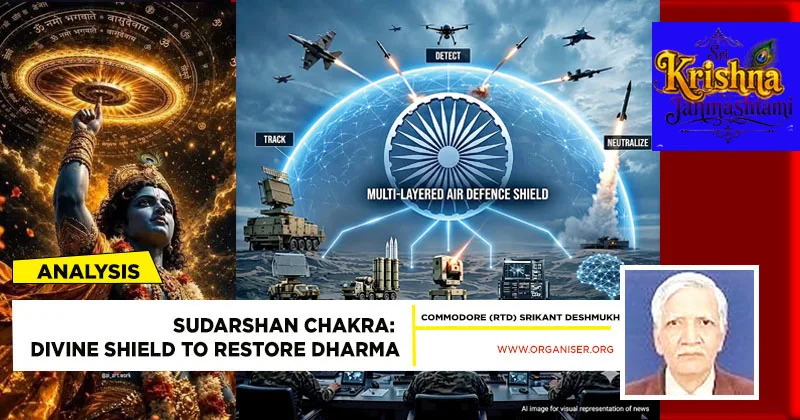
The Sudarshan Chakra is not just about weapons; it is a symbol of divine power, protection, and righteousness. The global evolution of missile warfare and Integrated Air and Missile Defence (IAMD) systems has clearly brought to the fore an interplay of technology, strategy, and geopolitics. Yesteryear’s tactical air defence weapons have expanded into multi-domain, high-tech networks. They have now functioned as instruments of deterrence, alliance management, and defence diplomacy. The wars in Ukraine and West Asia have strongly revived global interest in multi-layered, integrated air defence systems capable of countering threats ranging from unmanned aerial vehicles to intercontinental ballistic and hypersonic missiles.
Bharat’s Security Scenario
Bharat’s current security environment encompasses a complex mix of external threats, regional rivalries, and ever-expanding technological challenges. Bharat shares borders with two nuclear-armed neighbours, boasting of multiple cruise and ballistic missiles, anti-satellite weapons, and expeditiously deployable assault capabilities. Bharat’s conventional adversaries now possess advanced hypersonic missiles and other lethal autonomous weapon systems, increasing Bharat’s vulnerability. Effects of State-sponsored terrorism and vagaries of weather also add to Bharat’s security woes.
Multi-Tiered Missile Shield
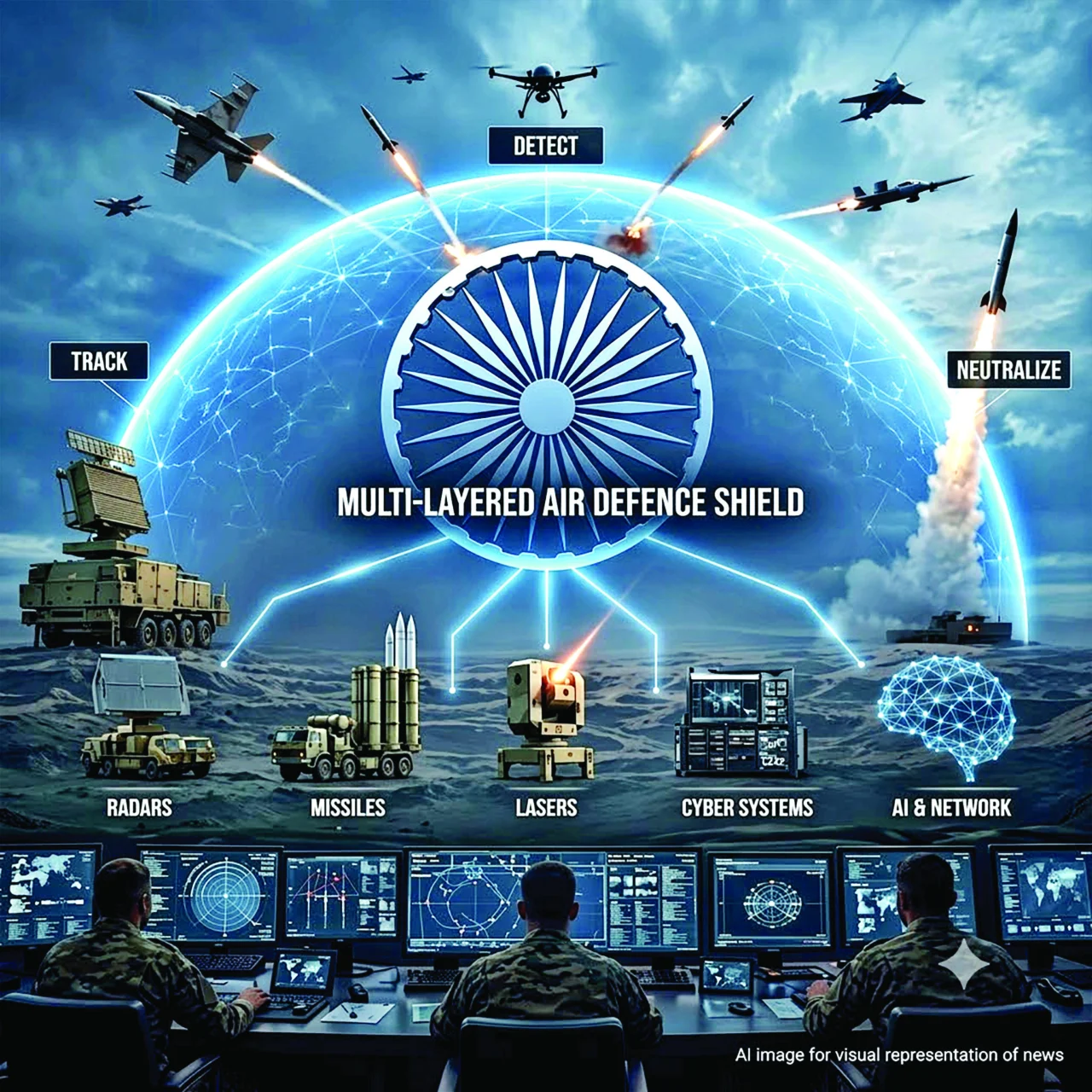
These threats to Bharat’s national security require it to be fully prepared to counter situations beyond conventional warfare. It needs to be ready to safeguard its expanding strategic infrastructure on the ground, in and under water, and in outer space. That requirement makes a strong case for a multi-tiered missile shield capable of detecting, tracking, and neutralising incoming threats. It also serves as a strategic tool to strengthen deterrence, reduce the risk of catastrophic damage, and ensure Bharat can respond to crises from a position of strength. That gave birth to the idea of developing a robust, multi-layered indigenous missile defence system- Mission Sudarshan Chakra.
Mission Sudarshan Chakra
Mission Sudarshan Chakra, announced on August 15, 2025, is a national security initiative envisaging time-bound (Circa 2025-2035) development of an indigenous Iron Dome (like Israel), comprising an air defence architecture, advanced technologies, and multi-layered defence systems. In brief, Mission Sudarshan Chakra is expected to be Bharat’s multi-layered, AI-enabled National Defence System, designed to protect strategic and critical civil and defence infrastructure in Bharat while enabling precise counter-strikes.
Anatomy of Mission Sudarshan Chakra
Mission Sudarshan Chakra, an ambitious Bharatiya defence initiative, was launched by Prime Minister Narendra Modi on Bharat’s 79th Independence Day. It has been inspired by Bhagwan Krishna’s powerful weapon- Sudarshan Chakra.
Shield to Safeguard Strategic Infrastructure Structure
Mission Sudarshan Chakra seeks to create a national surveillance and strike network based on AI-enabled analysis, big data processing & real-time coordination across all military branches.
Key Features of the Architecture:
- Integration of national radars, satellites, and command centres to form a seamless threat-monitoring grid
- AI-based threat modelling to predict and neutralise attacks
- A surveillance layer covering entire Bharat plus 2,500 km beyond borders
- Real-time coordination between Bharatiya Army, Navy, Air Force, and intelligence agencies
- Ability to launch soft kill (jamming) and hard kill (missile interception) responses
- Support for hypersonic interceptors with coverage up to 2,500 km and altitude up to 150 km
- Nationwide drone-countering systems, laser-based weapons, and directed-energy weapons
- Capability to detect and neutralise missiles, drones, artillery shells, and swarm-based threats
Once operational, this system would help India create a comprehensive, multi-layered air and missile defence shield integrating surveillance, interception, cyber protection, and offensive strike capabilities to safeguard India’s population, infrastructure, and strategic assets. It is also expected to provide capabilities for countering threats from ballistic missiles, hypersonic weapons, drones, loitering munitions, and cyber-attacks.
Its key objectives are to establish an AI and predictive technology-enabled national multi-domain shield for real-time threat detection, interception, neutralisation, and effective retaliation.
Potent System Architecture
Mission Sudarshan Chakra is being designed to afford multiple layers of defence through long-range interception using the integrated S-400 Triumf system (operationally called Sudarshan S-400) and an indigenous extended-range air defence system, named Kusha, with interceptors covering 150–400 km ranges. Systems like the Indo-Israeli Barak-8 (MRSAM) would cover medium-range defence by neutralising intermediate threats. Short-range defence would rely on Israel’s Iron Dome and future laser-based systems like Iron Beam, along with Bharat’s own Durga-II system for drones and low-flying threats.
The system would have effective surveillance capabilities using Space-based, airborne, and ground sensors for monitoring not only the Indian territory but also the 2,500 km beyond-the-border area, enabling early detection of aerial threats and planning their effective neutralisation using its integrated offensive capabilities through precision-guided munitions, hypersonic missiles, and directed-energy weapons, allowing rapid retaliation against the adversary’s hostile missions.
This formidable Sudarshan Chakra would operate under an equally capable Command-and-control centre, comprising AI-enabled networks, the Integrated Air Command and Control System (IACCS), and the Akashteer system to provide real-time coordination across the Army, Navy, Air Force, and intelligence agencies.
Mission Sudarshan Chakra is accordingly expected to address Bharat’s geopolitical vulnerabilities, including long borders with hostile neighbors, extensive coastline, and high-value economic and technological targets. This multi-layered shield is also expected to function as a deterrent, discouraging adversaries from attempting attacks against India’s military bases, nuclear plants, industrial hubs, and public spaces.
This indigenous technologically advanced system is being designed for effectively reducing reliance on foreign defence systems. It is envisaged that all research, development, and manufacturing will be done in India, leveraging DRDO, Bharat Electronics Limited, and private-sector innovators’ capabilities. However, where India lacks required advanced technologies, it will incorporate them through technology collaborations with appropriate foreign partners. From that perspective, India has already strengthened its strategic partnership with Israel, focusing on technology transfer for advanced missile defence systems like Iron Dome and Iron Beam, enhancing Sudarshan Chakra’s capabilities, while maintaining domestic production under the Make in India initiative.
In summary, Mission Sudarshan Chakra represents a revolutionary leap in Bharat’s defence architecture, combining indigenous technology, AI-driven command systems, and multi-layered missile defences to protect the nation against evolving aerial, cyber, and hybrid threats. By 2035, Mission Sudarshan Chakra is expected to provide a nationwide, integrated shield capable of both defensive and offensive operations, ensuring India’s strategic autonomy and comprehensive national security. Finally, the Sanskrit shloka: “उदायुधो यावदहं तावदन्यैः किमायुधैः। यद्वा न सिद्धमस्त्रेण मम तत् केन सेत्स्यति॥“ (So long as I’m armed, what fear of others’ weapons? What isn’t achieved by my weapon, who else can succeed?), will say it all.
(Views expressed are personal)