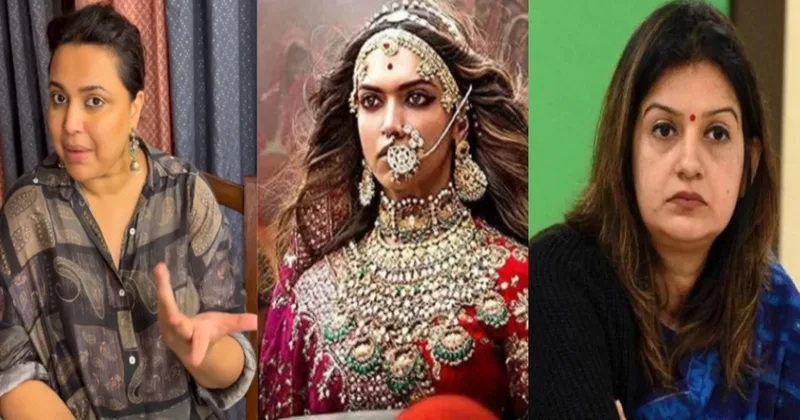
New Delhi: Actor Swara Bhasker has attempted to clarify and soften her controversial remarks on the Jauhar sequence in Sanjay Leela Bhansali’s Padmaavat after facing widespread criticism. While Bhasker now insists that she never called Rani Padmaavati or the women who performed Jauhar “cowards”, her original remarks at a Delhi event had questioned the very message conveyed by the depiction of Jauhar and suggested that it could make rape survivors feel that they should have chosen death over survival.
https://x.com/ReallySwara/status/2094834771197329724?ref_src=twsrc%5Etfw%7Ctwcamp%5Etweetembed%7Ctwterm%5E2094834771197329724%7Ctwgr%5Ee4c08473229259771a0109cc936b80daa090c939%7Ctwcon%5Es1_c10&ref_url=https%3A%2F%2Fwww.opindia.com%2Fnews-updates%2Fpadmaavat-jauhar-row-swara-bhasker-clarification-after-outrage-blames-mistranslation%2F
The controversy erupted after Bhasker spoke at the “Woman, Life, Freedom” talk at the India International Centre in Delhi on August 31. Revisiting the open letter she had written to Padmaavat director Sanjay Leela Bhansali after the film’s release in 2018, Bhasker said she had been deeply disturbed by the Jauhar sequence and questioned what message it could send to women who had survived sexual violence.
Bhasker recalled watching the sequence in which hundreds of women enter the flames and said she wondered what a rape survivor would think while watching it. According to her argument, such a survivor could potentially feel like a “coward” for choosing to remain alive instead of taking her own life to preserve her honour. She further questioned whether the portrayal suggested that rape marked the end of a woman’s life. She also singled out a shot involving a pregnant woman, saying that it made her angry because she interpreted the scene as suggesting that even an unborn girl should not live because she could potentially face sexual violence. Bhasker said these concerns were among the reasons she eventually wrote an open letter to Bhansali.
From strong criticism to ‘I was mistranslated’
In a video posted on X on September 1, Bhasker said a “lie” was being created around her comments and insisted that she had never called Rani Padmaavati or the women who performed Jauhar “cowards”. She accused people of failing to understand her English and urged them to check the meaning of her words before spreading what she described as false claims.
However, the clarification does not amount to a withdrawal of her central criticism of the Padmaavat sequence. Bhasker continues to argue that the problem lies in what she believes the film’s depiction of Jauhar communicates about women’s honour, sexual violence and the right of survivors to live.
In fact, even after the backlash began, she doubled down on the broader argument, saying that she found it striking that people were “triggered” by the idea that rape survivors have a right to life after rape. She subsequently responded directly to Priyanka Chaturvedi, arguing that the issue was not whether the women who performed Jauhar had exercised choice, but what society chooses to glorify through such a depiction.
This is where Bhasker’s clarification becomes difficult to separate from her original remarks. She may be rejecting the interpretation that she personally labelled Padmaavati and the other women cowards, but she continues to question the cultural significance of a historical act that was portrayed in Padmaavat as a response to the threat of capture and sexual enslavement.
Rajya Sabha MP Priyanka Chaturvedi pushed back against Bhasker’s interpretation, particularly the suggestion that the women involved in Jauhar should primarily be viewed through the lens of modern-day rape-survivor discourse.
Chaturvedi argued that the women depicted in the Jauhar sequence were confronted with an extraordinarily brutal choice in the context of medieval warfare. In a post on X, she said that when the alternatives were death or becoming sex slaves or concubines of conquerors, several women chose death. Others, she noted, might have chosen survival, but those who chose Jauhar exercised their agency. Chaturvedi further said that whether one agrees with their decision can be debated, but the fact that it was a choice should be acknowledged.
She also defended the depiction in Padmaavat, saying she found the Jauhar sequence among the film’s most powerful moments. Her argument was that the women were refusing to be reduced to objects of sexual exploitation and made a difficult decision in the circumstances imposed upon them.
‘It was a choice’: Chaturvedi’s central argument
Chaturvedi’s response is significant because it directly challenges the implication that portraying Jauhar as an act of courage necessarily diminishes the value of women who survive sexual violence. The two issues need not be mutually exclusive.
A modern rape survivor has an unequivocal right to live, dignity and justice. But that does not automatically mean that a historical depiction of women choosing death in the face of imminent captivity and sexual enslavement is telling contemporary survivors to imitate them. That distinction lies at the heart of the controversy.
Padmaavat is a cinematic depiction of a medieval setting in which warfare, conquest, captivity and sexual violence were understood very differently from the protections available under a modern constitutional and legal system. The Jauhar sequence is presented as part of that historical world rather than as an instruction to contemporary women.
Bhasker’s criticism essentially asks viewers to judge that historical depiction through a modern social lens. Chaturvedi’s response asks viewers to first acknowledge the agency of the women within the circumstances they faced.
Jauhar was associated with circumstances of war and impending defeat in which women feared capture, enslavement and sexual violence. Whether one regards the practice as heroic, tragic or morally troubling, the women who undertook it cannot simply be removed from the historical circumstances that shaped their decision.
This is precisely the point Chaturvedi sought to make: one can debate the morality of the decision while still recognising that those women exercised agency under extraordinarily coercive circumstances. Bhasker’s September 1 clarification may have been intended to counter the most damaging interpretation of her remarks, but it has not fundamentally changed the position she articulated at the IIC event.