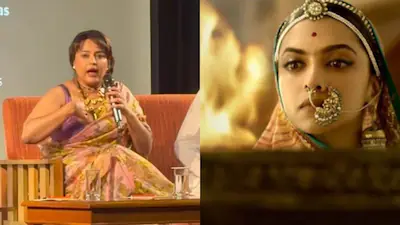
Eight years after her controversial open letter to filmmaker Sanjay Leela Bhansali over Padmaavat, actor Swara Bhasker has again criticised the film’s depiction of Jauhar, saying the sequence involving hundreds of women left her deeply disturbed.
Bhasker questioned whether such a portrayal could send the message that women who survive sexual violence have somehow failed to protect their honour, while her fresh remarks have triggered another debate and criticism on social media.
Swara Bhasker questions Padmaavat’s Jauhar depiction
Actor Swara Bhasker has once again reopened the debate over the Jauhar sequence in Sanjay Leela Bhansali’s 2018 film Padmaavat, arguing that its depiction of women choosing death raises troubling questions about how society views survivors of sexual violence.
Speaking at a recent event in Delhi, Bhasker recalled watching the sequence in which hundreds of women are shown committing Jauhar.
She said the scene made her think about the message it could convey to women who have survived rape or sexual violence.
Bhasker said she wondered how she would feel if she herself had survived such an assault and saw the film’s portrayal of women choosing death to preserve their honour.
Her comments centred on the question of whether a woman who survives sexual violence should ever be made to feel that she was less courageous or honourable for choosing to live.
‘Are we saying that rape is the end of a woman’s life?’
Bhasker questioned the idea of linking a woman’s honour or worth to whether she chooses death after sexual violence.
She argued that portraying Jauhar in such a manner could potentially send a damaging message to survivors, particularly in a society where sexual violence remains a serious concern.
Her criticism was directed at what she perceived as the broader social message of the cinematic depiction rather than simply the visual presentation of the scene.
Bhasker questioned whether films should leave survivors with the impression that they were somehow expected to die rather than continue living after an assault.
The remarks have once again placed the actor at the centre of the long-running debate surrounding Padmaavat and its portrayal of historical themes involving honour, violence, Jauhar and Sati.
Bhasker also criticises scene involving pregnant woman
Bhasker also recalled another sequence from the film that she said particularly angered her.
She referred to a shot involving a pregnant woman and questioned what message viewers could take from its placement in the context of the film’s story.
Bhasker interpreted the sequence as potentially suggesting that an unborn girl should not be brought into the world because she could face sexual violence under a Muslim ruler.
She said the scene made her angry and described her reaction after watching the film as strongly negative.
Her interpretation of the sequence has also become part of the renewed online debate surrounding her comments.
2018 open letter to Sanjay Leela Bhansali
Bhasker’s latest remarks revisit a controversy that began when Padmaavat was released in 2018.
After watching the film, she wrote an open letter to director Sanjay Leela Bhansali, criticising what she described as the glorification of Jauhar and Sati.
The letter became a major talking point on social media and generated a wider debate about the portrayal of women, honour and self-sacrifice in Indian cinema.
Bhasker has now clarified that her original reaction was not an impulsive outburst.
According to the actor, she waited for five days after watching the film before deciding whether she still stood by her criticism.
She said she deliberately allowed herself time to consider her response before publishing the letter.
‘I waited for five days’
Recalling the controversy, Bhasker said people often assume that she expresses her views in anger or immediately after becoming upset.
She rejected that characterisation, saying that she waited several days before publishing her open letter because she wanted to determine whether she still felt strongly about the issue.
Her explanation indicates that the criticism of Padmaavat was, in her view, a considered position rather than an immediate emotional reaction to the film.
What Bhasker wrote in her original letter
In her 2018 letter, published by The Wire, Bhasker used strong language while describing her reaction to Padmaavat.
She said she felt “reduced to a vagina” after watching the film and criticised what she viewed as the glorification of Jauhar and Sati.
She also argued that women should have the right to continue living after being raped and should not be defined by sexual violence or the death of their husbands.
Her central argument was that a woman’s right to live should not depend on notions of honour, male protection or control over her sexuality.
Fresh remarks trigger social media backlash
Bhasker’s Attack on Jauhar Sparks Fury: Critics Reject Her Dismissal of Rajput Women’s Choice
Swara Bhasker’s renewed attack on the Jauhar sequence in Padmaavat has drawn fierce criticism from those who reject her attempt to judge Rajput women who chose Jauhar through a modern ideological lens. Her remarks fail to acknowledge the extreme violence, sexual brutality and threat of captivity that surrounded such historical episodes.
Bhasker’s argument has therefore been criticised as deeply disrespectful to those women. By asking why they did not choose to live, critics argue, she imposes a modern moral framework on women who faced circumstances fundamentally different from those of women today.
Bhasker’s description of how she would supposedly feel as a rape survivor has also provoked anger because many say it shifts the focus away from the historical circumstances that made Jauhar a last act of resistance.
Many have accused Bhasker of reducing a complex historical reality to a contemporary argument about whether women should choose to survive at any cost.
They contend that the women who chose Jauhar should be allowed to be remembered on their own terms rather than having their decisions repeatedly questioned by people living centuries later.