West Bengal to celebrate Sanskrit day in celebrations
August 28, 2026
  • Read Ecopy
  • Circulation
  • Advertise
  • Careers
  • About Us
  • Contact Us
Android AppiPhone AppArattai
Organiser
  • ‌
  • Bharat
    • Assam
    • Bihar
    • Chhattisgarh
    • Jharkhand
    • Maharashtra
    • View All States
  • World
    • Asia
    • Europe
    • North America
    • South America
    • Africa
    • Australia
  • Editorial
  • International
  • Opinion
  • RSS @ 100
  • More
    • Op Sindoor
    • Analysis
    • Sports
    • Defence
    • Politics
    • Business
    • Economy
    • Culture
    • Special Report
    • Sci & Tech
    • Entertainment
    • G20
    • Azadi Ka Amrit Mahotsav
    • Vocal4Local
    • Web Stories
    • Education
    • Employment
    • Books
    • Interviews
    • Travel
    • Law
    • Health
    • Obituary
  • Subscribe
    • Subscribe Print Edition
    • Subscribe Ecopy
    • Read Ecopy
  • ‌
  • Bharat
    • Assam
    • Bihar
    • Chhattisgarh
    • Jharkhand
    • Maharashtra
    • View All States
  • World
    • Asia
    • Europe
    • North America
    • South America
    • Africa
    • Australia
  • Editorial
  • International
  • Opinion
  • RSS @ 100
  • More
    • Op Sindoor
    • Analysis
    • Sports
    • Defence
    • Politics
    • Business
    • Economy
    • Culture
    • Special Report
    • Sci & Tech
    • Entertainment
    • G20
    • Azadi Ka Amrit Mahotsav
    • Vocal4Local
    • Web Stories
    • Education
    • Employment
    • Books
    • Interviews
    • Travel
    • Law
    • Health
    • Obituary
  • Subscribe
    • Subscribe Print Edition
    • Subscribe Ecopy
    • Read Ecopy
Organiser
  • Home
  • Bharat
  • World
  • Operation Sindoor
  • Editorial
  • Analysis
  • Opinion
  • Culture
  • Defence
  • International Edition
  • RSS @ 100
  • Magazine
  • Read Ecopy
Home Bharat

Sanskrit Divas Celebration in Bengal’s Schools: A step towards reconnecting with Bharatiya civilisational roots

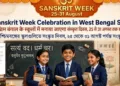
In a significant move to promote awareness of India’s ancient linguistic and intellectual heritage, the West Bengal Government’s School Education Department has directed all government, government-sponsored and government-aided schools across the state to observe one day as “Sanskrit Divas” during Sanskrit Week from August 25 to 31, 2026

Diganta ChakrabortyDiganta Chakraborty
Aug 28, 2026, 07:00 pm IST
inBharat, Culture, West Bengal
Follow on Google News
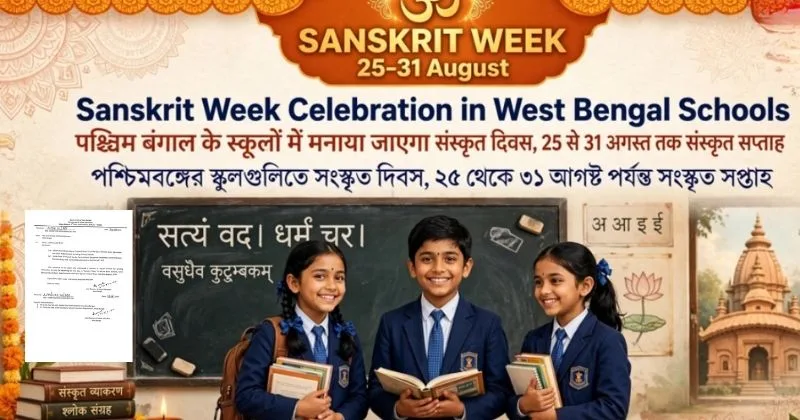
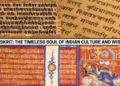
West Bengal to have week Long Sanskrit Day celebrations

West Bengal to have week Long Sanskrit Day celebrations

Facebook
Twitter
WhatsAppTelegramEmail

KOLKATA: The West Bengal Government’s School Education Department has issued a notice directing schools to observe one day as “Sanskrit Divas” during Sanskrit Week, from 25th to 31st August. On August 25 2026, the Joint Director of School Education, Government of West Bengal, issued a memorandum addressed to the District Inspectors (DI) of Schools across the state. The directive calls for the observance of Sanskrit Week from August 25-31, 2026.

As part of the initiative, all government, government-sponsored and government-aided schools across West Bengal, including primary schools, have been instructed to designate any one day during this week as “Sanskrit Day” and observe it accordingly. Importantly, the directive was issued in response to a letter dated August 13, 2026 addressed to the Hon’ble Education Minister by Pranab Nanda, Organising Secretary of the Eastern Region of Sanskrit Bharati. What may appear to be a routine administrative instruction is, in fact, significant: it places Sanskrit—one of the foundational languages of India’s intellectual and cultural traditions—within the formal educational space of schools across West Bengal.

Read More: Delhi Police bust Pakistan-ISI backed espionage module; Couple held for providing Indian SIM card to Pakistani handlers

As Pranab Nanda, Eastern Zonal Organisation Secretary of Sanskrit Bharati, explains, the organisation has played an important role in promoting Sanskrit in India and across the world. He notes that the Government of India’s Ministry of Education first announced the observance of World Sanskrit Day in 1969. The day is celebrated annually on the full moon of the month of Shravan according to the Hindu calendar, which coincides with the traditional festival of Raksha Bandhan or Shravani Purnima. The choice of this day has deep civilisational significance. In ancient India, Shravani Purnima was associated with the Upanayana ceremony, when students formally began their study of the Vedas and other branches of knowledge under the guidance of their gurus. By choosing this auspicious day to commemorate Sanskrit, the tradition seeks to reconnect the language with its historical role as a vehicle of learning, knowledge and the guru-shishya tradition.

Those so-called modern people, for whom modernity means rejecting their own language, culture, and civilisation, never give Sanskrit the value it deserves. They even describe it as a dead language. But what do modern Western thinkers actually think about this language? This is evident from Stephen Cross’s writings. Anquetil-Duperron, a French Orientalist and Indologist, had tried to learn Sanskrit. One of the earliest and most notable conduits for this Indo-Western philosophical transmission was Anquetil-Duperron, who translated the Upanishads from Persian into Latin under the title Oupnek’hat. What Cross has quoted is even more interesting. Cross writes, “Even so, he brought Sanskrit texts back with him to France and remained keenly interested in the Hindu scriptures. ‘Let us study the Indians,’ he says in one of his books, ‘as we study the Greeks and the Romans.’ What he meant by this was that they should be studied seriously, as a civilisation from which we might learn, and not simply as an Oriental curiosity.” This is how Western thinkers used to value and prioritise our languages.

So, the observance of World Sanskrit Day at the school level holds particular significance. Sanskrit is one of the world’s oldest languages and is often described as the “mother” of several Indian languages. The primary purpose of observing this day is to create greater awareness about this ancient and classical language and encourage its study and practice. Sanskrit is not merely a language; it is a repository of India’s ancient literary, philosophical and scientific traditions, carrying the knowledge contained in the Vedas, Upanishads, Ayurveda and numerous other classical texts. Celebrating the day in schools can therefore help students develop a deeper understanding of India’s rich civilisational heritage and foster greater appreciation for its intellectual and cultural traditions.

What was Swami Vivekananda’s observation on Sanskrit? In a lecture delivered at the Shakespeare Club, Pasadena, California, on February 2, 1900, he said, “God spoke once. He spoke in Sanskrit, and that is the divine language.” Again, he said, “This Sanskrit language is so intricate, the Sanskrit of the Vedas is so ancient, and the Sanskrit philology so perfect, that any amount of discussion can be carried on for ages in regard to the meaning of one word. If a Pandit takes it into his head, he can render anybody’s prattle into correct Sanskrit by force of argument and quotation of texts and rules.” Now, it is a matter of pride that the children and students of Swamiji’s own state would learn Sanskrit with due importance and learn to respect this language.

As Dr Vivek Karmakar, Assistant Professor and Head of the Department of Sanskrit at Scottish Church College, Kolkata, observes, “Celebrating the Sanskrit language means celebrating Bharat. If our objective is unity in diversity, then Sanskrit is the language that can connect the diverse linguistic traditions of India. Even in the Constituent Assembly, the demand to make Sanskrit the national language was raised, and Dr. B. R. Ambedkar supported this demand. In West Bengal too, there were voices advocating Sanskrit as the national language, one of them being Nasiruddin Ahmed. Therefore, Sanskrit is a truly pan-Indian and widely inclusive language, and there should be no confusion about its civilisational significance. The Sanskrit Commission Report of 1956 is also highly significant in this regard.” He further stated, “Today, when we speak of building a Viksit Bharat, the first thing we need is an understanding of Bharat itself—its history and civilisational heritage. In this context, the decision taken by the Chief Minister of West Bengal, Suvendu Adhikari, is like watering the roots of a tree; by strengthening the roots, we ultimately strengthen the entire tree.”

Topics: World Sanskrit DayPranab NandaEastern Zonal Organisation Secretary of Sanskrit Bharati
Share
Tweet
SendShareSend
✮ Subscribe Organiser YouTube Channel. ✮
✮ Join Organiser's WhatsApp channel for Nationalist views beyond the news. ✮
Previous News

Indian Navy receives first Multi-Purpose Vessel ‘Samarthak’ from L&T, with over 75 percent indigenous content

Next News

Karnataka Horror: Hindu Nurse receives threat from Naushad after police complaint in Mangaluru

Related News

Representative Image

World Sanskrit Day: Why Sanskrit is key to reconnecting Bharat to its civilisational roots

Karnataka’s Mattur — India’s only village conversing entirely in Sanskrit

Mattur: The story of only Sanskrit speaking village of India

World Sanskrit Day 2023: Celebrating ancient language, PM Modi extends greetings

World Sanskrit Day: Baldevanand Sagar and Sanskrit Varta -The long-lasting legacy of Sanskrit Journalism

Load More

Latest News

Accused Naushad who threatened the Hindu Nurse in Mangaluru

Karnataka Horror: Hindu Nurse receives threat from Naushad after police complaint in Mangaluru

West Bengal to have week Long Sanskrit Day celebrations

Sanskrit Divas Celebration in Bengal’s Schools: A step towards reconnecting with Bharatiya civilisational roots

Multi-Purpose Vessel (MPV), ‘Samarthak

Indian Navy receives first Multi-Purpose Vessel ‘Samarthak’ from L&T, with over 75 percent indigenous content

RSS Sarkaryawah Dattatreya Hosabale Ji addressing the gathering in Kashi

Unity and Oneness are the foundation for protecting and promoting Universal Brotherhood: RSS Sarkaryavah Hosabale

Nipun, the second indigenously designed and constructed Diving Support Vessel (DSV)

Indian Navy to commission Nipun: Indigenous vessel marks milestone in strengthening Indian Ocean maritime security

Representative Image

Raksha Bandhan 2026: Floral Rakhis, tree protection and traditional rituals mark celebrations across Bharat

Paramasivam, temple archaka (File Photo)

Madurai temple archaka Paramasivam’s death: Family alleges custodial torture, Tamil Nadu Police deny assault

Naga groups recieve bodies of deceased naga civilians

Manipur: Bodies of Naga civilians killed by Kuki militants reach Senapati; Civil groups call bandh amid rising tensions

Keralam: Hindu Aikyavedi leader seeks central probe into youths in military attire during Milad un-Nabi processions

UCC Panel Seeks Stakeholder Views During Raipur Consultation

Chhattisgarh Advances UCC Consultation: Religious entities, social representatives, statutory bodies submit suggestions

Load More
  • Privacy
  • Terms
  • Cookie Policy
  • Refund and Cancellation
  • Delivery and Shipping

© Bharat Prakashan (Delhi) Limited.
Tech-enabled by Ananthapuri Technologies

  • Home
  • Search Organiser
  • Bharat
    • Assam
    • Bihar
    • Chhattisgarh
    • Jharkhand
    • Maharashtra
    • View All States
  • World
    • Asia
    • Africa
    • North America
    • South America
    • Europe
    • Australia
  • Editorial
  • Operation Sindoor
  • Opinion
  • Analysis
  • Defence
  • Culture
  • Sports
  • Business
  • RSS @ 100
  • Entertainment
  • More ..
    • Sci & Tech
    • Vocal4Local
    • Special Report
    • Education
    • Employment
    • Books
    • Interviews
    • Travel
    • Health
    • Politics
    • Law
    • Economy
    • Obituary
  • Subscribe Magazine
  • Read Ecopy
  • Advertise
  • Circulation
  • Careers
  • About Us
  • Contact Us
  • Policies & Terms
    • Privacy Policy
    • Cookie Policy
    • Refund and Cancellation
    • Terms of Use

© Bharat Prakashan (Delhi) Limited.
Tech-enabled by Ananthapuri Technologies