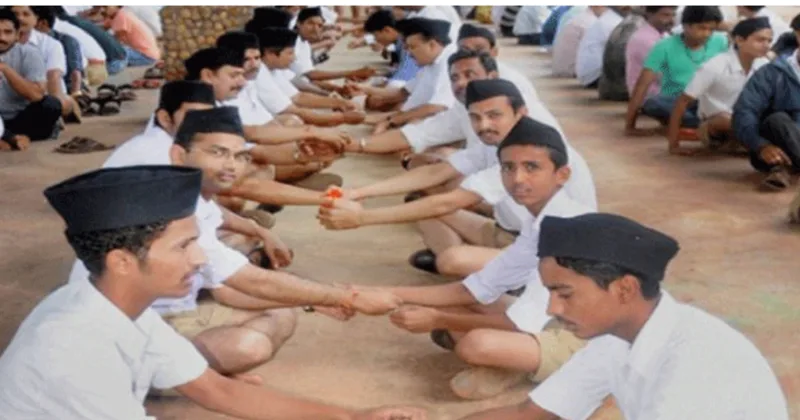
Some festivals are more than rituals. They carry within them the memory and philosophy of a civilisation. Raksha Bandhan is one such festival. Traditionally associated with the bond between a brother and sister, its deeper meaning is the strengthening of relationships, mutual responsibility and the protection of one another. In the Bharatiya context, this idea can extend from the family to society and, ultimately, to the nation.
This is precisely why Raksha Bandhan has a special place in the work of the Rashtriya Swayamsevak Sangh (RSS) and its emphasis on Samajik Samrasta—social harmony. Bharat is not merely a geographical territory or a political state. It is a Rashtra with a civilisational foundation that has survived extraordinary historical challenges. For centuries, this land faced invasions, political upheavals and attempts at cultural disruption. Yet the civilisation endured. Its survival cannot be explained only through military or material power. At its core was a civilisational consciousness that connected individuals to family, society, nature and the larger moral order.
This is one of the distinctive features of the Bharatiya worldview. It places relationships and duties alongside individual interests. The ideal of “Sarve Bhavantu Sukhinah”—may all be happy—reflects the aspiration that welfare should extend beyond oneself. Swami Vivekananda repeatedly presented Hindu Dharma as a spiritual tradition concerned with the welfare and upliftment of humanity. Sri Aurobindo, too, understood the nation as more than a political arrangement—as a living cultural and spiritual reality.
The RSS emerged in this broader historical context. Founded by Dr Keshav Baliram Hedgewar on Vijayadashami in 1925, the RSS sought to address what it regarded as one of the major weaknesses of Hindu society: internal disunity. Centuries of historical disruption, colonial policies and social divisions had created multiple barriers among people in the name of caste, region, language and other identities. The Sangh’s fundamental emphasis was therefore on organisation, discipline and social unity. Raksha Bandhan became one of the important occasions through which this message could be communicated. The RSS observes Raksha Bandhan as one of its six major annual celebrations, a tradition that has continued since 1926, shortly after its establishment in 1925. The significance of the festival within the Sangh is not restricted to the biological relationship between siblings. The rakhi becomes a symbol of social responsibility and fraternity. It conveys the idea that every member of society is connected to another and has a responsibility towards the larger social family.
This idea is particularly relevant to Samajik Samrasta. Social harmony does not mean erasing India’s diversity. Bharat has always been a civilisation of enormous diversity. The real challenge is to ensure that differences do not become permanent walls between communities. Samrasta seeks to create harmony amid diversity by strengthening the sense of belonging that binds society together. A society cannot be united merely through constitutional provisions or political slogans. Laws can provide equality before the state, but social harmony also requires interpersonal trust and fraternity. People must be willing to see beyond narrow identities and recognise one another as members of the same national community.
This is where the RSS’s work needs to be evaluated not merely through political narratives but also through its activities on the ground. The organisation has a vast network of shakhas and associated social-service initiatives. Its volunteers participate in education, healthcare, rural development, disaster relief, tribal welfare and other community-oriented activities. Raksha Bandhan provides another opportunity to take the message of social unity beyond organisational boundaries and into society.
The symbolism is simple but powerful: the thread on the wrist represents a bond of responsibility. It reminds us that society is sustained by relationships. If caste, economic status, language or region becomes more important than social fraternity, the nation becomes internally weaker. Conversely, when people develop a sense of belonging and responsibility towards one another, diversity can become a source of strength.
This question has become even more important in contemporary India. India is experiencing rapid economic, technological and demographic transformation. The aspiration of Viksit Bharat @2047 is not simply about becoming a larger economy or building modern infrastructure. Development must also have a social foundation. A prosperous but deeply divided society cannot realise its full civilisational potential.
For this reason, the idea of Samajik Samrasta deserves serious attention. The RSS has often been described through labels such as ‘Brahminical’ or as representing a particular section of society. Such claims should neither be accepted nor rejected merely on the basis of political perception. They should be tested against the organisation’s actual work. Criticism of any institution is legitimate, but it should be accompanied by an honest examination of evidence. If an organisation’s workers spend their time in social service, community outreach and efforts to bring different sections of society together, these activities are also part of the story that must be understood.
This does not place the RSS beyond criticism. Rather, it demands a more nuanced assessment. The larger significance of Raksha Bandhan lies precisely here. The rakhi is a small thread, but it represents something much larger: trust, affection, responsibility and solidarity. It tells us that strength is not merely an individual’s capacity to protect oneself; it is also the willingness of society to stand together.
The Bharatiya civilisation has survived not simply because of its political institutions, but because its cultural traditions repeatedly created bonds between generations and communities. Festivals, family structures, shared sacred traditions and social practices helped preserve a sense of continuity even during periods of political instability. Raksha Bandhan is part of that civilisational inheritance. The RSS’s use of the festival to promote Samajik Samrasta therefore reflects an attempt to transform a traditional celebration into a contemporary social message: society must be bound together by fraternity before the nation can realise its full strength.
In the end, the question is larger than the RSS. What kind of Bharat do we want to build?
A developed Bharat cannot be created by material progress alone. It needs social trust, mutual respect and a shared sense of national belonging. Economic growth may provide prosperity, but social harmony provides cohesion. That is the enduring message of Raksha Bandhan: a nation becomes strong when its people recognise their bond with one another. The thread of rakhi may be tied on a wrist, but its true significance lies in the relationship it represents. And if that relationship expands from the individual to society—from ‘main’ to ‘hum’—then Raksha Bandhan becomes not merely a festival of protection, but a celebration of Samajik Samrasta and national unity.