King Pari Vallal was a 9th-century Tamil Chola king. Once, while travelling in his chariot, he saw a jasmine creeper plant spread across the road. He stopped the chariot so as not to harm the creeper. He alighted, left the chariot there and went walking to his destination. On his return, he saw the creeper had spread all over the chariot. He did not disturb the creeper, left the chariot there, and went to his palace. He was famously known as “mullaikku ther kotutthan pari” (King Pari who donated the chariot to the jasmine creeper). People there still remember his love for nature and have built a sculpture depicting the king, creeper and the chariot at the Piranmalai Kodunkundranathar Temple. This incident is a striking expression of Bharat’s ideal environmental ethos. Eco-culture and ecological consciousness are deeply embedded in our DNA.
Statue at Piranmalai Kodunkundranathar Mandir, Sivaganga District, Tamil Nadu
Arnold Toynbee regarded Bharatiya approach to environmental preservation as a model and observed that the remedy for the global ecological crisis lies in reverting from ‘Western monotheism’ to ‘Indian pantheism’.
Focus on Family Model
We regard nature as a family in which human beings, flora, and fauna all belong together. Akam poetry of the Sangam tradition narrates an occasion where a young girl says that a tree planted by her parents before her birth is her elder sister. Our relationship with nature is therefore maternal—Mother Nature, Ganga Mata, Gau Mata, Bhu Mata, and so on. The concept of Mother Earth can be traced to Rig Veda 10.18.10: mātaram bhūmim—“Mother Earth.” Likewise, one of the earliest references to the cow as a mother, gomātaraḥ, occurs in Rig Veda 1.85.3. This idea is elaborated in the celebrated Bhumi Sukta (Hymn to Mother Earth) of the Atharva Veda and later in the Guru Granth Sahib: mātā dharat mahat—“The earth is mother.”
Similarly, Buddha taught that a tree offers shade even to the person who comes to cut it down, exemplifying the scarifying motherly attitude of nature.
The concept of “Mother Earth” is Bharat’s contribution to the world. At the historic Stockholm Environment Conference on July 14, 1972, Indira Gandhi quoted the Prithvi Sukta and introduced the concept of “Mother Earth” before the representatives of the global community, from where it became a widely recognised expression across the world.
The Bharatiya approach to using natural resources is dohanam—the “milking” of Mother Nature, taking only what is needed with love and care. This concept can be traced back to Rig Veda 10.18.11. Drawing upon this organic concept of family, the Madras High Court, in the Periyakarupa case (2022), declared nature to be a legal entity.
Organic Unity with Nature
Ramayana Manjari (3.446–448) describes that when Rama approached the hermitage of Agastya, even the enmity between the lion and the elephant came to rest. We believe in harmony with nature, as reflected in Yajur Veda 36.18. In contrast, the West generally follows a fragmented, mechanistic worldview in which nature can be broken into separate parts. Kalidasa states in Abhijnanasakuntalam that the forest is śaraṇyaṃ sarva-bhūtānām—a refuge for all beings. There exists a gravitational bond even among the planets.
The Bharatiya worldview advocates the peaceful co-existence of human beings and nature. Sadhguru Jaggi Vasudev observes, “We are a bundle of bacteria and viruses” living within our bodies without violence. When nature is harmed, it becomes violent. The Śukla Yajurveda calls for the non-violence between humans and nature. The Bhagavad Gita elevates this to an eternal principle through the expression parasparam bhāvayantaḥ—a symbiotic relationship of mutual support and harmony. During the Vedic period, this principle was known as Ṛtam, and in later times it came to be understood as Dharma.
This organic outlook was incorporated into daily life. Before ploughing the land, the farmer prayed to Mother Earth that his act should not cause her harm. This derives from the Atharva Veda, Bhumi Sukta (12.1.35): “O Mother Earth, whenever I dig you, let it quickly grow over again. O Pure One, may we not injure your vital regions.”
Nature is Divine
Nature has always been an object of religious reverence. Sacred places were established on mountains, at the confluence of rivers, and around rocks and trees. Even today, Bhumi Pooja is performed before constructing buildings and other structures. Rabindranath Tagore discusses this tradition in “The Religion of the Forest” (Essays, 2.8).
Rig Veda 1.6.3 affirms the divinity of nature and declares that the beauty of nature is divine grace. Taittiriya Upanishad 2.1 explains that the Pancha Mahabhutas (the five great elements) originated from Brahman. Samkhya philosophy discusses Prakriti and Purusha. According to the Shakta tradition, Prakriti is the primordial energy and the source of the five great elements. In the Bhagavad Gita (20.10), Lord Krishna declares, “I am in the heart of all creatures.” The Bhagavata Purana (2.1.32–33) compares various aspects of nature to different parts of the Divine Being.
This understanding of the divine nature of creation explains why trees are worshipped in Bharat. When we offer namaskar to the peepal tree, regarded as the king of trees, it is believed that Brahma resides in its roots, Vishnu in its trunk, and Shiva in its branches and leaves (Ashvatha Stotra 16; Skanda Purana 6.1.247.41–42).
Natural Living
In Mahabharata Shanti Parva (12.177.10–39; 12.184.10–39), Sage Bhrigu affirmed that plants possess life. This was scientifically demonstrated publicly by Jagadish Chandra Bose in 1901.
Prakriti Jeevanam (nature living) is a fundamental Ayurvedic principle. The ideal is following the ways of nature, and not merely environmental protection. Buddhism expresses a similar idea through Svabhava Niyata, meaning that life is regulated by nature. It is no coincidence that civilizations developed in river valleys.
Nature functions through an eternal cycle. The sun draws up water and returns it to the earth as rain. Vegetation supplies oxygen to humans and animals, while humans and animals provide carbon dioxide required by vegetation.
Sustainable consumption has always been an integral part of Bharatiya culture. Among forest resources, non-timber forest produce was traditionally used for livelihood. While international agencies today advocate green jobs, in Bharat, traditionally, all occupations were essentially green jobs.
Eco-“Feminism”
Although eco-feminism is generally regarded as a Western concept, its underlying ideas were well developed in Bharat. Maria Mies and Vandana Shiva, in their book Ecofeminism, argue that the Semitic “one God” religions have been hostile towards nature, peace, and women alike. The Western worldview considered both nature and women to be subordinated. In contrast, Bharatiya eco-feminism is positive rather than confrontational. Women have traditionally played a greater role in environmental protection. The very expression “Mother Nature” reflects the feminine conception of nature. The Ramayana narrates that even the creepers and trees of the forest wept at the abduction of Sita, while the bird Jatayu launched an aerial attack to rescue her and sacrificed his life in the attempt. During Shakuntala’s farewell in Act IV of Abhijnanasakuntalam, Sage Kanva remarks that she would not drink water until she had first watered the plants.
No Conquest over Nature
In her celebrated address at the Stockholm Conference, Indira Gandhi recalled that Jawaharlal Nehru objected to the expression “conquest of Everest.” The Western worldview, rooted in the Biblical tradition, holds that man should have dominion over everything. Rabindranath Tagore observed that Western literature often presents a malignant image of nature. Shakespeare’s The Tempest, for example, reflects a form of “ecophobia.”
Human intervention in nature should be kept to the minimum. It cannot be completely avoided. However, Fukuoka presented the extreme view of total non-intervention in agriculture.
Protect Nature
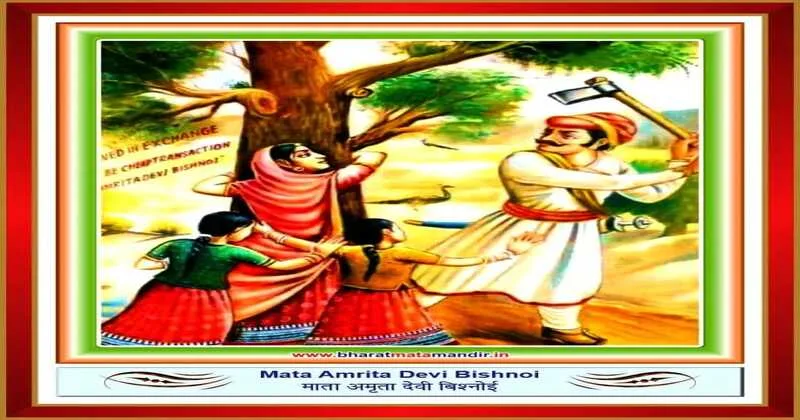
The conservation of trees and forests has always been a priority in the Bharatiya tradition. The sacrifice of Amrita Devi of Khejarli village near Jodhpur in 1730 is a remarkable example of this commitment. She sacrificed her life, along with many other villagers, while protecting the sacred khejri trees from being felled by the Maharaja of Jodhpur’s guards. Paryavaran Manch of Bharatiya Mazdoor Sangh observes August 28, Amrita Devi Balidan Diwas, as National Environment Day. During periods of extreme heat and drought, food and water were traditionally provided for birds and animals. Kalidasa, in Raghuvamsa, even records discussions about whether the deer of the forest were having safe deliveries.
The Apah Sukta of Rig Veda 10.9 highlights the importance of water and emphasizes its purity and preservation. In the Bharatiya tradition, water is regarded as the very basis of life. Accordingly, the conservation of rivers, lakes, wells, ponds, village tanks (pokhars) and other water bodies has always been considered both a religious and a social responsibility. Innumerable such water reservoirs across the country stand as enduring examples of the traditional system of rainwater harvesting. These were not merely means of storing water, but also served as the foundation for groundwater recharge, irrigation, biodiversity conservation, and the maintenance of local ecological balance.
India has a profound historical relationship with its rivers. Traditionally, rivers were not merely sources of water; they were life-giving streams that shaped Indian civilisation, culture, agriculture, the water economy, and spiritual life. They were centres of life, culture and faith, as well as the foundations of social, economic and urban life. The intimate and direct relationship between society and rivers naturally fostered a culture of river conservation. Nature possesses a remarkable capacity for self-purification, and, when supported by an appropriate environmental ethos and low levels of pollution, river ecosystems remain largely balanced. The Indian ethos emphasised use (Upayoga) over consumption (Upabhoga). In harmonious coexistence with nature, the Panchamahabhutas remain in balance through the need-based use of water, earth, fire, air and space.
Bharat nurtured a culture of afforestation as part of its tradition of greening the land. Matsya Purana (154.511–512) declares, Dasa putra samo drumah—“one tree is equal to ten sons.” Shukra Niti (4.4.46) states that the king should undertake tree planting in villages. Varaha Purana (172.39) provides a recommended list of trees to be planted and declares that one who plants a peepal tree, a neem tree, a banyan tree, ten flowering plants or creepers, two pomegranate trees, two lemon trees, and five mango trees will not go to hell after death. Tribal communities have traditionally demonstrated ecological wisdom by protecting trees, animals, hills, forests, ponds, and other natural resources.
No Pollution
The Ramayana gives a timeless call against violence towards nature through the famous words, Ma Nishada—“Do not kill, O hunter.” Likewise, Kalidasa, in Abhijnanasakuntalam (1.10), declares that an arrow is never meant to pierce the tender body of a deer.
There are injunctions against pollution. Yajur Veda (6.22) declares:—“Do not pollute water.” The Bhagavata Purana narrates that when Kaliya polluted the Kalindi River, Sri Krishna purified and restored it. Polluting nature was regarded as a grave sin. Padma Purana (7.8.8–10) equates the contamination of the Ganga with the grievous sin of Brahmahatya (killing a Brahmin). Padma Purana (7.9.44–45) further prohibits washing clothes or even cleaning one’s teeth in the waters of the Ganga.
We prayed for peace throughout the universe and with nature itself. The Yajurveda (36.17) prayer invokes peace throughout the entire cosmos—peace in the heavens, the atmosphere, the earth, the waters, the herbs, the vegetation, the divine forces, and indeed in the whole of creation.
In Bharat’s environmental justice, punishments were prescribed for harming nature, particularly for cutting trees. The Skanda Purana mentions a hell called Jrimbhanam for such offenders. Another punishment is sending the wrongdoer to Asipatra forest, where the leaves of the trees are as sharp as razors and injure him. Agni Purana (152.3) prescribes punishment by the king for cutting trees, while Manusmriti (8.285) imposes monetary fines for the same.
Environment and Development
The Bharatiya approach is “Environment AND Development” and not “Environment versus Development.” Development must be environmentally sustainable, while environmental protection should not come at the cost of social and economic development. Likewise, tribal and indigenous rights should advance together with development. The livelihoods of those living in and around forests—farmers, labourers, forest-dependent tribal communities, and others—must be protected while addressing issues such as tribal displacement.
Grama Sabha has a role in environment management. People’s participation through the Grama Sabha is essential for effective environmental management.
Emerging modern technologies such as Artificial Intelligence raise new environmental concerns. The operation of large AI data centres places enormous demands on natural resources, particularly water and electricity, while also generating significant quantities of waste. In modern times, technological advancement and artificial intelligence (AI) are essential. However, it is equally essential to strike a balance between technological progress and environmental responsibility.