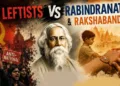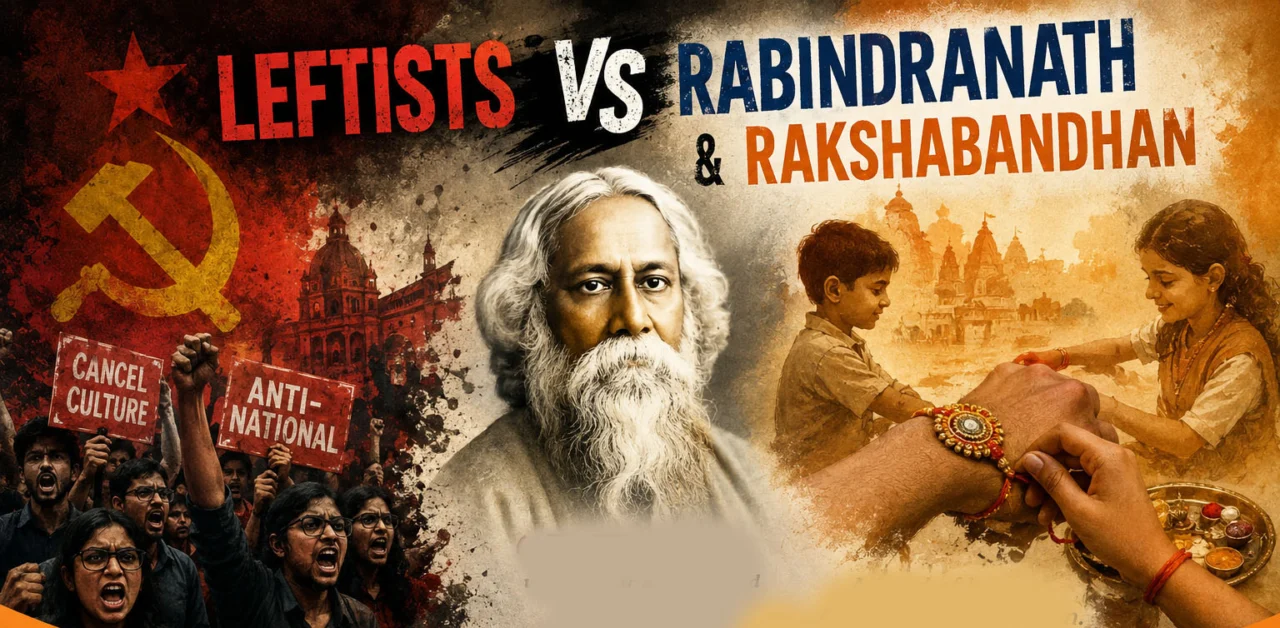
On October 16, 1905, when Bengal was partitioned under Lord Curzon’s conspiracy, Kobiguru Rabindranath Tagore led an unprecedented, barefoot, silent, and deeply spiritual procession through the streets of Calcutta. After bathing in the holy waters of the Ganges, singing his timeless song of unity, Banglar Mati Banglar Jol, Banglar Bayu Banglar Fol, Punyo Houk Punyo Houk He Bhogoban (May the soil of Bengal, the water of Bengal, the wind of Bengal, and the fruits of Bengal be holy, O Lord!), he tied saffron-threaded rakhis on the wrists of the common masses, regardless of whether they were Hindu or Muslim, coolie or labourer. On his lips was an infallible divine call: Bhai Bhai Ekthai (Brothers united as one).
Leftist Appeasement of the 1942 Partition versus the Rakhi of 1905
The most brutal and shameful irony of history emerged in 1942. A few decades after Rabindranath had celebrated the Rakhi festival in 1905 to foster Hindu-Muslim unity, the Indian Communists openly lent their support to Jinnah’s communal demand for the creation of “Pakistan”!
By examining the documents in Sajal Basu’s famous essay, “Communist Party of India and the Muslim League” (anthologised in Communalism in Bengal: From Famine to Noakhali, 1943–47, edited by Suranjan Das), it is revealed that in 1942, through the “Adhikari Thesis” (Pakistan and Indian National Unity) formulated by Dr. Gangadhar Adhikari in the Central Committee of the Communist Party, it was claimed that India was not a single nation, but rather a hodgepodge of eighteen different nationalities, and that the Muslim League’s demand for Pakistan was actually a progressive self-determination movement of the Muslim masses.
Based on Joseph Stalin’s distorted “Nationality Theory” imported from Moscow, the Communists officially instructed leaders like Sajjad Zaheer and Danial Latifi to infiltrate the Muslim League to accelerate the wheels of Partition. The bloody tragedies of the “Great Calcutta Killing” on August 16, 1946, and the Noakhali riots proved that the spiritual and humanist pulse of unity embedded in Rabindranath’s rakhi thread had been permanently decimated by the poisonous theory of materialist class struggle imported by the Communists.
In the 1940s and 50s, during the radical era of B.T. Ranadive, when the Communists ridiculed Rabindranath as a “poet of joy” (anandabadi kobi) or a bourgeois poet, they simultaneously realized that it was impossible to conduct politics in Bengal by completely boycotting Rabindranath. Thus, they embarked on a clever cultural co-optation or “cultural hijacking”. In Sudhi Pradhan’s edited volume Marxist Cultural Movement in India: Chronicles and Documents (Navana, 1979) and Rustom Bharucha’s Rehearsals of Revolution (University of Hawaii Press, 1983), it is demonstrated how the Indian People’s Theatre Association (IPTA) and the Progressive Writers’ Association (1936) converted Rabindranath’s songs and poems into songs of their own class struggle.
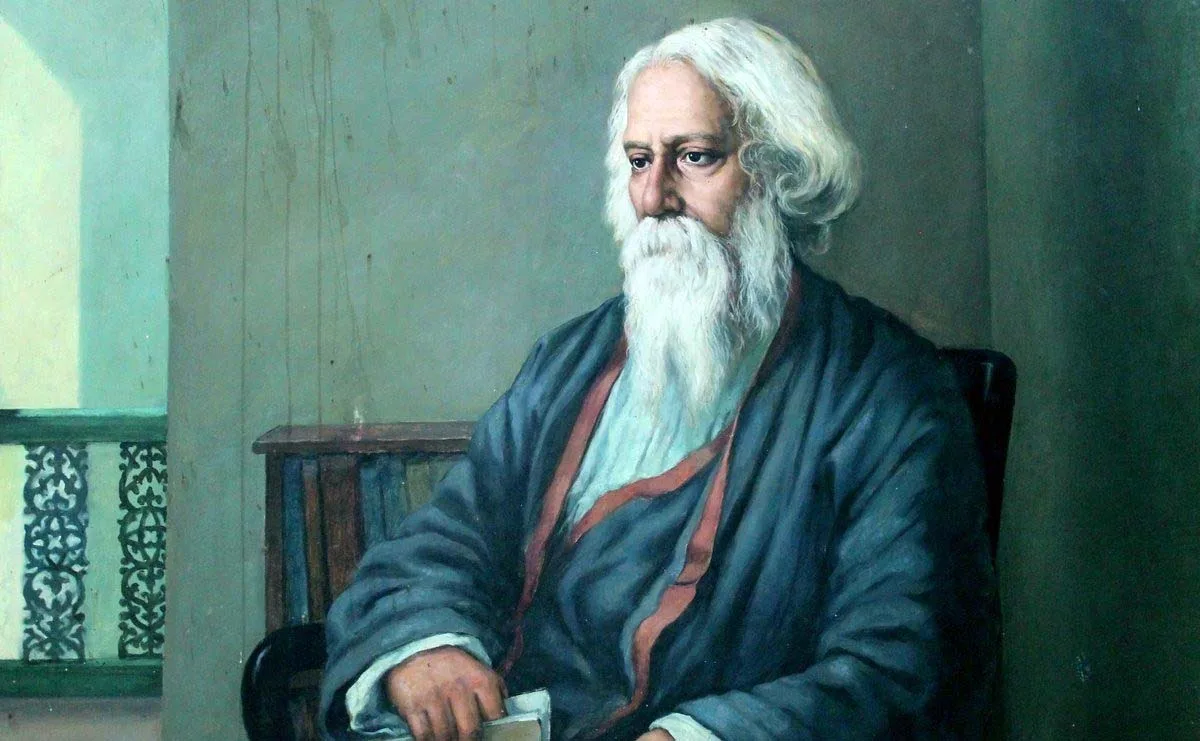
The very songs Rabindranath composed in 1905 to express self-surrender to God and spiritual brotherhood were forcibly reinterpreted on IPTA stages as “anti-fascist” and “working-class revolutionary struggle” songs. By stripping away the poet’s Upanishadic spirit and spiritual integrity, they reduced his songs to dry, mechanical manifestos of a propaganda machine.
Destruction of Tagorean Liberalism
The Left Front’s uninterrupted 34-year rule in West Bengal from 1977 to 2011 was an institutional assault on Rabindranath’s liberal, open, global humanism. In The Caravan magazine’s June 2011 special investigative report, “Scenes from the Last Days of Communism in West Bengal,” it was demonstrated how, during the Left regime, the intellectual environment of Santiniketan and Calcutta was tightly bound in party shackles. Labelling the speaking of English as a “symptom of the class enemy,” denouncing computers as the “enemy of the laborer,” and calling rock music “cultural pollution”—this extreme reactionary and illiberal narrow-mindedness was entirely antithetical to Rabindranath’s open-world philosophy. And its ultimate and shameful symbolic demise occurred on March 25, 2004, when, taking advantage of the Left regime’s extreme apathy and total administrative failure, the poet’s Nobel Medal was stolen from the Rabindra Museum in Santiniketan—and has not been recovered to this day.
Kerala & Modern Left-Wing Attacks
This Marxist opposition to Rabindranath, along with their extreme allergy toward the Rakshabandhan festival, continues unabated to this day. In August 2023 and 2024, the Directorate of Medical Education (DME) under Pinarayi Vijayan’s Left-wing Government in Kerala issued an official circular imposing a strict ban on celebrating Rakshabandhan inside medical college campuses, triggering a storm of controversy in The Hindu and The News Minute. SFI cadres assaulted general students who went to tie rakhis and branded the festival as a “communal agenda”.
Assault on Rakshabandhan
Simultaneously, Left-feminist icon Kavita Krishnan (AIPWA) and CPI(M) Politburo member Brinda Karat, in her book Survival and Emancipation: Notes from Indian Women’s Struggles (Three Essays Collective, 2005), launched a fierce attack on Rakshabandhan, calling it a “symbol of women’s enslavement and dependence”. In their view, the concept of “protection” in Rakhi supposedly subordinates women to men and denies women’s independent constitutional identity.
Saffron Thread Vs Rusty Red Sickle
History is indeed a strange and ruthless judge. In 2011, just before the historic downfall of the Left Front, West Bengal’s then-Chief Minister Buddhadeb Bhattacharjee was forced to admit publicly at the Pramod Dasgupta Memorial Lecture: “The Leftists made a monumental mistake in understanding Rabindranath; ridiculing him as a bourgeois poet was our historical sin.” (The Telegraph, July 14, 2011).
Rabindranath’s 1905 festival of a single piece of yellow thread proved that the human heart cannot be won with the jargon of foreign theories or dry, mechanical class struggle. The heartbeat of India’s soil—which lies in its spiritual and cultural heritage, and in a profound love for universal unity—was something this imported, parasitic red manifesto could never touch. Therefore, today, while the theoretical rhetoric of Moscow or London is cast into the dustbin of history, Rabindranath’s saffron-threaded Rakshabandhan festival still resonates gloriously in the skies and in the hearts of the people of India: Ek sutre badhiachi sohosroti mon, ek karje sopiachi sohosro jibon — Vande Mataram (We have bound a thousand minds with a single thread, we have dedicated a thousand lives to a single cause — Vande Mataram).