

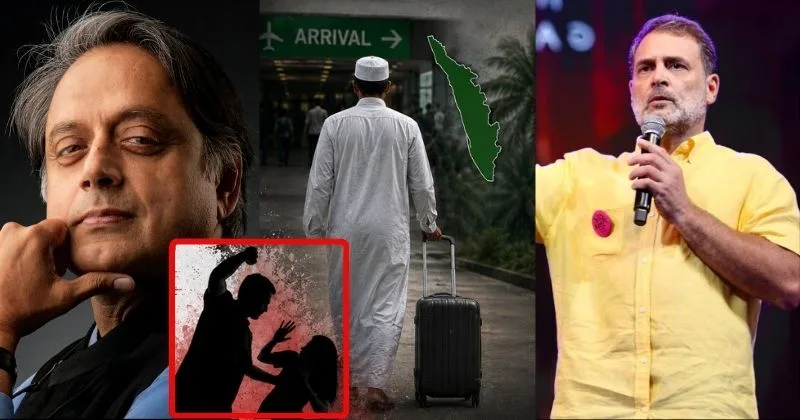
Rahul Gandhi’s “smash patriarchy” slogan sounds forceful. Yet even voices inside the Congress party are now pointing to uncomfortable truths that have long persisted in most states the party has governed for decades. Congress MP Shashi Tharoor recently highlighted a 2022 World Bank report focused on Keralam, which shows how conservative gender norms—brought back by return migrants—continue to shape the lives of many Muslim women in the state.
The world Bank study raises a larger question for Keralam: while political discourse increasingly calls for dismantling patriarchy, what happens when conservative gender norms are simultaneously being brought back through migration and social influence from more traditional societies?
Keralam has been governed alternately by Congress-led United Democratic Front (UDF) and Communist-led Left Democratic Front (LDF) governments since its formation in 1957. The state’s first elected government was formed by the Communist Party of India (CPI) under E. M. S. Namboodiripad. A Congress-led government came to power in 1960 with R. Sankar as Chief Minister. Since then, these two fronts have largely alternated in power.
The Indian Union Muslim League has been a key partner in UDF coalitions and has at times shared platforms with LDF forces as well. In a state where both major formations have held power for decades, and where Gulf migration has been an economic mainstay, the tension between progressive political rhetoric—including Rahul Gandhi’s recent “smash the patriarchy” appeal—and the documented transmission of more conservative gender attitudes through return migration remains unresolved.
When reports highlight how “imported” patriarchy from Saudi Arabia and other Gulf countries—through conservative interpretations of Islam—has made life more difficult for many Muslim women, and note substantially more conservative attitudes toward women and gender-based violence in parts of the community, both major political formations bear responsibility.
The Indian Union Muslim League is currently aligned with the Congress-led UDF, which is in power in Keralam. The Muslim League has also previously shared power in Keralam as part of alliances with the Communist-led LDF.
World Bank study raises a larger question for Keralam
While political discourse increasingly calls for dismantling patriarchy, what happens when conservative gender norms are simultaneously being brought back through migration and social influence from more traditional societies? Muslims form a disproportionately large share of Keralam’s emigrants (over 40% of emigrants while comprising roughly a quarter of the population), and Malabar districts with high Gulf links have long been central to this flow. Top Congress voices, such as the current Chief Minister V.D. Satheesan, have pushed back by insisting that Keralam’s Muslims remain very progressive overall. Yet the data on Saudi returnees specifically, and the concept of “social remittances,” have kept the debate alive.
What the World Bank study reveals – Imported Patriarchy
The World Bank study has come out with a shocking report which has opened a debate on male migrants of Keralam. It says that the men returning to Keralam after years working in Saudi Arabia carry home significantly more conservative attitudes toward women than those who worked elsewhere in the Gulf — a divergence so sharp that researchers say it challenges the common practice of treating the region as a single migration destination.
The paper, “Beyond Money: Does Migration Experience Transfer Gender Norms?”, was published in March 2022 by a team of World Bank economists — George Joseph, Qiao Wang, Gnanaraj Chellaraj, Emcet O. Taş, Luis Andres, and Syed Usman Javaid — along with migration researcher Irudaya Rajan of the Centre for Development Studies in Thiruvananthapuram. It draws on the Keralam Migration Survey 2013, a large household study covering more than 63,000 people across the state, and uses statistical techniques designed to isolate the effect of migration itself from the personal traits of the people who choose to migrate.
The researchers looked at 256 return migrants from Saudi Arabia, 322 from other Gulf countries, and 8,614 non-migrants in Keralam. Importantly, they did not treat all Gulf migration as the same. They studied Saudi Arabia separately from Bahrain, Kuwait, Oman, Qatar and the UAE because migrants encounter different social environments in these countries. The difference was striking.
Returnees from Saudi Arabia were significantly more conservative than non-migrants in their attitudes towards gender-based violence and extreme views on violence against women. In contrast, returnees from the other Gulf countries generally showed a more open or less conservative pattern.
From “Immodest Dress” to Justifying Violence Against Women
Concrete survey responses on the study underscore the scale of the gap: among Saudi returnees, about 43% agreed a man has the right to beat his wife if she disobeys him (37% among other Gulf returnees); nearly 85% believed a man who cannot control his wife loses community respect; around 70% held that women’s “immodest” dressing provokes men; nearly half thought a woman who is raped usually did something careless to put herself in that situation; and high percentages blamed women who go out alone after dark if they are molested. The paper notes these patterns alongside Keralam’s long record of high female literacy and education, including among Muslim girls and women.
Nearly half agreed that when a woman is raped, she usually did something careless to put herself in that situation. Around 68% believed a woman who has been sexually assaulted loses the respect of the community. Approximately 53% of Saudi return migrants held that a woman or girl who goes out alone after dark is herself to blame if she is molested. Roughly 52% agreed that in a rape case it is necessary to question whether the female victim is promiscuous or has a bad reputation. These attitudes go beyond ordinary conservatism. They amount to victim-blaming and the social policing of women’s behaviour.
Why World Bank used the term “Social Remittance”
World Bank researchers use the term “social remittances” to describe the transfer of ideas, behaviours and social norms from destination countries back to the communities migrants come from. The concept matters because migration is almost always discussed in purely economic terms: a migrant sends money home, a house is built, children are educated, and the family rises economically.
Yet migrants also return with experiences and ideas acquired abroad. The paper notes that migration can transmit cultural norms concerning law, religion, dress codes, social and moral values, and attitudes towards women. It specifically examines whether exposure to more conservative societies can negatively shape gender attitudes after migrants return. In Keralam’s case, the findings on Saudi returnees suggest that this social remittance can sometimes be deeply conservative.
Why the Saudi–Other Gulf Difference Matters
It would be inaccurate to claim that Gulf migration automatically produces conservative gender attitudes. The study does not say that. In fact, its findings demonstrate the opposite. Return migrants from countries such as the UAE, Qatar, Kuwait, Bahrain and Oman did not show the same pattern as Saudi returnees; on several measures they were actually less conservative than non-migrants.
This makes the Saudi result harder to dismiss as a generic consequence of migration. If migration itself were responsible for more conservative attitudes, returnees from the various Gulf states would be expected to display broadly similar outcomes. Instead, the country of exposure appears to matter. Saudi Arabia, with its historically conservative Islamic social framework and more restrictive interpretation of women’s roles, emerges as the clear outlier in the study. Keralam’s Modernisation Has Another Side.
Keralam-Gulf Relations
This finding presents an uncomfortable contradiction. Keralam is widely associated with high literacy, social development, education and relatively strong indicators of women’s advancement. At the same time, the state has maintained one of India’s largest and longest-standing migration corridors to the Gulf. The World Bank research suggests that economic modernisation and international migration do not necessarily produce uniformly liberal social attitudes. A migrant can return with greater wealth, new skills and improved economic standing while also returning with more conservative ideas about women’s behaviour, sexuality and autonomy. Migration, in other words, can modernise one part of society while reinforcing traditional attitudes in another. The Issue Is Not Migration. It Is What Comes Back with It.
The answer is not to demonise Gulf migrants or portray migration as inherently harmful. The World Bank study makes no such claim. Its central contribution is more nuanced: migration can transmit social norms, and those norms depend in part on the society in which migrants live and work.
Saudi Arabia’s case is particularly important because the study finds a measurable association between return migration from that country and more conservative gender attitudes in Keralam. The paper therefore adds a significant dimension to Keralam’s migration story. The Gulf has sent billions in remittances back to the state. But migrants can also bring something else home—the values and social attitudes they encounter abroad. And when the destination is a deeply conservative Islamic society such as Saudi Arabia, the World Bank evidence suggests that some of those returning “social remittances” can reinforce restrictive attitudes towards women.