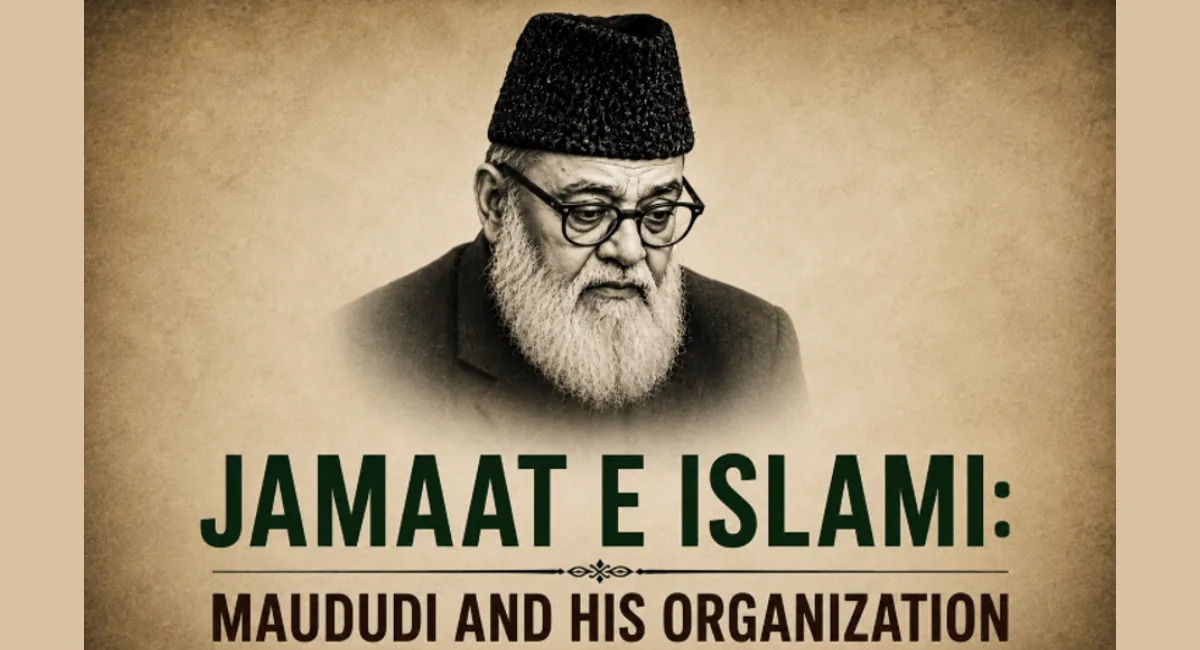
Maulana Abul Ala Maudidi (1903-1979) has been reckoned in the sequence of fundamentalist and orthodox thinkers and activist of the stature of Shaikh Ahmad Sarhindi (1564-1624) and Shah Waliullah (1703-1762). These personages were born in India but they metamorphosed Islamic thought worldwide. The challenge the Muslims of foreign origin faced in India in attaining religious, cultural and political hegemony, inspired Sarhindi and Waliullah’s writings and activism. Maududi played a role in the 20th century which Sarhindi and Waliullah had played in the 17th and 18th century respectively.
Wilfred Cantwell Smith, a renowned Canadian Islamicist, author of the 1957 book, Islam in Modern History, considers Maududi “the most systematic thinker of modern Islam”. Smith highlights the unique appeal of Maududi to educated youth despite his traditional background”.
Early Life and Career:
Maudidi was born in Aurangabad, in Hyderabad state. He received religious education at the hands of his father and from teachers employed by him at home. This education consisted of learning Arabic, Persian, Islamic law and Hadith. He also studied books of mantiq (logic, meant to give proofs and rational explanations). Afterwards he studied at Oriental High School, Aurangabad, founded by Shibli Nomani.
Then he moved to Darul Uloom Hyderabad. After the death of his father in 1919, when he was 16, he moved to Delhi and read books written by Sayyid Ahmad Khan. He took to editing at an early age and edited Al-Jam’iyat (1925–1928) a periodical of the Jamiat Ulama-i-Hind at a time when Khilafat movement collapsed and the chagrined Muslims started riots gratuitously against Hindus.
In 1932, he joined another journal, Tarjuman al-Quran. From now on he began to reflect over politics. In 1938 Allama Iqbal persuaded him to leave Hyderabad for Northwest India.
Liberation struggle led by Swamy Ramananda Theertha against Hyderabad State disconcerted Maudidi. He was alarmed also at the increasing secularism among the followers of Anjuman Taraqqipasand Urdu Musannfin (the Progressive Writers Movement), the Muslim faction in the Congress with Communistic leanings and lack of purdah among Muslim women in Delhi. This made him begin work on establishing an organisation for Da’wah (propagation and preaching of Islam). On August 26, 1941, Jamaat-e-Islami, the largest Islamic organization, was founded by Maudidi, to promote orthodox Islamic values and practices.
Books Authored by Him:
He authored several books. Of these more significant were (1) Al Jihad fi al Islam, exploring the concept, rules, and philosophy of jihad written in 1927, when he was 24 years of age. (2) His most important and influential work is the 6 volume Tafhimul-Quran (Towards Understanding the Qur’an), translation and commentary of the Qur’an which took many years labour. (3) Tajdld-o-lhyu- I – Din (Revival of the Religion). This was a small book of about 100 pages, but with a tremendous potential to radicalise.
Views Propounded by Him and Activism:
Maudidi opposed the partition, arguing that the concept violated the Islamic doctrine of the ummah. After migrating to Pakistan in 1949, his sole purpose was to institute Shariya and Islamise Pakistan.
With the partition of India in 1947, the Jamaat E Islami was split into Jamaat-e-Islami Pakistan and Jamaat-e-Islami Hind. Later with creation of Bangladesh, Jamat-e-Islami Bangladesh emerged. In 1953 an autonomous group in Indian Kashmir was founded.
In 1953, Jamaat E Islami launched a campaign against the Ahmadiyyas in Pakistan. Maududi was arrested and sentenced to death for his part in the agitation. But the anti-Ahmadi sentiments were so powerful that public pressure forced the government to release him after two years of imprisonment.
Maudidi had such a clout in Pakistan that the 1956 Constitution, a resultant of nine years consultations, accommodated many of the demands of the Jamaat E Islami. But this constitution was shelved when General Ayub came to power in 1958. The Jamaat E Islami now had bad days. Maudidi was twice imprisoned and left activism. But when Nizam-i-Mustafa (Order of the Prophet) a coalition was organized by group of parties, Maudidi assumed its leadership.
In 1977 began the heyday of Maududi. He occupied centre stage. Bhutto tried to woo him but failed. When Zia-ul-Haq came to power in 1977, he accorded Maududi the status of senior statesman and sought his advice.
Worldview of Maudidi:
Maudidi viewed Islam as a system encompassing all fields of life – politics, economics, science, health, psychology and sociology. It was to be followed by all Muslims without distinction of race, colour, language etc. Like Waliullah, Maududi was primarily interested in preserving Islamic dress, language and customs.
He adopted Ibn Taymiyya’s doctrines on apostasy, holding that the punishment for a Muslim leaving the faith was death.
This was a misgiving of Maudid that “not more than 0.001%” of Muslim knew what Islam actually was. He emphasized acquisition of knowledge about Islam and acting upon the teachings of Quran and Hadis.
His view about weak Hadis (Hadiis-e-Zaif) was that “on seeing a Hadith, I can tell whether the Holy Prophet could or could not have said it.” He raised question of the reliability of companions of the prophet as transmitters of hadith, saying “even the noble Companions were overcome by human weaknesses….”
His views about capitalism and industrialization were wildly unreasonable and impractical. He called it “satanic economic system” and “ruinous for humanity” leading to downward spiral of lower wages, protectionism, trade wars and desperate attempts to export surplus production and capital through imperialist invasions of other countries. This ‘spiral’ may be vicious but it was not simply possible to shun this “satanic system”. Maududi emphasised the elimination of interest on loans (riba). That too is beyond bounds of reality.
He was critical of innovations of Akbar. About Sufism his views are much akin to those of Sarhindi, who subordinated Sufism to Sharia. After the creation of Pakistan, Maududi concentrated his efforts on implementing Sharia in the country.
Women:
He firmly viewed that women must remain behind pardah, which keeps them from becoming “hell on this earth” and “storm centres of that Satanic liberty which woman is seeking and which is threatening to demolish the entire structure of human civilization.” He wanted sexes to be segregated, and made hijab compulsory. To him “the greatest threat to morality” was “women’s visibility” in the bazaar, colleges, theatres and restaurants and “art, literature, music, film, dance, use of makeup by women: all were shrieking signs of immorality.”
Maududi preached that the duty of women was to manage the household, bring up children and provide them and her husband with “the greatest possible comfort and contentment”. He supported covering of women’s faces and hands whenever they left their homes.
Jihad:
He said that thousands of lives may be lost in Jihad but this to him was necessary for the victory of good over evil and rooting out atheism. (P. 31 Jihad fil Islam).
Legacy and Impact:
Jamat-e-Islamis in Pakistan, India Bangladesh and Kashmir are the enduring monument of Maudidi’s fundamentalist tenets. The anti-CAA protests allowed Jamaat E Islami to raise its ugly head. Jamaat E Islami linked Indian Musim Association of Canada wants US action against India.
SIMI was the student wing of Jamat-e-Islami formed at Aligarh in 1977. It was proscribed under the Unlawful Activities (Prevention) Act. It is an Islamist fundamentalist organization and blindly follows Maudidi. It advocates the ‘liberation of India’ (Azadi) by converting it to an Islamic land. It has declared Jihad against India, with the aim of establishing Dar-ul-Islam by either converting everyone to Islam or by violence.
Homepage of the SIMI website features the slogan “Jihad our path” and “Shahadat our desire”. These phrases are followed by the stern message for Muslims who are comfortable “Living under an un-Islamic order”. An Ayat from the Quran (4:97) is quoted: “When the angels seize the souls of those who have wronged themselves—scolding them” “What was wrong with you?” they will reply, “We were oppressed in the (non-Muslim) land.” The angels will respond, “Was Allah’s earth not spacious enough for you to emigrate?” It is they who will have Hell as their home—what an evil destination! The meaning is clear Muslims were told to either Islamise the country or migrate to a Muslim country. The former alternative was the obvious choice.
As SIMI was banned, PFI was officially formed in 2006 through the merger of the Kerala’s National Development Front (NDF) and parallel bodies like the Karnataka Forum for Dignity (KFD) and Manitha Neethi Pasarai (MNP) in Tamil Nadu. Investigators noted that several founding members and leaders of the newly formed PFI had past associations with the banned SIMI.
Maulana Sajid Rashidi, President of the All-India Imam Association, says “the core belief of the organization revolves around the proposition that Muslims should propagate Islam throughout the world and struggle to establish the Kingdom of Allah globally. The Pakistani and the Kashmiri wings of the Jamaat–e–Islami are fully committed to conduct such a jihad to meet their objective”.
During the 1971 Bangladesh Liberation War, Jamaat E Islami Bangladesh strongly opposed the independence of Bangladesh and actively collaborated with the Pakistani military. The group helped create auxiliary paramilitary forces like the Al-Badr, Al-Shams, and Razakars. These militias worked directly with the Pakistani military in a systematic campaign of terror, mass killings, rape, and targeted assassination of Bengali intellectuals.
Maudidi’s Recognition:
Maudidi has carved a niche for himself by his views and activism. In 1979, Saudi King Faisal International award was given to him for services to Islam. He played part in establishing and running Islamic University of Medina.
Absentee funeral for him in the Kabba, was the rarest post-humous honour to him. Such an honour was given to the 7th century King Ashama Ibn Abzar of Ethiopia for offering safe harbour to the early Muslim refugees who went to Ethiopia from Mecca in 615 CE.
Maudidi was acclaimed by Jamaat E Islamis of the subcontinent, Muslim brotherhood, Islamic circle of North America, Hamas etc.
Iqbal praised his book “Al Jihad Fil Islam” for being a profound research work with unapologetic content.
Maududi remains a pillar of modern Islamic fundamentalism and radicalization. He stressed in Al-Jihad fil-Islam that Islamic law views the entire world as the domain of God, and that Muslims should reclaim lands where Islamic governance had previously existed. India was clearly the target and this is what Jamaat E Islami aim at.