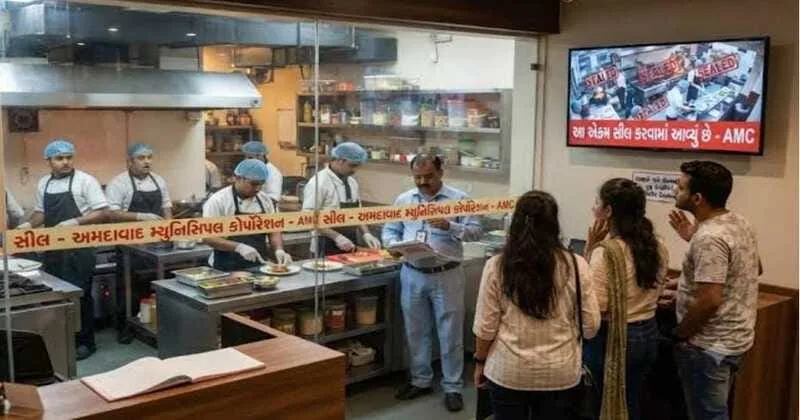
Ahmedabad: The Ahmedabad Municipal Corporation (AMC) has stepped up its crackdown on unsafe food practices and poor hygiene at restaurants and other food establishments across the city. The AMC health department issued an advisory to 11,123 restaurants and food business operators, urging them to install CCTV cameras in their kitchens and display live footage near reception or seating areas. The initiative is aimed at allowing customers to observe food preparation and assess whether basic hygiene standards are being maintained.
The civic body directed food businesses to comply with cleanliness and sanitation requirements under the Food Safety and Standards Act and guidelines issued by the Food Safety and Standards Authority of India (FSSAI). These requirements include maintaining personal hygiene among food handlers, keeping raw and cooked food separate, using clean water, ensuring proper food storage, controlling pests and disposing of waste appropriately. Restaurants have also been instructed to regularly clean and sanitise their kitchens and utensils.
The AMC further advised establishments to protect food from dust and other contaminants, use only FSSAI-approved colours and ingredients, and ensure proper handling and disposal of cooking oil. It warned that violations could invite legal action, while repeated or serious breaches could lead to the cancellation of licences and sealing of the premises.
While installing live CCTV cameras in kitchens is not currently a legal requirement, the AMC has strongly encouraged restaurants and food businesses to voluntarily adopt the measure as an additional transparency and hygiene safeguard.
The advisory comes amid intensified inspections by the civic body, during which officials have detected several serious violations. Some establishments were also sealed during Wednesday’s inspections as part of the ongoing action against food safety and hygiene violations.
Ahmedabad Restaurants Face Action
The Ahmedabad Municipal Corporation took action against several restaurants and food establishments after inspections uncovered food safety and hygiene violations. Mad Over Grills in Kankaria was sealed after inspectors reportedly found pests in stored refined flour. Santosh Ghee Bhandar in Madhupura was shut after a sample of its Agmark desi ghee tested positive for a compound associated with vegetable oils, raising concerns over possible adulteration.
Rajesh Dudh Ghar in Kubernagar also faced action after its paneer sample failed quality tests. In Sarkhej, Sabru Chinese Mughlai & Tawa Fry Centre was shut over unhygienic conditions and the absence of a pest control certificate. Samrat Bakery in Behrampura was sealed for allegedly operating without a valid licence and maintaining unhygienic premises. Bhairavnath Bhojanalay in Rakhial was also sealed after its paneer sample failed quality testing.
The AMC additionally inspected eight school and college canteens. The Mahatma Gandhi Physiotherapy College Hostel canteen in Saijpur Bogha was sealed for operating without a valid food licence and for multiple hygiene violations. Inspectors reportedly found insects in food, unhygienic conditions, and the absence of medical fitness certificates for staff, pest control records and water quality reports.
The risks associated with unsafe food were underscored by a tragic incident in Surat, where a five-year-old girl died after her family reportedly fell ill following a restaurant meal. The family has reportedly attributed the illness to a kaju-paneer curry consumed at the restaurant. The family, residents of Ranujadham Society, had ordered Kaju-Paneer Curry from Sheetal Restaurant. Five members of the family were hospitalised, while five-year-old Arya died during treatment. According to the family, Ashokbhai Kalsaria and one of his daughters developed severe stomach pain at around 4 am on August 16. They initially visited a local clinic at around 9 am, but their condition reportedly worsened. Other family members soon developed similar symptoms and were taken to Sadvichar Hospital. The family said Arya died within 15 to 20 minutes of reaching the hospital’s emergency department. The incident has renewed concerns over food safety and the need for restaurants to maintain proper standards in food storage, preparation, cooking and hygiene.
Several food safety violations have also been reported in Bengaluru. During a raid at Skyye Lounge in UB City on August 9, Karnataka food safety officials reportedly recovered 45 kg of rotten meat, 6 kg of rotten vegetable cutlets and 15 litres of used cooking oil. Officials also found an unhygienic kitchen, with meat reportedly covered in fungus. Milk and curd stored at the premises had also expired around 10 days earlier. The findings have once again highlighted the importance of regular inspections and strict compliance with food safety and hygiene standards at restaurants and other food establishments.
Across five establishments, food safety officials seized or discarded 132 kg of food items and 15 litres of used cooking oil during inspections. Royal Chain Hotel accounted for 50 kg of duck and 5 kg of fish, while food items were also seized or discarded from Madras Kitchen, Tescon Hotel and Sanchez Hotel.
The inspections uncovered serious violations related to food storage. Officials reportedly found meat at one establishment that had been kept in cold storage for more than six months, while fish at another was allegedly stored for over a year. Notices were issued to establishments found violating food safety norms, and samples were sent to laboratories for further testing.
In another case, food safety officials inspected a KFC outlet at City Centre Mall on KS Rao Road in Mangaluru following a customer complaint that an online order contained spoiled and foul-smelling chicken. Officials inspected the outlet’s kitchen, storeroom and cold storage facilities before sealing its go-down. Food samples were collected and sent to a laboratory, with further action expected to be based on the test results.
The food safety campaign was subsequently extended to Mysuru, where officials seized 9 kg of expired chicken from Rio Meridian Hotel, 68 kg of meat from Grand Mercure Hotel and 4 kg of mushrooms from Q Star Hotel. KFC said it follows FSSAI guidelines and global quality standards, conducts multiple food safety checks and is cooperating with the authorities.
Installing CCTV cameras in restaurant kitchens could improve transparency, but cameras alone cannot eliminate food adulteration or unsafe practices. Regular inspections, laboratory testing, proper food storage and strict action against violations remain essential to ensuring food safety. However, allowing customers to view kitchen activities could create an additional layer of accountability. Restaurants may be encouraged to maintain better standards of cleanliness, food handling and storage when their practices are visible to customers.
The AMC’s initiative, coupled with regular inspections and action against violators, could encourage restaurants to adopt stronger hygiene practices. The broader objective should be not merely to penalise establishments after violations occur, but to ensure that safe, hygienic and responsible food-handling practices are maintained every day.