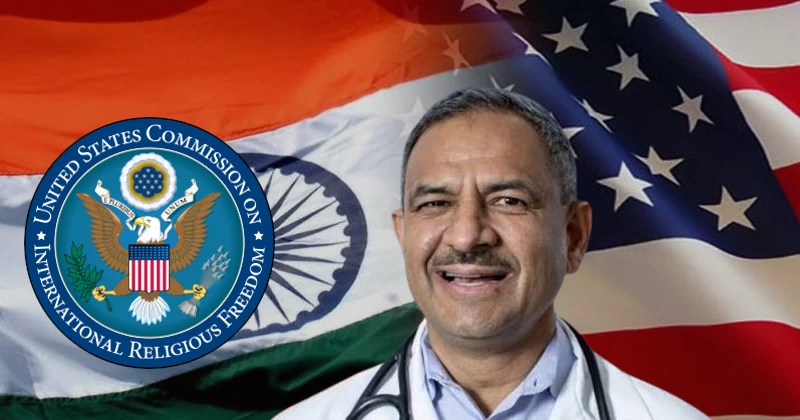
From Kashmir advocacy and congressional lobbying to leading the US Commission on International Religious Freedom, Dr Asif Mahmood’s record raises questions about the ideological lens through which the body is now targeting India
The United States Commission on International Religious Freedom (USCIRF) has once again put India in its crosshairs.
In March 2026, the commission recommended that the United States consider targeted sanctions against India’s external intelligence agency, the Research and Analysis Wing (R&AW), and the Rashtriya Swayamsevak Sangh (RSS), including measures such as asset freezes and entry restrictions. It also recommended that India continue to be designated a “Country of Particular Concern” over alleged religious-freedom violations.
Now, ahead of RSS Sarsanghchalak Dr Mohan Bhagwat’s reported visit to the United States, Canada and the United Kingdom from August 25, USCIRF officials have again called for sanctions against RSS members and urged Washington not to extend high-level diplomatic courtesies to its leaders.
USCIRF Chair Dr Asif Mahmood said that Prime Minister Narendra Modi is a member of the RSS and alleged that groups associated with the organisation have perpetrated attacks against religious minorities.
Commissioner Gene Mills separately called for sanctions against RSS members allegedly responsible for violations of freedom of religion or belief.
Who exactly is the man now sitting at the top of that commission?
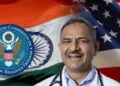
That man is Dr Asif Mahmood a Pakistan-born American physician, political activist and longtime advocate on Kashmir who has now risen to chair a US federal advisory commission whose recommendations can influence American foreign policy.
And his record on India predates his USCIRF appointment by several years.
From Pakistan’s Punjab to the top of USCIRF
According to Mahmood’s own account and reporting on his career, he was born in Kharian in Pakistan’s Punjab province and later moved to the United States after completing his medical education in Pakistan. He trained at the University of Kentucky Medical Center and subsequently completed a pulmonary fellowship at Harlem Hospital, affiliated with Columbia University. He went on to establish a career as a pulmonologist in California.
Mahmood is now an American citizen. In a message published by Pakistan’s Los Angeles consulate, he wrote that he had been living in the United States for around 30 years and described himself as proud to be an American.
His professional career, however, was accompanied by an increasingly prominent political and human-rights activism.
Before joining USCIRF, Mahmood was active in Democratic Party politics. He ran for California Insurance Commissioner in 2018 and later sought a congressional seat. He was appointed to USCIRF by then-House Minority Leader Hakeem Jeffries in 2024. After serving as vice chair, Mahmood was reappointed in 2026 and was unanimously elected chair for the 2026-27 term on July 20.
USCIRF itself describes him as a practicing pulmonologist, human-rights advocate and community leader, and says his humanitarian advocacy has included work relating to Kashmir and other conflict zones.
Kashmir was not a footnote in Mahmood’s activism
Long before he became a USCIRF commissioner, Mahmood was actively involved in lobbying Washington over Kashmir.
In 2019, following India’s abrogation of Article 370, Mahmood played a prominent role in efforts to bring the Kashmir issue before the US Congress. He helped organise meetings involving congressional staff and Kashmiri-American activists, culminating in a House Foreign Affairs Subcommittee hearing on Kashmir. He also testified before the congressional panel himself.
His own account of those efforts is even more revealing.
In a publication of Pakistan’s Consulate General in Los Angeles, Mahmood wrote that after August 5, 2019, he had supported Pakistani and Kashmiri diaspora groups seeking to approach members of Congress over what he described as India’s actions in “Occupied Jammu & Kashmir”. He said he helped arrange meetings with US public officials and described the subsequent congressional hearing as a productive outcome of those efforts. He also specifically acknowledged the role of Pakistan’s ambassador and consul general in coordinating the initiative.
At the 2019 congressional hearing, Mahmood declared that “Kashmiris are not alone” and pledged continued support until their basic rights were secured. For supporters of his activism, this is evidence of a longstanding commitment to human rights.
His own words on India deserve scrutiny
Mahmood’s public commentary on India has not been limited to Kashmir. Archived social-media posts attributed to him show repeated criticism of the Narendra Modi government and its policies, particularly on the Citizenship Amendment Act, the Ram Mandir and Kashmir.
In one post concerning the Citizenship Amendment Act (CAA), Mahmood argued that implementation of the CAA during Ramadan sent a message that Muslims were no longer equal citizens and described religious freedom in India as being at its lowest.
Following the consecration of the Ram Mandir in Ayodhya in January 2024, he questioned whether the event represented “the beginning of the end of secular India” and again described religious freedom in India in extremely negative terms.
His Kashmir commentary has similarly been uncompromising. In a 2023 post cited by Indian media, Mahmood described developments in Kashmir as a “dark day” for democracy and self-determination and accused India of encroachment.
More recently, his USCIRF testimony has continued along the same broad line. At a May 2026 USCIRF hearing on India, Mahmood described religious freedom conditions in India as “abysmal” and criticised the CAA and NRC, while specifically highlighting the cases of activists including Umar Khalid and Sharjeel Imam.
These are not isolated remarks made after his elevation to the chairmanship. They form part of a public record extending years before he joined USCIRF.
USCIRF’s own record shows that Mahmood has also participated in the commission’s criticism of Pakistan. In 2024, as a USCIRF commissioner, he explicitly supported redesignating Pakistan as a “Country of Particular Concern” and called for action over Pakistan’s blasphemy and anti-Ahmadiyya laws, forced conversions, vigilante violence and religiously motivated crimes. He also supported targeted sanctions against Pakistani officials and entities responsible for severe religious-freedom violations.
The relevant question is whether an official who has spent years advocating on Kashmir, publicly condemning Indian policies and expressing strongly negative views on issues such as the CAA and Ram Mandir can simultaneously be perceived as an entirely detached and neutral arbiter when his institution recommends sanctions against Indian organisations and agencies.
USCIRF’s India campaign predates Mahmood
There is another important piece of context. USCIRF’s criticism of India did not begin with Mahmood. The commission has been recommending increasingly severe action against India for years.
Its 2026 recommendations again place India among its Countries of Particular Concern, alongside countries including China, Iran, Pakistan, Saudi Arabia and North Korea. In March 2026, USCIRF went further, recommending targeted sanctions against R&AW and the RSS. He led the commission’s May 2026 India hearing as vice chair, and after becoming chair in July, he has continued to publicly defend the commission’s position on India.
What exactly is USCIRF?
USCIRF is not the US State Department, nor is it America’s intelligence establishment.
It is an independent, bipartisan federal advisory commission created under the International Religious Freedom Act of 1998. Its role is to monitor religious freedom abroad and make recommendations to the US President, Secretary of State and Congress.
Its commissioners are politically appointed. The current USCIRF roster reflects appointments and reappointments by senior Democratic and Republican congressional leaders. Mahmood, for example, was appointed and later reappointed by House Minority Leader Hakeem Jeffries.
That structure is important because USCIRF’s conclusions are recommendations, not automatically binding US sanctions. Its March recommendations concerning R&AW and RSS called for measures such as freezing assets and restricting entry, but implementation would require action by the relevant US authorities.