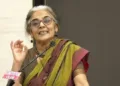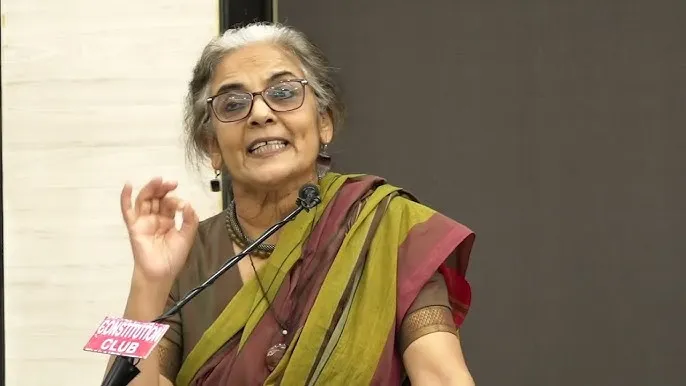
An Independence Day programme at Sardar Patel Vidyalaya in Delhi became the centre of a political and academic controversy after the school cancelled the scheduled appearance of JNU Professor Emerita Zoya Hasan.
Hasan had been invited as the chief guest for the school’s flag-hoisting and scholarship award ceremony and was expected to speak to students on the theme of pluralism. Her address was cancelled shortly before the event amid reports of protests outside the school and concerns over security.
Different accounts have emerged about the circumstances surrounding the cancellation. Reports said members associated with the Vishwa Hindu Parishad had gathered outside the school and raised objections to Hasan’s presence. However, the identity and affiliation of all those who gathered outside were not independently established. The New Indian Express also reported that there was no official confirmation regarding the protesters’ identities and that there were no reports of violence or damage to property.
Delhi Police said the school had informed them about the security concern and that police personnel were deployed for protection. Reports said the decision to cancel Hasan’s appearance was taken by the school rather than the police. The programme subsequently went ahead with another speaker.
The cancellation triggered a wider debate over academic freedom, political dissent and the suitability of politically prominent academics as speakers at school functions.
But to understand why Hasan’s invitation became controversial, it is important to look at her public career and her positions on some of India’s most politically contentious issues.
Who is Zoya Hasan?
Zoya Hasan is a prominent political scientist and Professor Emerita at Jawaharlal Nehru University. She previously served as Professor of Political Science and Dean of JNU’s School of Social Sciences.
Her academic work has focused on Indian politics, political parties, minorities, gender, social movements and the politics of Uttar Pradesh. She has authored and edited several books, including Congress After Indira: Policy, Power and Political Change, Politics of Inclusion: Castes, Minorities and Affirmative Action and India’s Living Constitution: Ideas, Practices, Controversies.
Hasan has also held several positions in public institutions. She was a member of the National Commission for Minorities and has served on bodies connected with education, national integration and minority affairs. The Hindu Centre’s profile lists her association with the National Integration Council, National Book Trust, Central Advisory Board of Education and other government-linked bodies.
Her academic credentials, therefore, are substantial. The controversy surrounding her recent public appearances is not about whether she is an academic. It concerns the political positions she has expressed publicly and whether those positions make her a polarising choice for certain institutional platforms.
Her role in the debate over the CAA
One of the issues most closely associated with Hasan in recent years has been the Citizenship Amendment Act, or CAA.
The CAA, passed by Parliament in 2019, provides a route to Indian citizenship for members of specified non-Muslim communities from Pakistan, Bangladesh and Afghanistan who entered India on or before the prescribed date. The legislation became the subject of nationwide protests, with Shaheen Bagh in Delhi emerging as one of the most prominent protest sites.
Hasan has written extensively about the anti-CAA movement.
In 2024, she co-authored When People Protest: Mobilising for Equal Citizenship in India with Avishek Jha. The book examines the protests against the CAA and particularly the mobilisation of women at Shaheen Bagh. A review published in the academic journal Social Change described the book as documenting and analysing the anti-CAA protests and their political significance.
Hasan has also publicly praised the role of Muslim women in the Shaheen Bagh protests. In a 2020 article, she described their participation as a defining feature of the movement and portrayed them as central to the resistance against the CAA.
Her position is therefore clearly part of the broader academic and political debate surrounding the CAA. Supporters of the anti-CAA movement have viewed such scholarship as an important examination of citizenship and democratic participation, while critics argue that it presents a particular political interpretation of the legislation and the protests.
That disagreement is central to the debate over Hasan’s public role.
The Ambedkar cartoon controversy
Another episode frequently cited in discussions about Hasan’s public interventions dates back to 2012, when a major controversy erupted over a political science textbook cartoon depicting B.R. Ambedkar sitting on a snail symbolising the slow pace of constitution-making, with Jawaharlal Nehru shown behind him holding a whip.
The cartoon triggered political protests and criticism, with opponents arguing that it was disrespectful to Ambedkar.
Hasan was then part of the National Monitoring Committee associated with NCERT textbooks. She criticised the recommendations calling for the deletion of cartoons, saying that the review had not adequately considered the complexities of the issue.
The controversy eventually resulted in NCERT removing several cartoons from its political science textbooks, including the Ambedkar cartoon.
Hasan’s position in the episode became another example of her emphasis on academic debate and freedom of expression, while critics saw the defence of the cartoon as insensitive to the concerns surrounding Ambedkar’s portrayal.
From the CAA debate to Palestine
Hasan’s public interventions have not been limited to domestic politics.
In November 2024, Gurugram University cancelled a discussion she was scheduled to deliver on the topic “Palestinian Struggle for Equal Rights: India and Global Response.”
According to The Indian Express, the university cancelled the event two days before it was scheduled to take place. Vice-Chancellor Dinesh Kumar said his approval had not been sought and described the subject as controversial.
The cancellation itself became another debate over academic freedom and institutional control over politically sensitive subjects.
For Hasan, the Palestine issue has consequently become another part of her public profile. Her scheduled discussion focused on Palestinian rights and India’s response to the conflict, placing her once again in the middle of a highly contested political issue.
The 2024 Gurugram University episode and the 2026 Sardar Patel Vidyalaya controversy have similarities in one respect: both involved institutions cancelling programmes involving Hasan after questions were raised over the nature or sensitivity of the subject or event.
Why does the school invitation matter?
The controversy at Sardar Patel Vidyalaya is therefore larger than the cancellation of a single speech.
The school had chosen Hasan to address students on pluralism during an Independence Day programme. Pluralism is an important constitutional and democratic principle, but the choice of any speaker for schoolchildren can also invite scrutiny when that person has a long and visible record of political commentary.
Hasan’s supporters can point to her academic credentials, research on Indian politics and minorities, and long engagement with questions of democracy, citizenship and constitutionalism.
Her critics, meanwhile, point to her positions on the CAA, her association with the intellectual discourse surrounding Shaheen Bagh, her interventions on the Ambedkar cartoon controversy and her public engagement with the Palestine question.
Neither side can reasonably be separated from the broader debate over her public profile.
A debate over academic freedom and school platforms
The immediate controversy also raises a difficult question: where should institutions draw the line between academic engagement and political advocacy?
Universities are traditionally spaces where contentious political ideas can and should be debated. Schools, however, operate in a different environment. Their students are younger, and institutions often exercise greater care in selecting speakers for formal civic and national events.
That does not mean controversial academics should automatically be excluded from schools. Nor does disagreement with a speaker’s political position by itself establish that the speaker is unsuitable.
At the same time, schools can legitimately consider whether a proposed speaker’s public profile is likely to turn an educational event into a political confrontation.
That appears to be what ultimately happened at Sardar Patel Vidyalaya.
The larger question
The cancellation has now placed the spotlight not only on the protesters but also on the school’s original decision to invite Hasan.
The protesters’ objections, the school’s decision, the police deployment and Hasan’s subsequent response have generated competing interpretations of the episode. Reports also indicate that the controversy did not prevent students and parents from hearing Hasan speak later through an online programme.
The episode therefore does not have a simple black-and-white explanation.
For Hasan’s supporters, the cancellation raises concerns about academic freedom and whether political pressure can determine who is allowed to speak. For her critics, it highlights the need for institutions to carefully assess the political baggage of speakers invited to address schoolchildren.
Ultimately, the controversy has reopened a larger debate over who gets to speak about pluralism, citizenship and India’s constitutional identity and whether schools should provide platforms for academics whose public interventions have already placed them at the centre of contentious political debates.