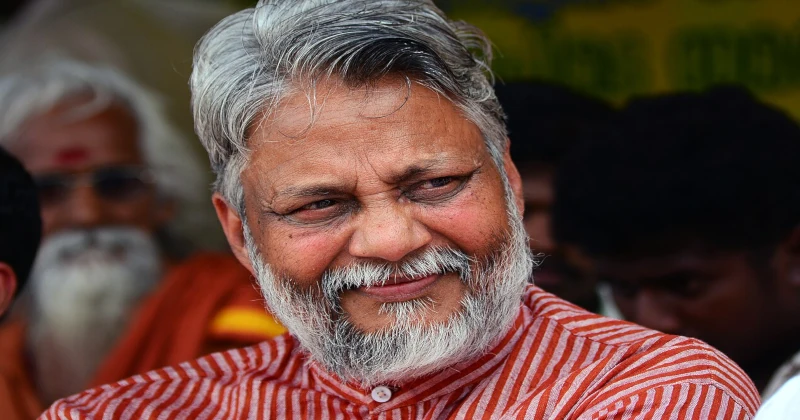
New Delhi: As concerns over water scarcity intensify across the globe, environmentalist Rajendra Singh widely known as ‘Water Baba’ continues to be celebrated as one of India’s foremost champions of water conservation. On his 70th birthday, his decades-long efforts to revive rivers and restore groundwater serve as a reminder of the power of community-driven environmental action.
Born on August 6, 1956, in a village in Uttar Pradesh’s Baghpat district, Rajendra Singh graduated in Ayurveda and later earned a Master’s degree in Hindi. Although he initially moved to Rajasthan for employment, his journey took a different turn when he dedicated himself to social service in the drought-prone Alwar region.
Inspired by the ideals of Jayaprakash Narayan during his student years, Singh founded the Tarun Bharat Sangh in 1975 to assist victims of a fire at the Rajasthan University campus. A defining moment came during a visit to a village in Alwar, where an elderly resident challenged him to stop making speeches and instead help the village by bringing water back to its fields.
6 अगस्त/जन्म-दिवस
पानीबाबा राजेन्द्र सिंह
इन दिनों विश्व पानी की समस्या से जूझ रहा है। लोग अपनी आवश्यकता से बहुत अधिक पानी प्रयोग कर रहे हैं। अत्यधिक भौतिकता के कारण पर्यावरण को बहुत हानि हो रही है। हिमनद सिकुड़ रहे हैं और गंगा-यमुना जैसी सदानीरा नदियाँ सूख रही हैं। कुछ…
— Rashtra Sevika Samiti Delhi Prant (@sevikasamiti) August 5, 2026
Accepting the challenge, Singh picked up a shovel and began constructing traditional rainwater harvesting structures known as johads. What started as a small initiative soon became a mass movement, with villagers joining hands to restore their local water systems.
Over the years, Singh and the Tarun Bharat Sangh helped build around 4,500 johads, significantly improving groundwater levels across Alwar and seven adjoining districts. According to the organisation, the region’s water table rose by 60 to 90 feet, while rivers including the Arvari, Bhagani, Sarsa, Jahajwali, and Ruparel were revived after years of decline.
The impact extended beyond water conservation. Improved groundwater availability encouraged the return of families who had migrated due to recurring droughts, boosted agricultural productivity, strengthened local economies, and supported the cultivation of fruits, vegetables, and medicinal plants. Better water availability also contributed to improvements in livestock health and helped reduce unemployment and malnutrition in the region.
One of the most remarkable aspects of Singh’s work has been his reliance on traditional, community-based water conservation methods rather than expensive modern technologies. His model has since drawn the attention of environmentalists, policymakers, researchers, and students from India and abroad, who visit Rajasthan to study the revival efforts.
Singh’s contribution to environmental conservation has earned him several honours, including the prestigious Ramon Magsaysay Award. His work has often been cited as an example of how indigenous knowledge and community participation can offer sustainable solutions to contemporary ecological challenges.
His journey, however, has not been without obstacles. According to accounts shared by the Rashtra Sevika Samiti, Singh faced resistance from sections of the administration, political interests, and land mafias. Despite legal battles and repeated challenges, he continued his campaign for water conservation and river rejuvenation.