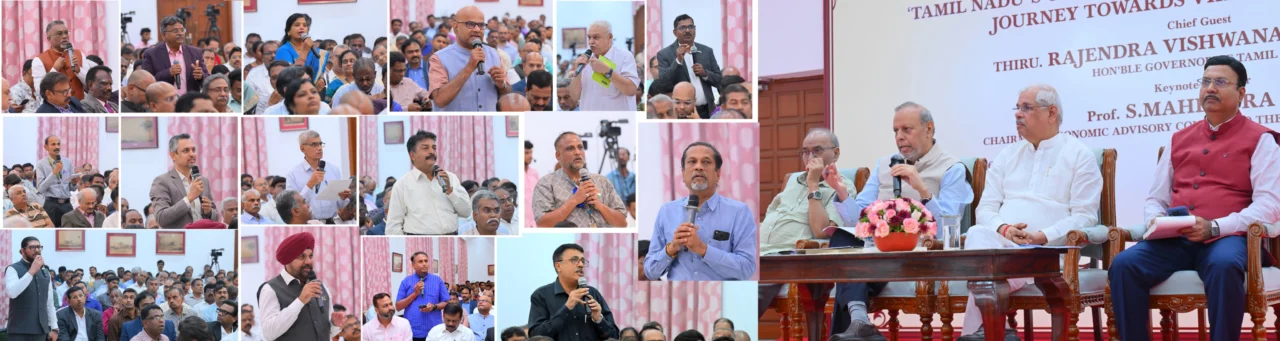
Tamil Nadu can achieve a $1 trillion economy by 2033–34 if it sustains a 9 per cent annual growth rate, Prime Minister’s Economic Advisory Council (PM-EAC) member Prof. Mahendra Dev said while addressing a seminar on Tamil Nadu’s Growth and Employment Agenda on the Journey towards Viksit Bharat@2047 at Lok Bhavan on June 29. He said the State has a pivotal role in India’s transition towards a developed economy by 2047 and stressed that sustained economic growth must be complemented by employment generation, skill development and inclusive development.
In his opening address, Tamil Nadu Governor Rajendra Viswanath Arlekar said, “This is the first time Lok Bhavan is holding this type of seminar, with lectures and participation from economists, industrialists, chartered accountants, top public sector executives and trade bodies to discuss, debate and deliberate on our economic policies, development agenda and the impediments to them.”
He said Bharat was once perceived and treated as a poor and underdeveloped nation after it was freed from the shackles of colonial rule. “But today we are a developed nation.”
Hon’ble Governor of Tamil Nadu, Thiru. Rajendra Vishwanath Arlekar, presided over the seminar on “Tamil Nadu’s Growth and Employment Agenda on the Journey towards Viksit Bharat@2047,” held at Bharathiar Mandapam, Lok Bhavan, Chennai, today (29.06.2026).
In his inaugural address,… pic.twitter.com/aH75KEOzwh— LOK BHAVAN, TAMIL NADU (@lokbhavan_tn) June 29, 2026
The Governor said, “Bharat is attempting to transition from a developing to a fully developed economy by 2047, the centenary year of its Independence. This national vision, often termed Viksit Bharat 2047, seeks to transform the country into a high-income nation by boosting per capita income and eradicating poverty.”
India aims for a Gross Domestic Product (GDP) of between $30 trillion and $40 trillion by 2047, which requires a concomitant increase in per capita income to between $15,000 and $18,000. Achieving this demands a sustained annual economic growth rate of 7–8%.
The Governor announced that hereafter there would be monthly programmes at Lok Bhavan. “It will be beneficial for all to design and formulate ideas that would help the State achieve economic growth and employment generation. Tamil Nadu has a vital role and the potential to achieve strong economic growth.”
JOIN US LIVE FOR THE “TAMIL NADU’S GROWTH AND EMPLOYMENT AGENDA ON THE JOURNEY TOWARDS VIKSIT BHARAT@2047” – CHIEF GUEST – THIRU. RAJENDRA VISHWANATH ARLEKAR, HON’BLE GOVERNOR OF TAMIL NADU , WILL PRESIDE OVER THE FUNCTION AND KEYNOTE ADDRESS BY GUEST OF HONOUR PROF. S.…
— LOK BHAVAN, TAMIL NADU (@lokbhavan_tn) June 29, 2026
Prof. Mahendra Dev, in his keynote address, said that Tamil Nadu has a pivotal role to play. He highlighted the country’s historical transition into the global economy, its strengths and technological changes. At a time when the global economy faces uncertainties, India has maintained steady yet among the fastest growth rates with consistency (7.3% per annum) and an inflation rate of 5.1%, even when crude oil prices are at $95 per barrel. India is pursuing inclusive growth, quality employment and human development alongside sustainable growth. “What will be needed 21 years from now? What type of technology, labour and employment requirements? Export growth, FDI, urbanisation, urban population, competitive and quality export products. This is needed under the collaborative federalism system. Tamil Nadu has a great role to play here.”
Mahendra Dev said, “India’s aspiration to become a developed nation by 2047 (Viksit Bharat) places renewed emphasis on the twin objectives of sustained economic growth and productive employment generation. As one of India’s most industrialised and socially progressive States, Tamil Nadu occupies a strategic position in this national transformation. With a diversified industrial base, strong human development achievements, relatively high levels of education and skills, and a proactive policy framework, the State offers valuable insights into how economic growth can be translated into employment opportunities and improved living standards.”
He said, “Tamil Nadu’s development experience demonstrates the importance of combining industrialisation, social development, infrastructure investment and human capital formation to achieve inclusive growth. The State’s achievements in manufacturing, services, healthcare, education and social welfare provide important lessons for other regions seeking to accelerate development while ensuring broad-based participation in its benefits.”
Listing several challenges, Prof. Mahendra Dev said, “Labour market informality remains significant, regional disparities persist between urban and rural areas, and skill mismatches have emerged in the context of rapidly changing technologies and evolving industrial requirements. Enhancing the participation of women, youth and socially disadvantaged groups in productive employment remains an important priority.”
He said, “The State also faces a major demographic transition. With fertility rates having fallen below replacement levels, Tamil Nadu is likely to experience a gradual ageing of its population and a slowdown in labour force growth. This raises important questions regarding labour supply, productivity enhancement, skill development, migration policies and social protection systems. Simultaneously, technological advancements, particularly in artificial intelligence and automation, are expected to reshape labour markets and alter the nature of work across sectors.”
The economist said, “The seminar is expected to generate policy-relevant insights on fostering employment-intensive and inclusive growth in Tamil Nadu, while identifying strategies that can contribute to India’s transition towards a developed economy.”
He said, “Tamil Nadu should have a plan for 2047. The State has fixed a $1.5 trillion economy as a target for 2036. Growth should not only be in per capita income but also in aspects such as employment. The State’s contribution towards achieving Viksit Bharat is important as it is one of the fastest-growing economies in the country.”
Dev said, “Tamil Nadu maintained an average growth of 10% between 2005 and 2011, but it fell to around 6% between 2012–13 and 2022–23. Then, over the past two years, it rose once again. In 2024–25, Tamil Nadu registered 11% growth in real GDP. Estimates for 2025–27 show that Tamil Nadu is continuing to grow at 13.15% in nominal terms and 10–11% in real terms.”
He cited a study by renowned economists C. Rangarajan and K.R. Shanmugam. Tamil Nadu’s youth unemployment rate (14%) is higher than the national average of 9.9%. This is because there are more educated youth in Tamil Nadu.
“In a State with fewer educated youth, unemployment may appear lower because people might run tea shops. But in Tamil Nadu, educated youth wait for better jobs, and hence the unemployment rate is higher.”
Prof. Alakh N. Sharma, Director, Institute for Human Development (IHD), New Delhi, and President of the Indian Society of Labour Economics, spoke briefly, adding several conclusive points to those made by the earlier speakers.
When the floor was opened for interaction, delegates offered several suggestions and pointed out shortcomings. One delegate suggested that since successive Dravidian governments were opposed to Navodaya schools, they could instead be established through private participation with government support. This, the delegate said, would help achieve the objectives of Viksit Bharat by creating a quality workforce.