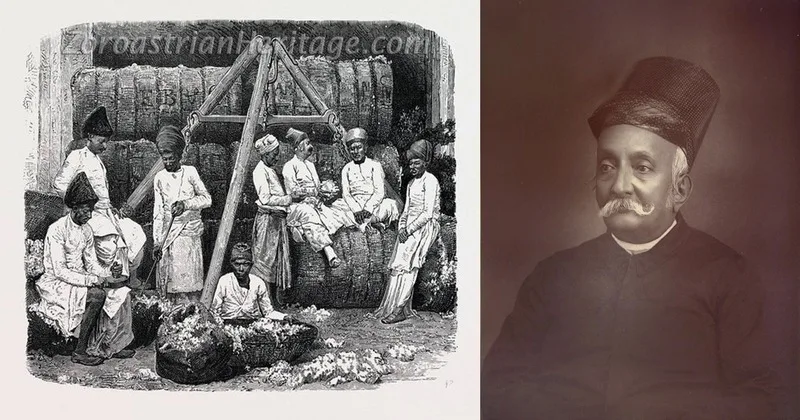
MUMBAI: Born this day (30 June 1823) Sir Dinshaw Maneckji Petit, 1st Baronet occupies a place of enduring honour in the grand narrative of India’s awakening to modernity.
A Parsi entrepreneur of rare vision, philanthropist of immense generosity, and nation-builder through quiet enterprise, he laid foundational stones for India’s modern textile industry at a time when colonial policies aimed to keep the subcontinent as a supplier of raw materials and a captive market for British goods.
Born over two centuries ago, his life exemplifies how individual initiative, rooted in dharma, foresight, and compassion, can transform cities, empower communities, and contribute to the economic self-respect of a nation.
As Mumbai celebrates its industrial heritage, Sir Dinshaw’s contributions continue to resonate as a beacon of Indian resilience and constructive patriotism.
How the Parsi Family Got the Petit Surname
The later extremely affluent and accomplished Parsi family had quite simple and humble beginnings. Dinshaw Maneckji Petit was born on 30 June 1823 in Bombay, British India, to Maneckji Nusserwanjee Petit and Humabai Petit. He had one brother, Nusserwanjee Maneckji Petit.
The family surname carries a delightful colonial anecdote: an ancestor working as a shipping clerk and interpreter for the British East India Company was affectionately called “le petit Parsi” by French merchants because of his short stature and lively personality.
The name became a proud family identity.
In 1837, at the tender age of 14, Dinshaw married Sakarbai Panday. Their union was blessed with 14 children, six sons and eight daughters, many of whom would later extend the family’s legacy across industry, science, education, and public life.
Early in his career, Petit served as a broker to European firms, acquiring deep knowledge of international trade, finance, speculation, and market fluctuations. This experience positioned him perfectly for the opportunities that arose in the 1860s.
Seizing Opportunity: The American Civil War and the Birth of Indian Mills
The American Civil War (1861–1865) disrupted global cotton supplies from the American South, causing prices to soar and creating a massive boom in Bombay. Petit, leveraging his accumulated capital and commercial acumen, transitioned boldly from trading to manufacturing.
He had begun modestly with a cotton gin in 1854. In 1855, he introduced powered looms, a pioneering step, and in 1858 established the Oriental Spinning and Weaving Mill in partnership with his father.
By 1860, he founded the Manockji Petit Spinning & Weaving Mill, named in memory of his father who had passed away the previous year. These were among the earliest successful mechanized textile enterprises in India.
This move was not merely entrepreneurial; it carried profound economic significance.
Weaving Enterprise Into India’s Business Fabric
Colonial policy deliberately positioned India as a supplier of cheap raw cotton for Lancashire’s mills in Manchester. Finished British cloth was then exported back to India, often under protective tariffs that disadvantaged local handloom weavers and drained national wealth.
Petit’s mills quietly, without publicising this accomplishment, reversed this exploitative cycle by processing Indian cotton into yarn and fabric locally.
His enterprises created direct competition to imported Manchester goods, generated thousands of jobs for local workers, stimulated ancillary industries such as dyeing, machine repair, and transport, and retained economic value within the country.
Petit’s success inspired confidence. In 1875, he played a pivotal role in founding the Bombay Mill Owners’ Association, giving Indian industrialists a collective voice.
Under his leadership and that of contemporaries, many from the enterprising Parsi community, the number of cotton mills in Bombay nearly doubled from around 43 to 82 between the mid-1880s and late 1890s.
Bombay evolved from a mere trading port into the “Cottonopolis” or “Lancashire of the East,” a bustling industrial hub powered by natural harbour facilities, proximity to cotton-growing regions in Gujarat and elsewhere, skilled and unskilled labour pools, and visionary capital.
Petit’s mills, along with expansions like the Mazgaon Spinning and Manufacturing Company and others, anchored this transformation.
While he operated within the colonial economic framework and later faced criticism from nationalists for his role in the Legislative Council, his industrial contributions undeniably advanced India’s manufacturing capabilities.
These laid empirical groundwork for later Swadeshi movements and the push for economic self-reliance. Petit was also a pioneer in the dyes industry and introduced steam-powered efficiency, proving that modern industry could thrive on Indian soil despite challenges like raw material quality variations.
A Life of Boundless Philanthropy
For Sir Dinshaw, wealth was never an end but a sacred trust to be used for societal upliftment.
In 1854, even before his major mill successes, he founded the Persian Zoroastrian Amelioration Fund to improve conditions for Zoroastrian brethren in Iran facing persecution and discriminatory taxes like jizya.
The Fund facilitated migration to India, giving rise to the Irani community, and contributed to relief measures. He generously supported Parsi institutions, including fire temples and the Towers of Silence.
His philanthropy was not for Parsis alone
The great that he was, Sir Dinshaw Maneckji Petit was compassionate and had a giving-spirit. His philanthropy transcended the community barriers and tended to the broader civic needs.
Healthcare: He endowed the Bai Sakarbai Dinshaw Petit Hospital for Animals, named after his beloved wife, reflecting compassion for all living creatures. He also contributed to a general hospital (the Petit Hospital), women’s healthcare facilities, and a leper home.
Education: Demonstrating remarkable foresight, he donated premises valued at Rs. 3,00,000 at Byculla to the Victoria Jubilee Technical Institute (VJTI), which the Government of Bombay recognised as the Central Technological Institute.
He further supported the Sir Dinshaw Petit Baronet School for Sheet Metal Working and Enameling within VJTI. He backed women’s education initiatives and vocational training, including industrial arts schools.
Other Causes: Substantial donations to public charities, famine relief efforts, and community welfare projects. Contemporary accounts suggest his total philanthropic contributions ran into several lakhs of rupees.
These acts reflected a holistic vision, strengthening cultural and religious roots while investing in skills, health, and technical education essential for India’s industrial future.
Honours, Family Legacy, and Final Years
Recognised for his contributions, Petit was knighted in 1887. On 1 September 1890, he was created the first Petit Baronet of Petit Hall, Bombay, with special remainder provisions.
He served as a member of the Governor-General’s Legislative Council from 1886 and as Sheriff of Bombay.
He passed away on 5 May 1901 in Bombay at the age of 77. A posthumous portrait by Sir James Linton captured his dignified presence.
His family legacy remains illustrious
Son Bomanjee Dinshaw Petit expanded the business empire.
Granddaughter Mithuben Hormusji Petit participated in the independence movement.
Another granddaughter, Meherbai, was the mother of nuclear scientist Homi J. Bhabha.
Through marital ties, the family connected to the Tata family and others.
Granddaughter Ruttanbai Petit married Muhammad Ali Jinnah; their daughter Dina Wadia became linked to the Bombay Dyeing empire.
Institutions such as the J.B. Petit High School for Girls in Mumbai’s Fort area reflect continued family commitment to education.
Timeless Inspiration
Sir Dinshaw Maneckji Petit’s life offers profound lessons for contemporary India. In an era of colonial extraction, he built industry and employment.
Amid strong community identities, he practised broad-based giving. As Bombay grew, he helped shape it into a city of mills, opportunity, and innovation.
His story reminds us that true patriotism often manifests through creation, factories that hum with productivity, schools that enlighten young minds, hospitals that heal, and institutions that endure across generations.
On his birth anniversary and in the pages of history, India remembers this pioneering son with deep gratitude.
From the rhythmic looms of textile mills to the laboratories of VJTI and the compassionate work of animal hospitals, Sir Dinshaw’s legacy weaves seamlessly into Mumbai’s, and Bharat’s, journey of progress and self-reliance.
May his example continue to inspire entrepreneurs, educators, philanthropists, and builders who dream of a stronger, more prosperous, and self-confident India.