Alongside the resolve to transform the nation into a ‘Viksit Bharat’ by 2047, the Modi government at the Centre is now decisively advancing the goal of a “Drug-Free India.” Recognising drug trafficking as a grave threat to national security, social stability and the future of the youth, the government has formulated a comprehensive strategy.
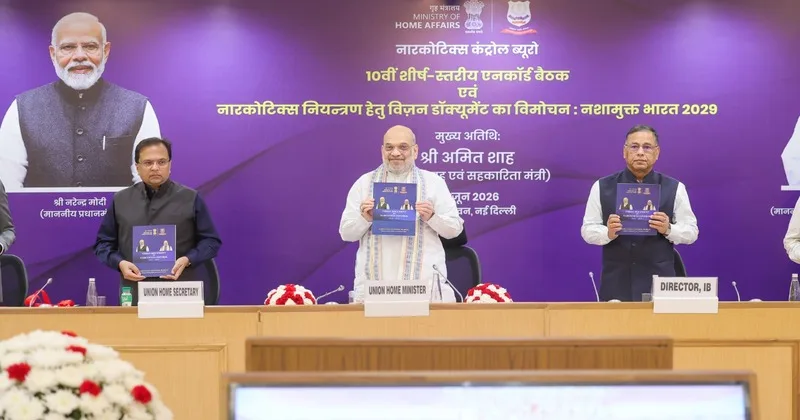
In fact, the “Drug Control Vision Document 2026-2029”, released by Union Home and Cooperation Minister Amit Shah during the 10th apex-level meeting of the Narco-Coordination Centre (NCORD), has emerged as the government’s most significant initiative in this direction. Its objective is to make India drug-free by simultaneously striking at the entire drug ecosystem: production, trafficking, financing, distribution and consumption.
Union Home Minister Amit Shah stated clearly, “The next three years will determine whether India triumphs over drugs or drugs triumph over society. With this perspective, the government has prepared a clear roadmap for the period from 2026 to 2029. It places equal emphasis on modern technology, financial investigation, border security, social awareness, rehabilitation and coordination among states.” He added, “The core mantra of the government’s new strategy is ‘Detect, Disrupt, and Destroy.’ The aim is not merely to intercept drug consignments but to completely dismantle the entire network, including its financial sources, international connections, and kingpins.”
Our roadmap for the fight against drugs is built on four pillars:
➡️ Enforcement, Intelligence & Operations
➡️ Precursor & Synthetic Drug Control
➡️ Demand Reduction & Rehabilitation
➡️ Capacity Building & Coordination pic.twitter.com/MUIvZxjNyd— Amit Shah (@AmitShah) June 26, 2026
The first phase of this strategy is ‘Detect,’ under which drug networks will be identified. This will involve the extensive use of human intelligence, technical intelligence, crime mapping, community policing and modern surveillance systems. The second phase is ‘Disrupt,’ which focuses on breaking the entire drug trafficking supply chain midway. The network will be dismantled through legal action targeting the hawala network, the darknet, cryptocurrency-based payments, transit routes and financial mechanisms. The third and most critical phase is ‘Destroy’. Its objective goes beyond merely arresting low-level smugglers; it aims to permanently eliminate entire drug cartels, their kingpins and their financial sources, ensuring the network cannot regroup.
The entire action plan rests on four pillars.
The government’s vision document is based on four key pillars. The first pillar comprises enforcement, intelligence and operations, involving targeted actions based on intelligence inputs. The second pillar focuses on the control of precursor chemicals and synthetic drugs; monitoring of chemicals used in synthetic drug manufacturing will be strengthened and strict controls will be enforced to prevent their misuse.
The third pillar addresses demand reduction and rehabilitation. The government will not limit itself to curbing drug supplies but will place equal emphasis on reducing the demand for drugs in society, raising awareness and rehabilitating those caught in the grip of addiction. The fourth pillar focuses on capacity building, coordination and monitoring, empowering central and state agencies through modern technology, enhanced training, and accountable systems.
मेरा सभी मुख्य सचिवों और पुलिस प्रमुखों से आग्रह है कि हम NCORD की बैठकों को परिणाम-लक्षी बनाने की दिशा में आगे बढ़ें। बैठकों की संख्या निश्चित रूप से बढ़ रही है, लेकिन यह भी आवश्यक है कि वे परिणाम-लक्षी हों। क्या बैठकों में लिए गए निर्णयों पर प्रभावी ढंग से अमल होता है? क्या…
— Office of Amit Shah (@AmitShahOffice) June 26, 2026
Strict Action Against Drug Mafias, Sensitivity Towards Affected Youth
Home Minister Amit Shah clarified that the government would adopt a dual-pronged policy. While “ruthless” action will be taken against criminals involved in the drug trade, a sensitive and empathetic approach will be adopted towards the youth who have fallen victim to drug addiction. In line with this vision, de-addiction centers, rehabilitation services, and counseling mechanisms will be strengthened.
Major Strike on Economic Networks
The vision document clearly states that illegal assets, bank accounts, ‘hawala’ networks, crypto transactions and other financial sources generated through drug trafficking will be completely dismantled. Financial investigations in major NDPS cases will be accorded top priority. The role of financial agencies, including the Enforcement Directorate (ED), will become even more critical to ensure the complete breaking of the drug mafia’s economic backbone.
States to Play a More Pivotal Role
The Central Government has directed all states to develop Anti-Narcotics Task Forces (ANTFs) into full-time, well-resourced, and accountable units. NCORD meetings held at district and state levels will be made result-oriented rather than mere formalities. Special emphasis has been placed on robust charge-sheeting, the appointment of special public prosecutors and enhanced coordination among agencies.
रियल-टाइम सूचना साझाकरण (Real-Time Sharing) को हमें हर हाल में सुनिश्चित करना होगा। इसके लिए NCB ने अनेक पोर्टल विकसित किए हैं। मेरा सभी मुख्य सचिवों और पुलिस प्रमुखों से आग्रह है कि अपने-अपने राज्यों में अपराधों का विवरण इन पोर्टलों पर समयबद्ध तरीके से अपलोड कराएं। इससे भारत…
— Office of Amit Shah (@AmitShahOffice) June 26, 2026
Special Courts to Expedite Trials
Addressing the issue of drug-related cases remaining pending for years, the document emphasizes the establishment of special NDPS courts. States have been urged to set up these special courts in consultation with High Courts to ensure regular hearings for major cases and the speedy sentencing of the guilty.
Special Focus on Darknet, Drones, and Crypto
The government has acknowledged the rapidly evolving nature of drug trafficking. Channels such as drones, the darknet, online delivery services, maritime routes, container-based smuggling and cryptocurrency have emerged as new threats. In response, the vision document outlines plans to strengthen dark web monitoring, real-time data sharing, AI-based analysis, technical intelligence mechanisms, and modern surveillance systems. Additionally, the roles of agencies like NATGRID, NCRB, I4C and NFSU will be expanded.
Strengthening Surveillance from Villages to Borders
Moving beyond merely enhancing surveillance at international borders, the government is set to develop a comprehensive monitoring network extending to border villages, ports, airports, railway stations and sensitive districts. Drug networks will be identified and acted upon in a timely manner through community policing, human intelligence, technical intelligence, and crime mapping.
आज हमारा देश नारकोटिक्स के खिलाफ लड़ाई के ऐसे नाज़ुक मोड़ पर खड़ा है कि आने वाले तीन वर्ष यह तय करेंगे कि नशा हम पर विजय प्राप्त करेगा या हम नशे पर विजय प्राप्त करेंगे। देश के आने वाले 100 वर्षों के भविष्य के लिए हमें यह संयुक्त रूप से दृढ़ता से लड़ना चाहिए। इसके लिए सभी सरकारों…
— Office of Amit Shah (@AmitShahOffice) June 26, 2026
Societal Participation: The Campaign’s Strength
Home Minister Amit Shah believes that the police or investigative agencies alone cannot win the fight against drug abuse; therefore, parents, teachers, educational institutions, youth organizations, voluntary bodies and various ministries will be made active participants in this campaign. Nationwide initiatives, including “Drug-Free Campus” and “Drug-Free Zone” programs, alongside extensive public awareness drives, will be launched to keep the youth away from drugs.
Launch of the Largest Drug Destruction Campaign
During the NCORD meeting, Home Minister Amit Shah also launched an “Online Drug Disposal Fortnight Campaign.” This campaign aims to destroy approximately 209,500 kilograms of narcotics valued at over ₹6,000 crore. Considered the country’s largest-ever drug destruction drive, it ensures that seized narcotics do not find their way back into the illicit market.
वर्ष 2004 से 2014 तक के दस वर्षों में 26 लाख किलोग्राम सिंथेटिक ड्रग्स जब्त किए गए थे। वहीं, वर्ष 2014 से 2026 तक हमने 1 करोड़ 18 लाख किलोग्राम सिंथेटिक ड्रग्स जब्त किए हैं। यह दर्शाता है कि हमारा अभियान सफलता की दिशा में निरंतर आगे बढ़ रहा है।
वर्ष 2004 से 2014 के दौरान जब्त किए…— Office of Amit Shah (@AmitShahOffice) June 26, 2026
Statistics Reveal a Shifting Landscape of Enforcement
According to the government, between 2004 and 2014, 2.6 million kilograms of narcotics worth approximately ₹40,000 crore were seized. In contrast, between 2014 and 2026, this figure rose to 11.8 million kilograms of narcotics valued at Rs 1.84 lakh crore. A significant increase was also recorded in the destruction of seized drugs during this period. While 326,000 kilograms of narcotics worth about Rs 8,000 crore were destroyed between 2004 and 2014, 4.247 million kilograms worth Rs 89,896 crore were destroyed between 2014 and 2026.
The scale of enforcement can also be gauged by the fact that while approximately 173,000 cases were registered during 2004–2014, over 875,000 cases were registered and more than 1.097 million accused individuals were arrested between 2014 and 2026.
Crackdown on Illegal Cultivation
The drug menace is not limited to trafficking alone; the government has also intensified its campaign against the illegal cultivation of opium and other narcotic crops. While approximately 10,000 acres of illegal opium cultivation were destroyed in 2020, this figure rose to 42,282 acres by 2025. This clearly indicates that the government is now pursuing a strategy to disrupt the supply chain at its very inception by taking action at the source of production.
Narco-terror will be crushed with the principle of Detect, Disrupt and Destroy. pic.twitter.com/oAKrzIERwf
— Amit Shah (@AmitShah) June 26, 2026
Focus on Kingpins Based Abroad
The government has made it clear that the process of bringing drug traffickers and gangsters hiding abroad within the ambit of the law will be accelerated. A strategy has been devised to intensify pressure on internationally active drug syndicates through measures such as Red Corner Notices, extradition proceedings, and the involvement of central agencies.
The fight against drugs reaches a decisive stage
In this context, the “Narcotics Control Vision Document 2026-2029” serves as a blueprint for the country’s comprehensive strategy for the coming years. Record seizures, widespread arrests, crackdowns on illicit cultivation, technology-driven surveillance and improved coordination with states over the past decade signal that the central government has placed the campaign against drugs among its top priorities. The government’s objective is to completely dismantle the entire narco-network, encompassing production, financing, trafficking, distribution, and the kingpins, associated with drug consignments.