Bharat strengthening global south leadership
August 6, 2026
  • Read Ecopy
  • Circulation
  • Advertise
  • Careers
  • About Us
  • Contact Us
Android AppiPhone AppArattai
Organiser
  • ‌
  • Bharat
    • Assam
    • Bihar
    • Chhattisgarh
    • Jharkhand
    • Maharashtra
    • View All States
  • World
    • Asia
    • Europe
    • North America
    • South America
    • Africa
    • Australia
  • Editorial
  • International
  • Opinion
  • RSS @ 100
  • More
    • Op Sindoor
    • Analysis
    • Sports
    • Defence
    • Politics
    • Business
    • Economy
    • Culture
    • Special Report
    • Sci & Tech
    • Entertainment
    • G20
    • Azadi Ka Amrit Mahotsav
    • Vocal4Local
    • Web Stories
    • Education
    • Employment
    • Books
    • Interviews
    • Travel
    • Law
    • Health
    • Obituary
  • Subscribe
    • Subscribe Print Edition
    • Subscribe Ecopy
    • Read Ecopy
  • ‌
  • Bharat
    • Assam
    • Bihar
    • Chhattisgarh
    • Jharkhand
    • Maharashtra
    • View All States
  • World
    • Asia
    • Europe
    • North America
    • South America
    • Africa
    • Australia
  • Editorial
  • International
  • Opinion
  • RSS @ 100
  • More
    • Op Sindoor
    • Analysis
    • Sports
    • Defence
    • Politics
    • Business
    • Economy
    • Culture
    • Special Report
    • Sci & Tech
    • Entertainment
    • G20
    • Azadi Ka Amrit Mahotsav
    • Vocal4Local
    • Web Stories
    • Education
    • Employment
    • Books
    • Interviews
    • Travel
    • Law
    • Health
    • Obituary
  • Subscribe
    • Subscribe Print Edition
    • Subscribe Ecopy
    • Read Ecopy
Organiser
  • Home
  • Bharat
  • World
  • Operation Sindoor
  • Editorial
  • Analysis
  • Opinion
  • Culture
  • Defence
  • International Edition
  • RSS @ 100
  • Magazine
  • Read Ecopy
Home Bharat

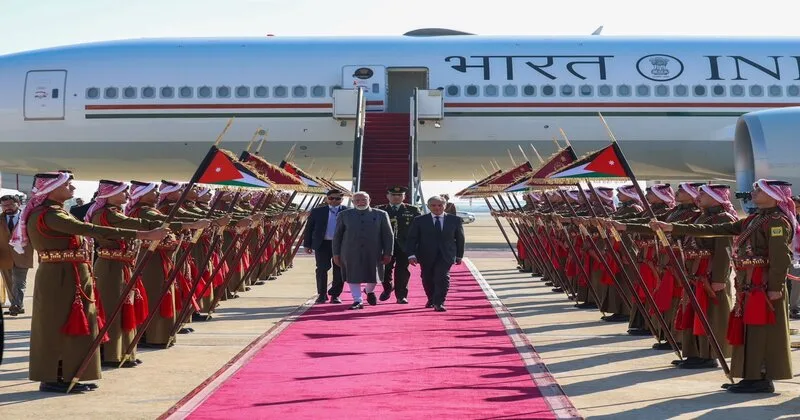
Bharat strengthening global south leadership through Africa, West Asia

At a time of shifting global power equations and growing demands for equitable representation, the outreach to West Asia and Africa highlighted New Delhi’s intent to strengthen political trust, expand economic cooperation, and reinforce people-to-people ties through a partnership-driven approach rooted in mutual respect, development, and strategic autonomy

Anubha MishraAnubha Mishra
Dec 16, 2025, 09:20 pm IST
inBharat, World, West Asia, Africa
Follow on Google News
Fostering South-South Partnership through West Asia and Africa

Fostering South-South Partnership through West Asia and Africa

Facebook
Twitter
WhatsAppTelegramEmail

The Prime Minister’s visit to Jordan and Ethiopia marked a significant moment in India’s evolving engagement with the Global South, reflecting a diplomatic approach that combines historical solidarity with contemporary strategic interests. At a time when global power structures are in flux and developing nations seek greater voice in international decision-making, India’s outreach to West Asia and Africa underscores its aspiration to act as a credible partner rather than a prescriptive power. The visits highlighted India’s intent to strengthen political trust, expand economic cooperation, and deepen people-to-people ties, while reinforcing a shared developmental narrative rooted in mutual respect and non-interference.

Jordan occupies a unique position in West Asia, acting as a bridge between regions often marked by instability. The Prime Minister’s engagement with Jordan reaffirmed India’s long-standing ties with the Arab world, grounded in civilizational exchanges, trade links, and cultural interaction. Jordan’s role as a moderate and stabilizing force in the region aligns with India’s own emphasis on dialogue, restraint, and peaceful coexistence. Discussions during the visit focused on political cooperation, counterterrorism, and regional security, areas where both countries face overlapping challenges. India’s approach emphasized cooperation without militarization, highlighting its preference for stability through institutional strengthening and inclusive governance.

Economic engagement formed a central pillar of the India-Jordan dialogue. The Prime Minister’s visit sought to expand bilateral trade, particularly in pharmaceuticals, information technology, fertilizers, and renewable energy. Jordan’s strategic location offers Indian businesses access to broader West Asian and Mediterranean markets, while Indian expertise in affordable healthcare and digital infrastructure aligns well with Jordan’s development priorities. This economic partnership reflects India’s broader Global South strategy of promoting sustainable growth through capacity building and technology sharing rather than extractive economic models.

Cultural and educational cooperation further reinforced the bilateral relationship. India’s soft power, expressed through yoga, traditional medicine, and academic exchanges, has found resonance in Jordan. The Prime Minister’s emphasis on civilizational links and shared values projected India as a nation that values cultural plurality and historical continuity. Such engagement strengthens people-to-people connections, which remain a durable foundation for long-term diplomatic relations, especially within the Global South where historical memory of colonial exploitation continues to shape political consciousness.

The visit to Ethiopia carried even greater symbolic and strategic significance. Ethiopia is not only one of Africa’s oldest civilizations but also the seat of the African Union, making it central to continental diplomacy. By engaging Ethiopia at the highest level, India signaled its commitment to Africa as a whole, rather than limiting its outreach to resource-driven or narrowly commercial interests. The visit aligned with India’s vision of Africa as a partner in shaping global governance rather than a passive recipient of aid or investment.

India’s historical relationship with Ethiopia dates back to shared anti-colonial experiences and cooperation within the Non-Aligned Movement. The Prime Minister’s visit revitalized this legacy by focusing on contemporary priorities such as infrastructure development, defence cooperation, education, and healthcare. Indian lines of credit, capacity-building programs, and development partnerships in Ethiopia illustrate India’s model of development cooperation, which emphasizes local ownership and long-term sustainability. This approach contrasts with debt-intensive or politically conditional models often criticized within the Global South.

Trade and investment featured prominently in discussions with Ethiopian leadership. India is among the largest foreign investors in Ethiopia, particularly in manufacturing, agriculture, and textiles. The Prime Minister’s visit aimed to encourage further private sector participation while addressing challenges faced by Indian businesses operating in the region. By advocating stable policy frameworks and skill development, India positioned itself as a partner invested in Ethiopia’s industrial transformation and employment generation, rather than short-term profit extraction.

The Ethiopia visit also reinforced India’s role as a voice for the Global South in multilateral forums. As Africa seeks greater representation in global institutions, India’s consistent advocacy for reforms in the United Nations Security Council and international financial institutions resonates strongly across the continent. The Prime Minister reiterated India’s support for Africa’s demand for equitable representation, reflecting a shared belief that global governance structures must evolve to reflect contemporary realities rather than post-war hierarchies.

Together, the visits to Jordan and Ethiopia highlighted India’s balanced diplomacy across regions, linking West Asia and Africa through a common Global South framework. India’s engagement strategy emphasizes dialogue, development, and dignity, seeking partnerships that are responsive to local priorities. This approach enhances India’s credibility as a nation that understands the developmental challenges of post-colonial societies and offers cooperation without coercion. The visits also demonstrated India’s ability to engage diverse political systems while maintaining strategic autonomy and principled foreign policy positions.

In a broader sense, the Prime Minister’s visits reinforced India’s emerging role as a bridge between developing nations and the wider international system. By engaging Jordan and Ethiopia, India showcased its capacity to operate across geopolitical divides while remaining anchored in Global South solidarity. These visits were not isolated diplomatic events but part of a sustained effort to reshape international engagement through inclusivity and shared growth. As global uncertainties persist, India’s outreach to Africa and West Asia strengthens its claim to leadership rooted in partnership, responsibility, and a collective vision for a more equitable world order.


Topics: PM Narendra ModiGlobal SouthEthiopia
Share
Tweet
SendShareSend
✮ Subscribe Organiser YouTube Channel. ✮
✮ Join Organiser's WhatsApp channel for Nationalist views beyond the news. ✮
Previous News

Indigo Crisis: Indi’s No-Go Zone

Next News

Kerala: Post-poll violence, internal dissent rock CPM after Kerala local body results, as BJP makes historic inroads

Related News

August 5 Milestones: Article 370 revocation and Ram Mandir Bhoomi Pujan

Kashmir Unbound: A New Dawn After Article 370

Jagannath Puri Rath Yatra

Odisha CM Mohan Majhi seeks centre’s support for UNESCO Heritage tag for Puri Rath Yatra

PM inaugurates Viveka Memorial, Swami Vivekananda Cultural Centre in Mysuru; says youth are India’s greatest strength

PM Narendra Modi

‘Guide them, don’t punish them’: PM Modi on youth who abused him and his mother during CJP protest at Jantar Mantar

PM Modi's Late-Night Instagram Reel Sets World Record with 303 Million Views,

Mass Connect Continues: PM Modi’s Instagram reel sets a new 24-hour world record with 303 million views

Load More

Latest News

The Indian Silambam team, which won 29 medals at the International Open Championship in Malaysia, arrives in Chennai

Silambam Glory on Global Stage: Team India Clinches 29 Medals Ancient Martial Art wins applause at Int’l championship

Tamil Nadu: Hindu Munnani slams TVK Budget over Quaide Milleth award and Jerusalem subsidy

Former Bangladesh PM Sheikh Hasina

Former Bangladesh PM Sheikh Hasina at FCC Delhi: ‘Whatever fate awaits me, will return to my people’ – Full Speech

Central Sanskrit University Signs MoU with Thailand's Silpakorn University to Promote Sanskrit and Indian Knowledge System

Central Sanskrit University signs MoU with Thailand’s Silpakorn University to expand Sanskrit studies globally

Zuckerberg Apologises Over PM Modi Video, Meta Faces Fresh Scrutiny

Meta under fire over content manipulation: Mark Zuckerberg apologises over PM Modi video row, CSAM & deepfake lapses

The Amritsar arrests expose a troubling new face of proxy warfare, low-cost, digitally recruited and built around vulnerable young recruits (AI generated image)

Amritsar Arrests Expose the New Face of Proxy War: Petrol bombs, online handlers & vulnerable teen recruits

CPM cadre convicted by Court

Keralam: CPM cadres get 16-year jail term for bid to murder RSS karyakartas in 2018 Panoor case

Tamil Nadu Finance Minister N. Marie Wilson presented the first Budget of the TVK government in Assembly on August 5, 2026

Tamil Nadu: TVK’s first Budget projects Rs 16,000 crore additional revenue, announces welfare push

India’s global crackdown on fugitives has intensified, with 274 offenders brought back from 36 countries since 2019 (AI generated image)

From Vijay Mallya to Tahawwur Rana: India’s global pursuit of fugitives brings 274 offenders back from 36 countries

SDPI National General Secretary Riyaz Parangipete

Karnataka Hate Speech Case: SDPI’s Riyaz Parangipete convicted in 11-year-old case, PFI links back in focus

Load More
  • Privacy
  • Terms
  • Cookie Policy
  • Refund and Cancellation
  • Delivery and Shipping

© Bharat Prakashan (Delhi) Limited.
Tech-enabled by Ananthapuri Technologies

  • Home
  • Search Organiser
  • Bharat
    • Assam
    • Bihar
    • Chhattisgarh
    • Jharkhand
    • Maharashtra
    • View All States
  • World
    • Asia
    • Africa
    • North America
    • South America
    • Europe
    • Australia
  • Editorial
  • Operation Sindoor
  • Opinion
  • Analysis
  • Defence
  • Culture
  • Sports
  • Business
  • RSS @ 100
  • Entertainment
  • More ..
    • Sci & Tech
    • Vocal4Local
    • Special Report
    • Education
    • Employment
    • Books
    • Interviews
    • Travel
    • Health
    • Politics
    • Law
    • Economy
    • Obituary
  • Subscribe Magazine
  • Read Ecopy
  • Advertise
  • Circulation
  • Careers
  • About Us
  • Contact Us
  • Policies & Terms
    • Privacy Policy
    • Cookie Policy
    • Refund and Cancellation
    • Terms of Use

© Bharat Prakashan (Delhi) Limited.
Tech-enabled by Ananthapuri Technologies