India’s success story in the space sector is indeed a testimonial for the global space aspirations to envision, build and achieve incredible milestones. The space saga of India resonates remarkable feats from Mangalyan to Chandrayan-3 to the foreseeable ambitious Gaganyan and Shukrayan(Human space flight and mission to Venus respectively), that has set global examples and has carved India a place in the club of elite nations as it has achieved phenomenal benchmarks in the space sector.
In this path of seeking a solid global footprint in the space sector, the most pivotal pillar or the roadmap in India’s space policy is seeking self-reliance and consolidating a sound privatisation of the space paradigm. Today, India has marked a remarkable breakthrough in this direction. Prime Minister Narendra Modi has unveiled Vikram 1, country’s maiden private launch vehicle to the Low Earth Orbit(LEO).
Vikram 1 is India’s maiden orbital rocket developed by a Hyderabad-based private space agency called Skyroot Aerospace. Meanwhile, the Prime Minister also inaugurated the space agency’s Infinite Campus in Hyderabad. “India has created its own insignia in the space sector through credibility, capacity and value. India possesses capabilities in the space sector that few nations in the world possess. In just the last six to seven years, India has transformed its space sector into an open, cooperative and innovative driven ecosystem”, the Prime Minister asserted. India’s space sector with its immense potential and innovative remarks is also emerging as an attractive destination for the global investors, PM Modi affirmed.
“Today, over 300 Indian space start-ups are giving new hopes to India’s space future. Most of these space start-ups began with small teams, sometimes two people, sometimes five, sometimes in a small rented room, with limited resources, but with the determination to reach new heights”, PM Modi further said.
A historic moment unfolds, the portal to Infinity is opening 🌌
We are honoured to have the Hon’ble Prime Minister @narendramodi inaugurate India’s Largest Private Rocket Factory and unveil India’s First Private Commercial Rocket 🚀 https://t.co/EJ1tyYqDYL
— Skyroot Aerospace (@SkyrootA) November 27, 2025
During his address Prime Minister Modi also hailed the incredible zeal and achievement of the founders of the Skyroot Aerospace Pawan Chandana and Bharat Daka and appreciated them as “big inspiration for the youth of the country”. The achievements of the private space agencies such as Skyroot is a testament to the direct impact of the reforms initiated by the government of India that has encouraged and catalysed the growth of private enterprises in the domain of space, innovation and emerging technologies.
Vikram 1: The valour of India’s first private space rocket
The state-of-the-art Vikram 1 launch vehicle is named after the legendary space pioneer of India Vikram Sarbhai. Its predominant features include:
- Four stage rocket/launch vehicle, which uses solid fuel for the first three stages and uses a hypergolic liquid for the upper stage, which helps for swift and precise orbital adjustment thus places the satellite in the exact target orbit with role control and small firing
- Targets launching satellites to Low Earth Orbit(LEOs)
- Vikram 1 launch vehicle is capable of placing upto 350kgs of satellite into the low earth orbit and 260kgs into the sun-synchronous orbit(SSO)
- It is 20 metre tall and has a diameter of 1.7 metres, equivalent to a seven-storied building
- Can place multiple satellites into the Low Earth Orbit(LEO) simultaneously
- Has all carbon composite structure/all carbon-fibered body and is light-weight with 1200kN of thrust
- Flexible, composite, reliable, quick-reverse and light-weight in nature thus enabling assembly, integration and launch from the launch site within 24 hours.
Emerging and cutting-edge technologies imbibed in Vikram 1
- The launch vehicle is ingrained with 3D printed engines that cuts down the weight of the vehicle by half, production time reduced by 80 per cent, thus enabling easier integration, flexible launch and real-time navigation
- The launch vehicle has ultra-low shock pneumatic separation systems and upgraded/cutting-edge avionics that enable easier and real-time navigation.
- Capable of precise and dedicated launches, rideshare missions, deploying satellites into multiple orbits in a single mission
- Has restartable orbital adjustments module
- 94 per cent of the volume of the launch vehicle is filled with propellant and uses submerged nozzle, which is built inside the motor thus has higher efficiency
Vikram 1 was unveiled after a series of tests and trials including Kalam-1200 proof pressure test, payload-fairing separation etc. Skyroot is aiming to launch the first satellite to the Low Earth Orbit(LEO) in early 2026.
The Infinity Campus
This is a state-of-the-art facility spreading over a massive 20,000 square feet of area in the outskirts of Hyderabad institutionalized by Skyroot Space Agency. It is equipped for design, development, integration and testing of the launch vehicles. The infinity campus is well-developed and has the capability to produce one orbital rocket per month.
The brilliant minds behind Skyroot Aerospace
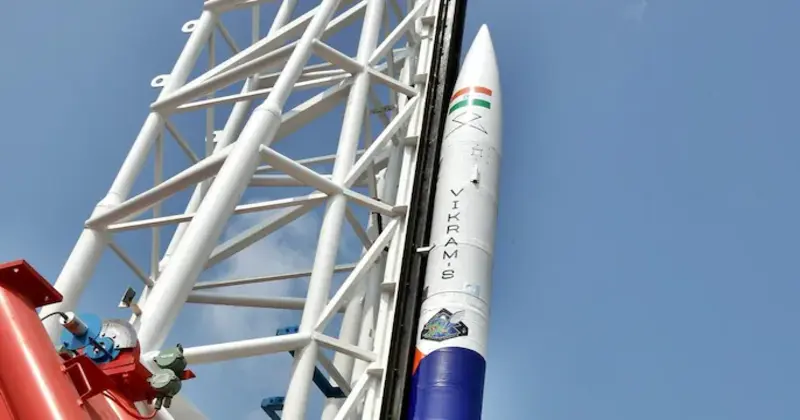
Hyderabad-based private space agency skyroot aerospace was co-founded by Pawan Chandana and Bharat Daka who are the alumni of IIT and former scientists in ISRO. The space agency had hit headlines in 2022, when they launched Vikram-S, India’s maiden privately developed sub-orbital rocket. Now they have yet again grabbed the global attention with the unveiling of Vikram 1. The founders reiterated that they have aim to invest Rs. 1000 crores in order to rapidly develop flexible and light-weight launch vehicles that are globally on demand in the current era.
Skyrocket with its Vikram 1 launch vehicle thus has crafted a history in the emerging small satellite market ecosystem and India with its vast knowledge economy, evolving private space sector with adequate government support and reforms is taking a major chunk in this small satellite network, which is high on demand globally due to its cost-effectiveness, reliability, quick turn-around, light-weight structure and flexibility.