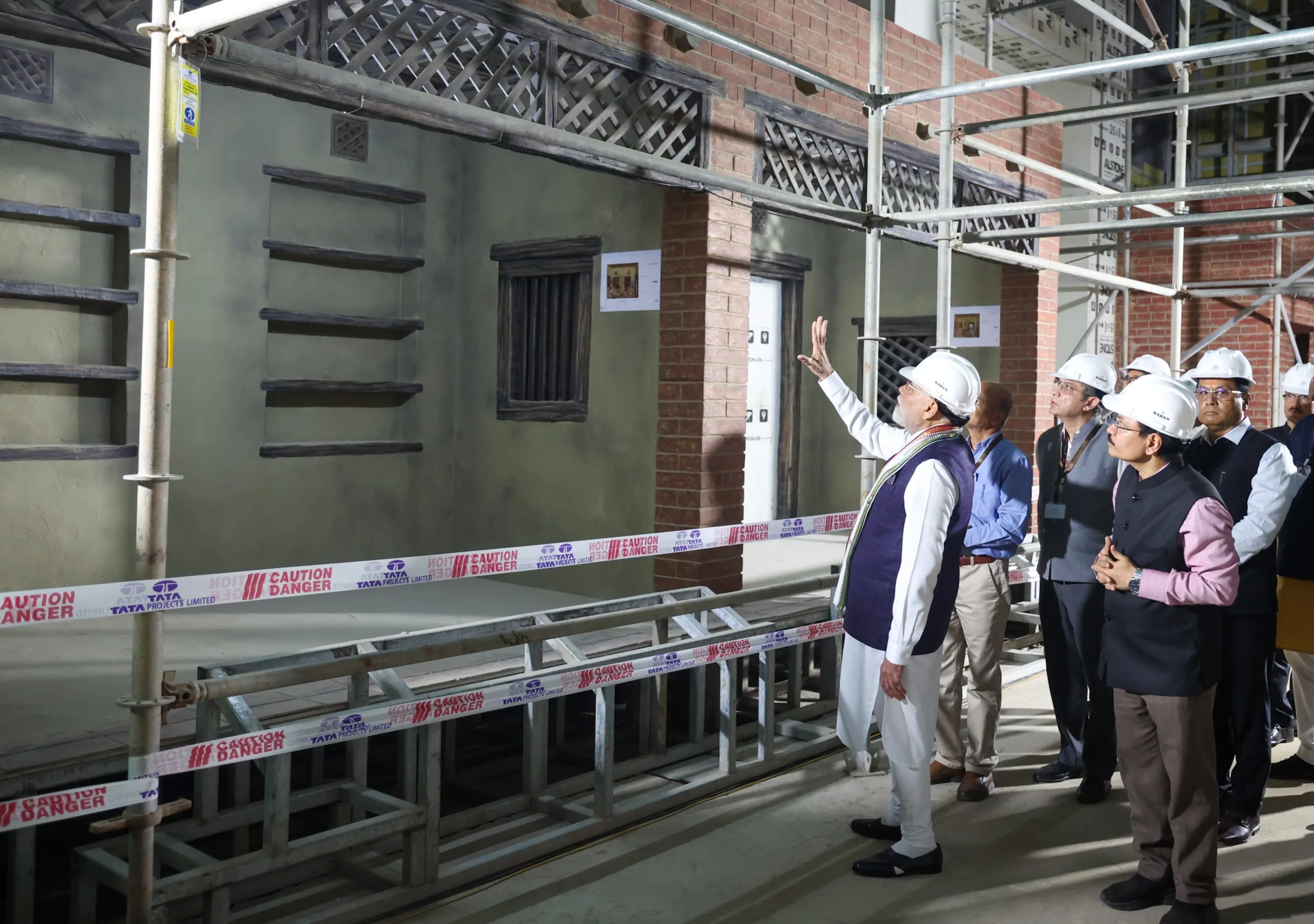
Prime Minister Narendra Modi visited Gujarat on September 20, where one of the central highlights of his itinerary was overseeing the progress of the National Maritime Heritage Complex (NMHC) at Lothal in the Ahmedabad district. Officials confirmed that Modi personally reviewed the site’s construction and chaired a meeting to assess the project’s timeline.
“Reviewed the progress of the National Maritime Heritage Complex at Lothal. Once completed, it will be the world’s largest maritime museum. It will showcase India’s ancient maritime traditions while serving as a hub for tourism, research, education and skill development,” PM in a post on X.
Reviewed the progress of the National Maritime Heritage Complex at Lothal. Once completed, it will be the world’s largest maritime museum. It will showcase India’s ancient maritime traditions while serving as a hub for tourism, research, education and skill development. pic.twitter.com/D3YWxkegNJ
— Narendra Modi (@narendramodi) September 20, 2025
What is the National Maritime Heritage Complex?
The NMHC is a flagship initiative of the Union government under the Sagarmala Programme, approved by the Cabinet in October 2024. The sprawling complex, designed to stand as a testament to India’s maritime heritage, is estimated at a cost of Rs 4,500 crore.
Planned in multiple phases, the NMHC will host a National Maritime Heritage Museum with 14 galleries tracing India’s maritime journey from the Indus Valley Civilisation (IVC) to modern naval power.
Phase 1A, already over 60 percent complete and slated for inauguration by the end of the year, will feature six galleries, including a grand Indian Navy and Coast Guard exhibit. Iconic artefacts like the INS Nishank missile boat, a Sea Harrier fighter jet, and a UH-3 helicopter will be showcased, alongside a recreated Harappan township and a jetty walkway.
India’s leadership in maritime is rooted in a legacy older than 4 millennia! Lothal Dockyard is where Harappan merchants perfected tidal-lock basins.
India Maritime Week 2025 celebrates this timeless legacy, reinstating India as a maritime powerhouse, now and forever.… pic.twitter.com/THjjtwpg7y
— India Maritime Week 2025 (@imw_gov) September 15, 2025
Phase 1B will introduce eight more galleries, a 77-metre Lighthouse Museum (touted to be the tallest in the world), a 5D dome theatre, and a visitor-friendly Bagicha Complex with parking for 1,500 vehicles, food courts, and medical facilities.
Phase 2, driven by public-private partnerships, will bring coastal state pavilions, eco-resorts, a Maritime Institute, theme parks, and a fully reconstructed model of Lothal city.
The Ministries of Ports, Shipping & Waterways and Culture are spearheading the project, backed by contributions from major ports, defence, the National Culture Fund, and private investment worth nearly Rs 3,000 crore. The Directorate General of Lighthouses and Lightships (DGLL) is tasked with funding the Lighthouse Museum.
The economic and cultural promise
The NMHC is projected to attract at least 25,000 visitors daily and generate 22,000 jobs, directly and indirectly, boosting local industries and the tourism ecosystem in Gujarat. Officials highlight that once operational, the complex will place Lothal on the global tourism map, comparable with India’s premier heritage destinations such as Hampi, Khajuraho, and Konark.
By weaving together culture, education, and economy, the NMHC aims to connect modern India with its rich maritime traditions, instilling pride while creating sustainable livelihoods.
Why Lothal matters: A dockyard of the ancient world
The choice of Lothal as the site for the NMHC is no coincidence. Around 2400 BCE, Lothal flourished as a key port city of the Sindhu Saraswati Civilisation. Located near the Gulf of Khambhat in Gujarat’s Bhal region, Lothal was home to the world’s oldest known man-made dockyard, a trapezoidal basin, 214 metres long and 36 metres wide, with vertical brick walls and sluice channels to manage tides.
The dockyard connected to the Sabarmati River via inlets and outlets, facilitating trade and cargo handling. Ancient engineers of Lothal displayed remarkable expertise in water management, city planning, and maritime logistics.
Archaeologist S.R. Rao, who led excavations between 1955 and 1962, described Lothal’s dockyard as the largest brick structure built by the Harappans. “Originally, the dock was designed to sluice ships 18m to 20m in length, and 4 to 6m in width… At least two ships could pass through the inlet simultaneously,” Rao had written in Expedition Magazine.
Modern studies reinforce ancient wisdom
Though Western scholars initially doubted Lothal’s dockyard identity, a recent study by IIT Gandhinagar vindicated Rao’s findings. Using satellite imagery, Professors V.N. Prabhakar, Vikrant Jain, and Ekta Gupta mapped ancient channels of the Sabarmati River, showing how its original course once aligned perfectly with the dockyard.
The study confirmed that during its prime, Lothal sat at the heart of a vibrant trade network extending from Gujarat’s Gulf of Khambhat to Mesopotamia. Supporting this theory are the numerous seals unearthed at the sit, ethe largest concentration in Saurashtra, likely used for marking cargo and correspondence in maritime trade.
Rise, decline, and rediscovery
Lothal’s prosperity was repeatedly tested by natural disasters. Catastrophic floods around 2000 BCE and again in 1900 BCE devastated the settlement, ultimately reducing it to a modest village before its eventual abandonment.
Yet, its legacy lived on through archaeological discoveries. Seals, beads, tools, and pottery recovered from the site continue to tell stories of a civilisation that mastered engineering, craft, and maritime trade millennia ago.
NMHC: A bridge between past and future
The National Maritime Heritage Complex at Lothal is not merely an infrastructure project; it is a cultural revival. By blending cutting-edge technology, 5D theatres, interactive galleries, and reconstructed ancient cities with authentic history, the NMHC will serve as a portal to India’s forgotten maritime past.
For a nation often seen through the lens of its land-based empires, this project seeks to remind Indians that their ancestors were also shipbuilders, navigators, and global traders. It is both a tribute to the Sindhu Saraswati Civilisation and a forward-looking investment in heritage-led development.
As Modi prepares to review the project this week, the NMHC stands to become a defining symbol of India’s cultural resurgence, anchoring the past while charting a course for the future.