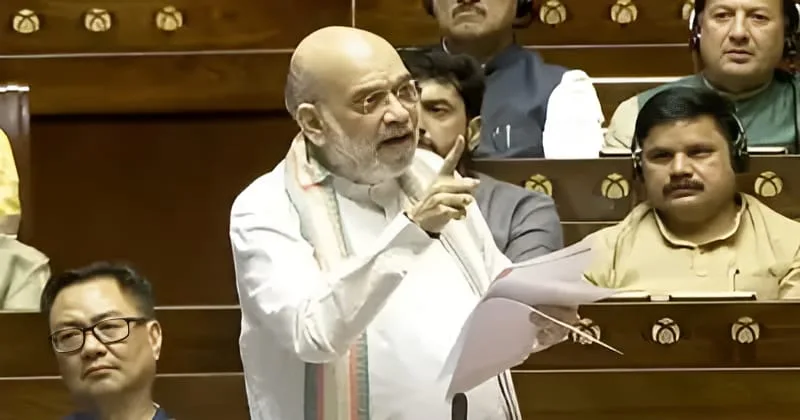
Union Home Minister Amit Shah on August 20, came down heavily on the Congress for opposing the Constitution (130th Amendment) Bill, 2025, which mandates the removal of Prime Ministers or Chief Ministers arrested on serious charges and kept in custody for over 30 days.
Shah alleged that Congress is against the bill because it wants to “run governments from jail” and place its leaders above the law. “The people of this country must decide whether it is appropriate for a Prime Minister, Chief Minister, or minister to govern from behind bars,” he said.
In a sharp attack, Shah compared Prime Minister Narendra Modi’s stance with that of former PM Indira Gandhi.
Shah recalled that Modi, during his tenure, introduced a constitutional amendment to bring even the Prime Minister within the ambit of law.
On the other hand, Indira Gandhi, through the 39th Constitutional Amendment (1975), shielded the office of Prime Minister from judicial scrutiny during the Emergency.
“The Congress party has always tried to keep the Prime Minister above the law, while the BJP has worked to make its own Prime Minister and ministers accountable,” Shah said in a post on X.
एक ओर प्रधानमंत्री श्री @narendramodi जी ने अपने आप को कानून के दायरे में लाने का संविधान संशोधन पेश किया है और दूसरी ओर कानून के दायरे से बाहर रहने, जेल से सरकारें चलाने और कुर्सी का मोह न छोड़ने के लिए काँग्रेस के नेतृत्व में पूरे विपक्ष ने इसका विरोध किया है।
देश को वह समय भी…
— Amit Shah (@AmitShah) August 20, 2025
The Constitution (130th Amendment) Bill, along with the Government of Union Territories (Amendment) Bill, 2025 and the Jammu and Kashmir Reorganisation (Amendment) Bill, 2025, was tabled by Shah in the Lok Sabha. The key provisions are:
1. No jailed leader can govern: A PM, CM, or minister arrested and in custody cannot continue in office.
2. 30-day rule: If the leader fails to secure bail within 30 days, they will automatically lose their position or be removed.
3. Reinstatement option: If granted bail later, they can return to their post.
Shah said the bill aims to restore “morality in public life” and curb the trend of leaders refusing to resign despite being in jail.
The move triggered an uproar in Parliament. Opposition MPs, including Asaduddin Owaisi, Manish Tewari, NK Premchandran, Dharmendra Yadav, and KC Venugopal opposed the bill, branding it as “anti-constitutional.”
Owaisi argued, “This bill gives executive agencies a free hand to act as judge and executioner. It will create a Police State and is a direct assault on democracy.”
Amid heated arguments, opposition members tore copies of the bills and threw paper bits towards the Treasury benches. The uproar forced Speaker Om Birla to adjourn the House.
Shah proposed that the bills be referred to a Joint Parliamentary Committee (JPC) for detailed scrutiny. Despite opposition, the government signalled its intent to push the legislation, calling it a “landmark step against corruption and immoral politics.”