Mirpur, Kotli, Bhimber and Muzaffarabad. Today they are names across a line on a map. In 1947, they were home to thousands of our own people, who were forced to leave everything behind. To understand why that line still hurts, we must go back to the night it began. On the night of 21-22 October 1947, Jammu and Kashmir woke up to war. Pakistan called it a spontaneous tribal uprising, but the planning, the weapons and the army officers behind it point to something else: Operation Gulmarg, an invasion run by the Pakistan Army, with tribal fighters sent ahead as a mask. Muzaffarabad fell within days, and the road to Srinagar lay open.
Between the invaders and the Srinagar stood Brigadier Rajinder Singh, Chief of Staff of the State Forces. With a small band of soldiers he rushed toward Uri, blew up bridges and held back an enemy many times his strength. He gave his life in the last week of October, but the days he bought changed history. On 26 October, Maharaja Hari Singh signed the Instrument of Accession. On 27 October, Indian Army was airlifted to Srinagar, making a decisive moment in the defence of Jammu and Kashmir against the Pakistani Army. But for Mirpur, Kotli and Bhimber, help came too late. Kotli was besieged for weeks.
Mirpur fell in late November 1947, and thousands of Hindus and Sikhs trying to flee were killed, abducted or never seen again. Bhimber and its villages emptied as families left behind their fields and temples and ran toward Jammu. Their grandchildren still tell the stories, and some still keep the keys to homes they have never seen. Then the guns fell silent, but the loss became permanent. When the ceasefire took effect on 1 January 1949, a line cut through one land. Cousins woke up in different countries, and the trade, marriages and pilgrimages of centuries stopped overnight. Even Sharda Peeth, the ancient centre of Sanskrit learning on the banks of Kishanganga River, was also left behind. Pakistan did not stop there: in 1965 it launched Operation Grand Slam through Chhamb toward Akhnoor, and in 1971 it struck Chhamb again.
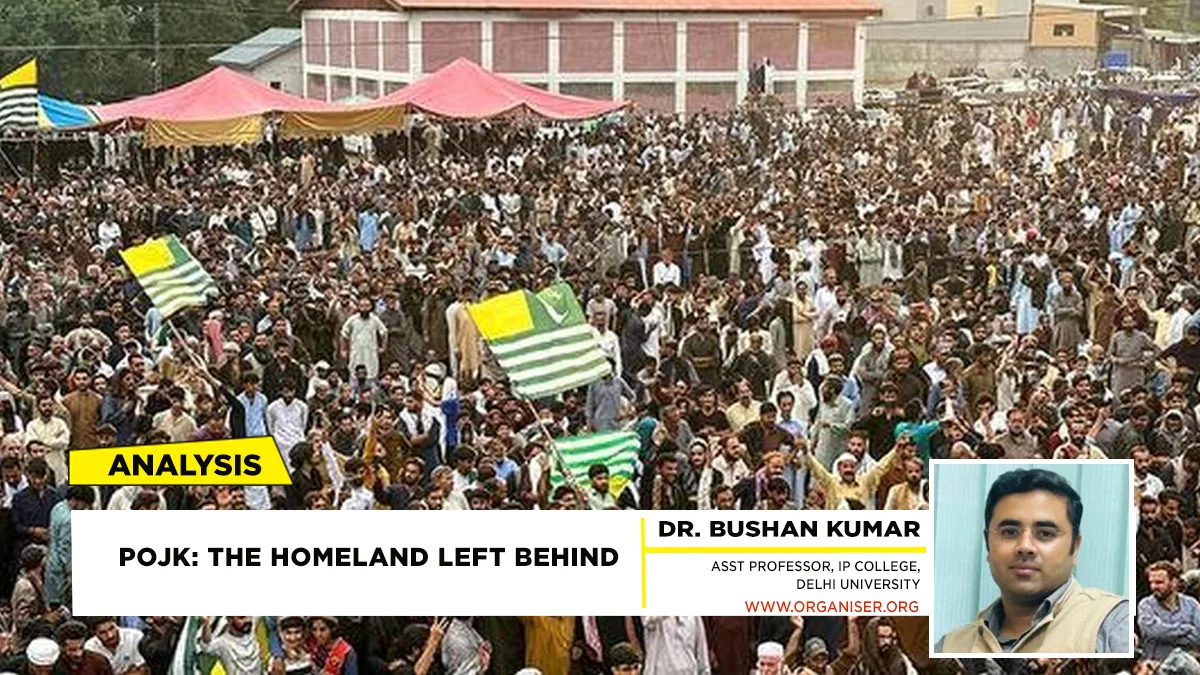
Seven decades on, the people on the other side of that line are still asking for the basics. The Mangla Dam, built near Mirpur in the 1960s, submerged the old town and displaced tens of thousands, yet locals say its benefits flow elsewhere. This year that long-buried anger has erupted. The Joint Awami Action Committee (JAAC) led strikes and marches. In June, markets stayed shut and reports spoke of over 20 people killed in police action, after which the group was outlawed. In July, about 1.5 lakh people were reported marching toward Muzaffarabad, and Reuters reported nine deaths in clashes on 14 July. Their demands are strikingly ordinary: release of arrested leaders, an end to the crackdown, restored communications, and reliable electricity and food. They also want the 12 “refugee seats” in the 53-member assembly abolished, alleging that mainstream Pakistani parties use them to install loyalists and sideline local voices. The marchers came from Rawalakot, Mirpur, Kotli and Bagh, the very towns attacked in 1947. The wound of that year has never closed. India’s Ministry of External Affairs has urged the world to scrutinise Pakistan’s use of force.
Now, let us turn our attention to the Union Territory of Jammu and Kashmir which tells a very different story. The Chenab bridge rises 359 metres above the river, the world’s highest railway arch bridge, and since April 2026 the Vande Bharat has linked Jammu and Srinagar in under five hours. Tourist and pilgrim visits grew from 25.19 lakh in 2020 to 2.35 crore in 2024. Seven new medical colleges opened, MBBS seats rose from 500 to 1,300, IIT, IIM and AIIMS Jammu is operational. Investment proposals reached Rs 1.63 lakh crore, with potential for over 5.90 lakh jobs. Challenges such as jobs and security remain, but the direction is clear.
This is what makes the contrast so painful. Imagine Mirpur, Kotli and Bhimber with even a fraction of this: their own universities, rail links to Jammu, and pilgrims once again walking to Sharda Peeth on the Kishanganga. That is the real price of 1947. It was not only the lives lost in 1947, but also the future denied to the generations left on the other side of the divide.
However, India has never accepted this division. On 22 February 1994, Parliament unanimously resolved that the whole of Jammu and Kashmir is an integral part of India and that Pakistan must vacate the areas it occupies. Defence Minister Rajnath Singh has repeated that PoJK is, was and will remain a part of India. In Jammu in 2022, he asked how Baba Amarnath, the abode of Lord Shiva, could be on this side while Sharda Devi, the Shakti, lies across the line. Shiv and Shakti cannot be separated. In May 2025, he added that the people of PoJK are India’s own family, and that the day is not far when they will return to the mainstream with dignity.
That is what PoJK Smriti Saptah (21-27 Oct) asks of us: to salute Brigadier Rajinder Singh and every soldier who stood in the way, to remember the families of Mirpur, Kotli, Bhimber and Muzaffarabad who lost everything, and to stand with those still raising their voices today. The families who still keep the keys are waiting for a door to open. The day Jammu and Kashmir is whole again will not be a day of conquest. It will be a day of homecoming.
