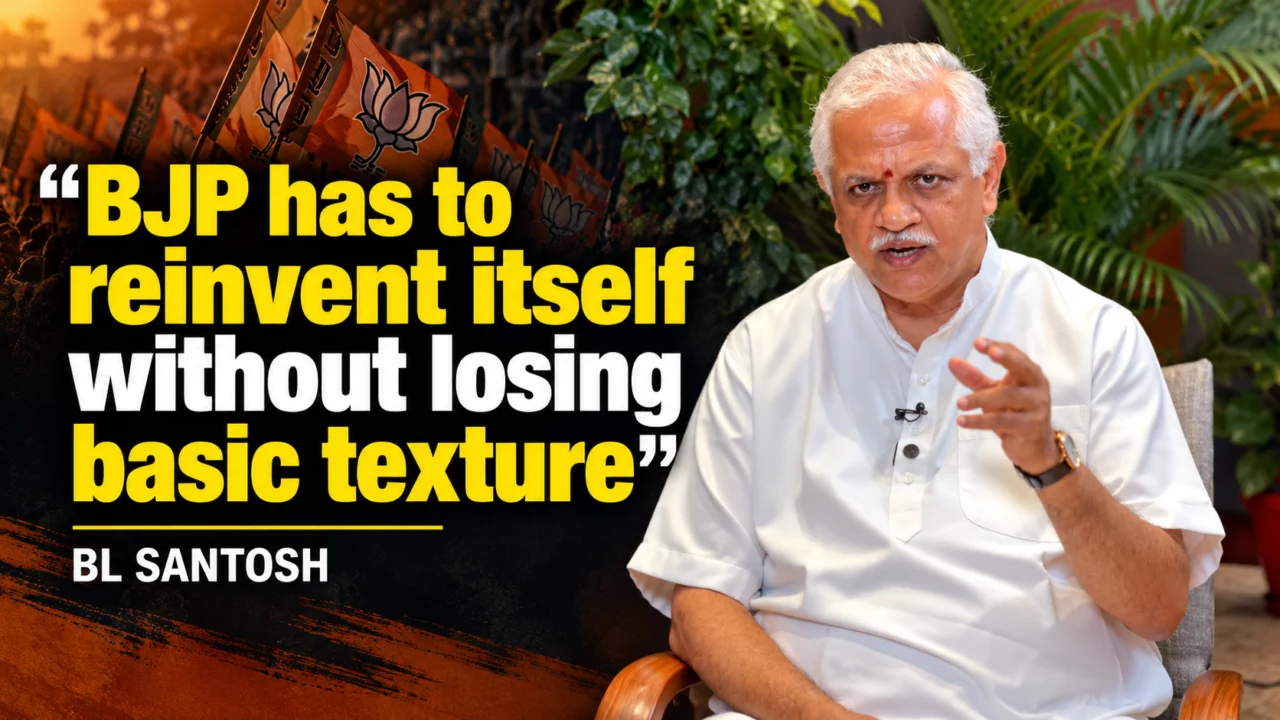
‘BJP has to reinvent itself’: B. L. Santhosh on what comes after Article 370 and UCC for the party
BJP National General Secretary (Organisation) B. L. Santhosh says the party’s next challenge is to adapt to its role in governance while retaining its ideological foundations. In an interview with Organiser, he spoke about organisational expansion, the need to bring in new faces, training party workers and responding to the expectations of a younger generation.
With the BJP having taken up major ideological issues such as Article 370 and the Uniform Civil Code (UCC), the question of what comes next remains a challenge for the party. Santhosh addressed this question while discussing the BJP’s journey from an opposition party to one governing at the national level.
“The party has to reinvent itself without losing the basic texture,” Santhosh said, recalling the term used by Prime Minister Narendra Modi during a party meeting.
He said the BJP’s ideological and organisational character must remain intact even as it adapts to the responsibilities of governance.
“We are not now a party in opposition, we are a party in governance,” he said, describing this transition as one of the biggest discussions taking place within the organisation.
Santhosh said the party was working on this change through multiple initiatives and hoped to see results in the coming years.
During the interview, the discussion turned to the BJP’s long-standing ideological issues, including its position on nuclear policy, Article 370, the Ram Janmabhoomi movement and the Uniform Civil Code.
The question was how the party would define its next priorities after pursuing several of the causes with which it had historically been identified.
Santhosh responded by focusing on the changing needs of the country and the party’s organisational responsibilities. He said the BJP’s growth had been substantial, but expansion also brought new demands.
The challenge, he indicated, was not limited to pursuing ideological issues. It also involved ensuring that the party’s growing organisation could respond effectively to the needs of people and the responsibilities of governance.
Addressing concerns over the induction of leaders from other political parties and the balance between organisational growth and ideological commitment, Santhosh said new entrants were necessary.
“Newcomers are a must. Without new joining there will be no freshness also,” he said.
He added that the BJP’s existing organisational growth might not always be enough to address the country’s immediate problems.
“In some cases our organic growth may not be sufficient to handle the present day problems also where it has to be solved immediately,” he said.
Santhosh acknowledged that newcomers could initially have less ideological affinity with the party or come from different political backgrounds. However, he said the BJP had systems of meetings and training camps to help them understand its working culture.
He also acknowledged that not everyone adjusted to the party immediately, indicating that integrating new entrants remained an organisational challenge.
Santhosh said the BJP’s expansion had created a need to strengthen communication with its representatives and workers at different levels.
He outlined four organisational priorities: connecting with elected representatives and workers, monitoring their activities, providing ideological and administrative orientation, and ensuring that they adopt people-friendly measures.
He said the party had expanded its organisational structure and developed systems to identify and connect with workers at the booth level. However, he acknowledged that connecting with them consistently and providing the required orientation remained unfinished work.
The task, according to Santhosh, is to ensure that organisational expansion translates into effective public service and governance.
The interview also raised the question of how the BJP would respond to a younger generation whose expectations are shaped by the party’s own record in government.
Santhosh’s response placed the emphasis on adapting the organisation without abandoning its basic ideological and organisational character. The party, he said, must find ways to address the country’s changing circumstances while retaining its core identity.
His remarks indicate that the BJP’s next phase, as described in the interview, is not framed around a single new political slogan or issue. It involves organisational reinvention, integrating new entrants, training representatives and making the party more effective in governance.
