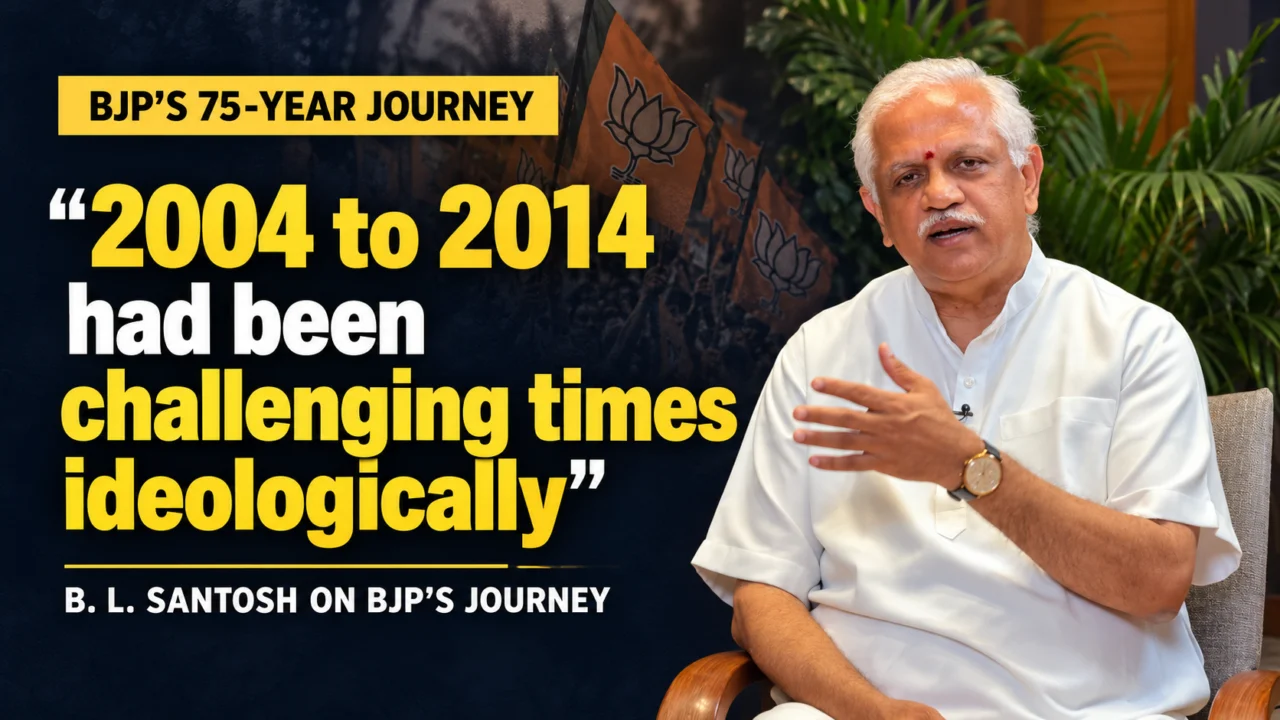
BL Santosh on journey of BJP: ‘2004 to 2014 had been challenging times ideologically’
On the foundation day of the Bharatiya Jana Sangh, BJP National General Secretary (Organisation) B. L. Santhosh speaks with Organiser. In his detailed interview with Editor Prafulla Ketkar, Santhosh reflects on the BJP’s ideological journey and describes the 2004-2014 period as a challenging phase for the party and its wider ideological movement.
Santhosh points to the “saffron terror” narrative, the National Advisory Council and what he describes as attempts to sideline the BJP and its leadership. He also recalls how the party regained momentum after 2009 by highlighting state-level governance models and challenging the Congress-led UPA on ideological and political fronts.
Looking back at the decade between the Atal Bihari Vajpayee-led government and the BJP’s return to power in 2014, Santhosh said the period posed challenges beyond electoral politics.
“See 2004 to 2014 had been very challenging time for our whole ideological movement. Not only a political party even the ideological movement also,” he said.
He identified the “saffron terror” phrase as one of the developments that marked this period. He also referred to the National Advisory Council (NAC), arguing that it represented an authority operating beyond the Prime Minister.
“All the words that were mentioned by you, saffron terror word was coined at that time and very many things like that also got introduced especially this concept of NAC National Advisory Council where beyond prime minister also there is an authority and beyond prime minister also there is an agency,” Santhosh said.
He alleged that these developments served the agendas of people he described as “not so nationalistic people or not so country-living people,” adding that they had individual, collective and party interests.
Santhosh also alleged that the BJP faced sustained attempts to restrict its political growth during the period. He linked these attempts to the Congress and some liberal forces aligned with it.
Referring to the period after the Congress returned to power in 2004, he said: “The Congress once it lost its power in 1996 when it came in 2004 it was very determined to see that Bharatiya Party had to be purged.”
He also referred to the scrutiny faced by BJP leaders, including Narendra Modi, who was then the Chief Minister of Gujarat. Santhosh cited the investigations and inquiries involving leaders as part of what he characterised as a wider pattern of targeting.
“This targeting was not one-off incident,” he said.
He further alleged that the aim was not merely to sideline the BJP but to remove it from the country’s political framework.
“They wanted to not only sideline BJP I will use the word purge BJP,” Santhosh said, adding that the party’s senior leadership and the RSS leadership were also targeted.
These are Santhosh’s allegations about the political climate of the period, as expressed in the interview.
Santhosh also raised concerns about the ideological influence of the Left in universities and other institutions during the 2004-2014 period.
He alleged that institutions had become centres of Left ideology and said the extent of this influence would become clearer over time. He also criticised the way the Gujarat riots were presented in sections of the media.
He said that the “saffron terror” narrative and the coverage of the Gujarat riots formed part of a broader political and ideological contest during the decade.
Despite describing 2004-2009 as a relatively dull period for the BJP, Santhosh said the party found its rhythm again after 2009.
He pointed to two areas of work: taking state-level governance models to a national audience and challenging the Congress-led United Progressive Alliance (UPA) on ideological and political grounds.
“2004 to 2009 was a little dull period but after 2009 we found our rhythm again,” he said.
He added that the party publicised state models nationally and worked to expose the Congress and the UPA on both fronts.
“So we came to power naturally in 2014. Everybody felt that we’ll be coming to power. Only the numbers were little surprising to many people or political pundits,” he said.
Santhosh described the 2014 result as a turning point, saying the scale of the BJP’s victory surprised many observers even though the party’s return to power was widely anticipated.
In the interview, Santhosh presented the decade from 2004 to 2014 as a period of ideological contest, political pressure and organisational adjustment. He argued that the BJP’s efforts after 2009 to project its state-level governance record and challenge the UPA helped it regain momentum ahead of the 2014 election.
His account frames the BJP’s rise in 2014 not only as an electoral change but also as the culmination of a longer ideological and organisational struggle.
