France freedom rankings vs reality: Islamist extremism & security failures
France is often presented as a model of democracy, individual liberty and republican values. It ranks highly on international measures of press freedom and civil liberties, while its passport offers extensive global mobility. Yet behind this favourable image lies a more difficult reality: France has spent years confronting jihadist terrorism and growing concerns about Islamist networks seeking influence within civil society and local institutions. A French government-commissioned report published in May 2025 warned that Muslim Brotherhood-linked political Islamism could threaten national cohesion through influence-building in schools, mosques and local associations.
The unrest witnessed on October 17, 2026, exposed a separate but equally pressing challenge: the state’s ability to protect public spaces, businesses and institutions when violence erupts. The burning of Lyon’s tourism office at Place Bellecour, alongside reports of looting and clashes with police, raised fresh questions about public order and the limits of France’s celebrated democratic credentials. These riots have not been established as an Islamist operation. But France’s wider struggle with extremist ideologies, integration failures and the defence of its secular republican principles cannot be brushed aside when assessing the country’s security and social cohesion.
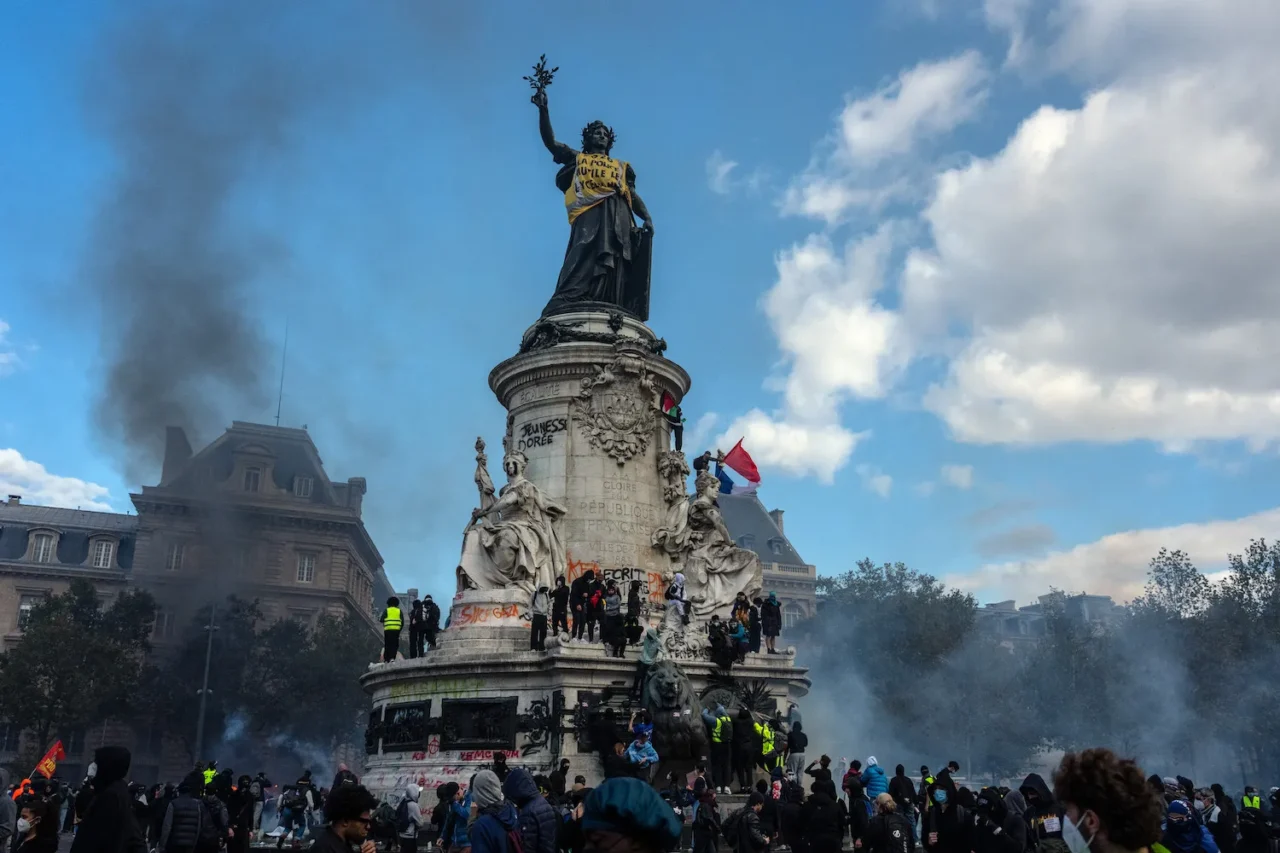
There is a major contrast between France’s favourable international rankings and the destruction visible on its streets. The images from France raise an uncomfortable question: do its celebrated freedom rankings also leave room for the “freedom to loot luxury stores”? The scenes challenge what these rankings actually reveal about a country’s ability to maintain public order and protect property.
The question deserves attention. What is the value of a high score on a freedom index if residents fear for their safety, businesses face destruction and public authorities struggle to protect shared spaces during mass unrest?
The answer is not that freedom or democracy has no value. It is that rankings cannot substitute for competent governance, effective law enforcement, secure borders and a society in which the rule of law applies equally to everyone.
The October 17 demonstrations began amid anger over the cost of living, school conditions and deteriorating public services. Hundreds of thousands of Islamists joined marches across France. Many protested peacefully, but violent groups exploited the mobilisation to attack businesses and public property.
Paris, Lyon, Marseille and other cities witnessed clashes, looting and fires. Lyon’s tourism office was set ablaze, while Limoges’ historic city hall suffered a major fire. Police faced attacks, and businesses were left counting the cost of the destruction.
French authorities blamed radical far-left groups and opportunistic criminals for much of the violence. Reports also described serious questions about police preparedness and the handling of the demonstrations.
The country has spent years confronting jihadist terrorism, radicalisation and political movements that seek to challenge its secular republican framework.
France’s international standing is frequently invoked to demonstrate the strength of its institutions. The World Press Freedom Index assesses the environment for journalism, while human-freedom and democracy assessments examine civil liberties, political rights and institutional safeguards. Passport rankings focus on international travel access.
Each measures a particular dimension of national performance. None provides a complete assessment of public safety, border management, integration, the prevention of radicalisation or the government’s ability to respond to riots.
This is where the debate over rankings becomes important. A country can protect a free press and hold competitive elections while still struggling to prevent extremist networks from exploiting democratic freedoms. It can have strong constitutional guarantees yet fail to ensure that those guarantees translate into security and equal enforcement of the law in every neighbourhood.
The more fundamental question is whether international indices give sufficient weight to the state’s most basic responsibility: protecting citizens while preserving their freedoms.
France’s struggle with Islamist extremism is not an invented controversy. It is a documented security and political concern that successive governments have had to address.
In May 2025, France’s Interior Ministry published a government-commissioned report on the Muslim Brotherhood and political Islamism in France. The report was intended to document the movement’s presence and examine the challenge posed by political Islamism to French society and republican institutions.
The concern extends beyond violent jihadist organisations. Political Islamist networks can seek influence through associations, educational activities, community organisations and local institutions. Where such activity promotes separatism, pressures people to conform to religious rules or challenges the authority of secular law, it raises legitimate questions about integration and the protection of republican principles.
France must be willing to confront such activity openly. If organisations use the freedoms of a democratic society to advance an agenda hostile to equal citizenship, women’s rights, freedom of conscience or the rule of law, authorities should investigate and act within the law. A policy of looking away for fear of being accused of intolerance would leave the republic vulnerable to those seeking to weaken it from within.
Border control has become another central part of the French debate. France is part of the European Union’s Schengen area, where internal border checks are generally absent or limited under common rules. That arrangement facilitates travel, but it also makes effective external-border controls, intelligence sharing and cooperation between European states important.
The real questions concern the effectiveness of controls, the management of irregular migration, the removal of people without a legal right to remain and the ability of authorities to identify genuine security threats while respecting asylum law and due process.
These issues should not be conflated. Immigration does not automatically lead to extremism, and people of immigrant background are not collectively responsible for criminality or failed integration. However, governments must be able to acknowledge when integration policies have failed, when extremist networks exploit social isolation and when local authorities struggle to enforce the law.
The French republican model rests on a common citizenship, secular public institutions and the principle that the law applies equally to all. That framework becomes difficult to sustain when political or religious movements seek special authority, reject equal rights or pressure individuals to place communal demands above their legal freedoms.
The government’s concerns about political Islamism show why the issue cannot be reduced to a debate about terrorism alone. Violent jihadism presents an immediate security threat. Organised political extremism can pose a different, longer-term challenge if it attempts to gain influence in civil society while weakening confidence in secular institutions.
The failure to enforce a shared civic standard can leave communities isolated, deepen distrust and create openings for radical actors. But these outcomes must be demonstrated through reliable evidence, not assumed from a person’s religion, ancestry or neighbourhood.
The destruction witnessed in October has exposed the limitations of treating formal democratic credentials as a complete measure of national success. Freedom is not simply a score on a chart. It must be supported by institutions capable of protecting peaceful protesters, ordinary residents, workers, businesses and public property.
A government that allows violent groups to dominate public spaces risks undermining the freedoms it is supposed to protect. Equally, a government that suppresses peaceful protest or abuses police powers damages the same democratic principles. The challenge is to defend both public order and civil liberties, rather than sacrificing one to the other.
France must therefore address the immediate causes of unrest, hold those responsible for violence accountable and examine why its security and policing arrangements came under such pressure. It must also continue confronting jihadist extremism, investigating political Islamist networks where credible evidence exists, and addressing failures in integration and immigration enforcement.
For India, the episode is a reminder to view international rankings critically. A favourable position on an index can provide useful information, but it should never be treated as a final verdict on a country’s governance.
France’s international reputation rests on a powerful set of ideals: liberty, equality, secular citizenship and democratic government. But ideals require enforcement. They cannot protect society if public institutions fail to respond effectively to violence, or if extremist movements are allowed to exploit democratic freedoms to undermine the principles that sustain them.
The October 2026 riots were primarily linked by authorities to radical far-left groups and opportunistic looters.
The country must confront extremist infiltration where evidence supports it, improve border management, address failures of integration and ensure that no group can place itself above the law. It must do so without collectively blaming migrants or Muslims, and without weakening the civil liberties it seeks to defend.
Ultimately, high rankings in press freedom, democracy or human liberty cannot tell the whole story of a nation. The real test is whether a republic can protect freedom, maintain public order and prevent extremist movements from eroding its institutions. France’s challenge is to make its democratic principles visible not only in international rankings, but also in the everyday security and freedom of its people.
