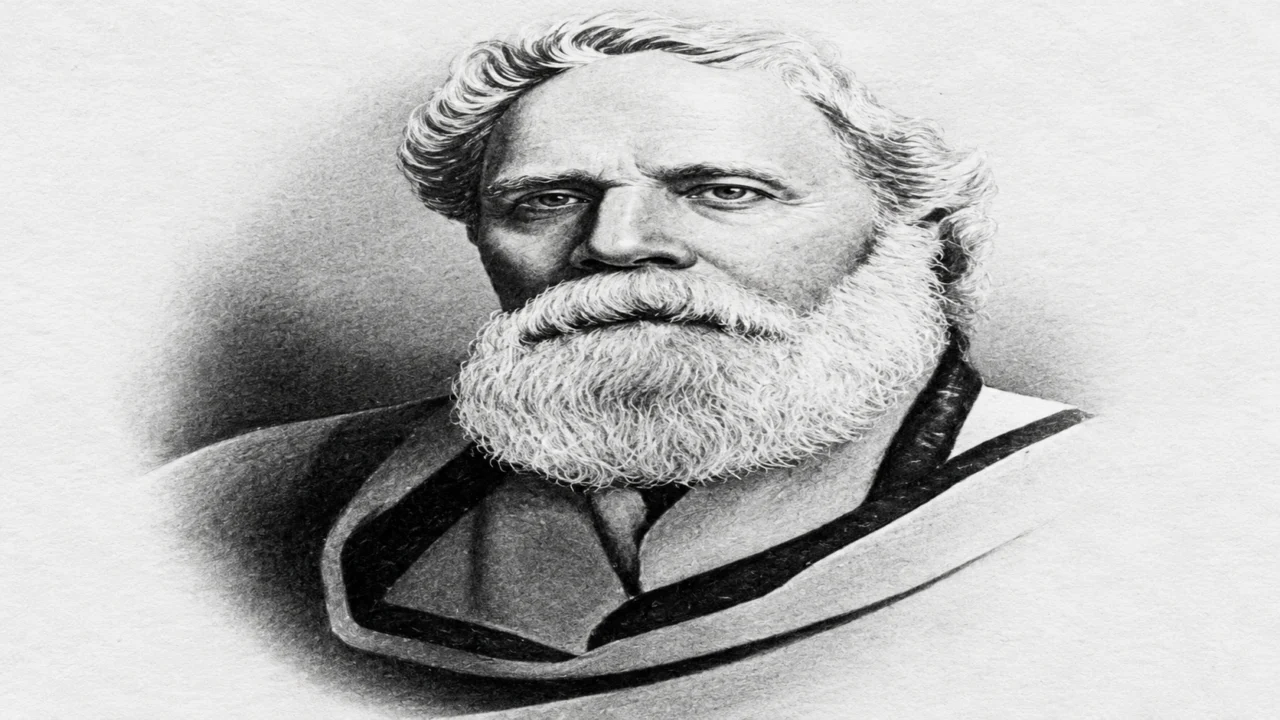
Raj Narayan Basu
Long before the freedom movement developed into a mass struggle, a generation of Bharatiya thinkers began asking a fundamental question, how could Bharat recover its confidence in its own civilisation after prolonged political subjugation and the growing influence of colonial institutions? Among those who addressed this question through education, literature and cultural initiatives was Raj Narayan Basu, a distinguished Bengali intellectual whose work helped lay the foundations of modern Bharatiya nationalism.
Basu belonged to a period when British colonial rule exercised not only political and economic power but also considerable influence over education and ideas about Indian society. Against this backdrop, he sought to revive pride in Bharat’s cultural inheritance and encourage people to examine their own traditions with renewed confidence.
The year 2026 marks his 200th birth anniversary. Remembering him during his Vijayadashami address in Nagpur on October 20, RSS Sarsanghchalak Dr Mohan Bhagwat paid tribute to Basu’s contribution, recalling his role as the inspiration behind and founder of the Hindu Mela, an initiative intended to awaken a deeper consciousness of the Self among people.
Raj Narayan Basu was born in 1826 in Bengal and became one of the notable intellectuals associated with the Bengal renaissance. His interests extended across education, literature and social thought.
Basu was associated with the reformist intellectual current of his time and became involved with the Brahmo Samaj. His engagement with religious and social questions formed part of a wider effort to examine inherited practices while preserving confidence in Bharat’s civilisational foundations.
One of the most significant initiatives associated with Raj Narayan Basu was the Hindu Mela, established in Calcutta in 1867 with Nabagopal Mitra playing a key organisational role. Basu’s ideas and encouragement provided important inspiration for the initiative.
The Mela emerged at a time when the modern idea of nationalism was still taking shape. Political freedom had not yet become the subject of a nationwide mass movement. Cultural gatherings, literary activities and public celebrations offered early opportunities to cultivate a shared consciousness among people.
The Hindu Mela sought to bring attention to Bharat’s cultural achievements, indigenous traditions, physical education, literature and artistic expression. It encouraged people to take pride in their heritage and to develop a collective outlook that extended beyond narrow social and regional considerations.
Its significance lay in the method it adopted. Rather than treating national consciousness as merely a political slogan, the initiative sought to nurture it through shared cultural experiences and public participation.
Basu believed that a society unable to value its own intellectual and cultural inheritance would struggle to develop genuine self-confidence. His emphasis on cultural awareness was therefore closely connected with the larger question of national regeneration.
His approach also illustrated that cultural revival could take place through peaceful intellectual and social activity. The Hindu Mela provided a public expression of this approach. It offered a platform where cultural remembrance could become a collective experience, encouraging people to see their traditions not as remnants of a distant past but as a living inheritance.
As the nation observes his 200th birth anniversary, the legacy of Raj Narayan Basu invites renewed reflection on the relationship between culture and national identity. The Hindu Mela remains an important episode in the history of organised cultural awakening.
