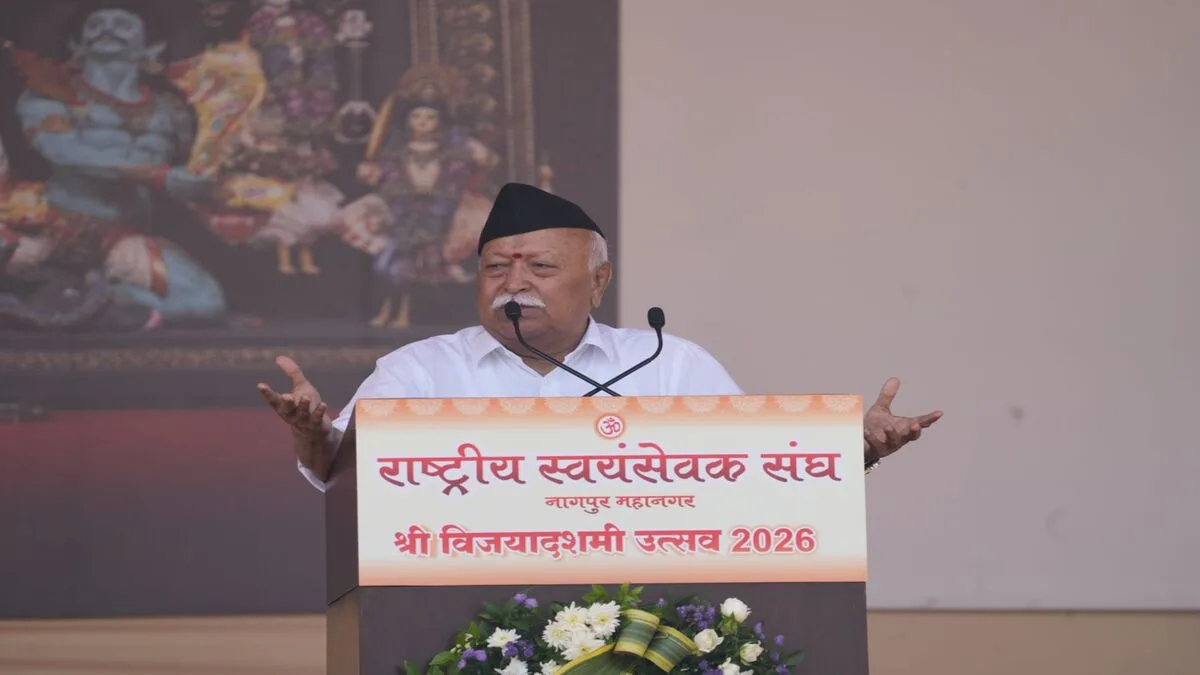
RSS Sarsanghchalak Dr Mohan Bhagwat addressed the gathering.
NAGPUR: The Rashtriya Swayamsevak Sangh (RSS) celebrated Vijayadashami Utsav in Nagpur on October 20, 2026, marking the culmination of its centenary celebrations. RSS Sarsanghchalak Dr Mohan Bhagwat addressed the gathering.
Speaking about the foundation of Bharat’s unity and the need to rediscover its civilisational identity, Dr Mohan Bhagwat said, “In our Constitution, we have described ourselves as One people—as “We, the People of India”—a society that, despite its immense diversity, is bound together by a deep sense of emotional unity. The very same Constitution, in its guiding principles, clearly envisions the need to continually strengthen and deepen this bond of unity among our people. Even though we possessed the profound realisation that gives rise to this emotional bond, as well as the world’s most sublime philosophy that articulates and elucidates that realisation, our conduct, unfortunately, became completely different from it and sank to a very low level. As a result, we fell so far from the exalted position of Vishwaguru—that we were compelled to endure centuries of foreign subjugation”.
Highlighting the sacrifices required to strengthen national unity and advance Bharat’s progress, Dr Mohan Bhagwat said, “Through Herculean efforts and countless sacrifices, we have freed ourselves from those difficult times and have once again embarked upon the path of unity and progress. Therefore, we must overcome our forgetfulness, clearly understand that fundamental truth, embrace it with conviction, and strive to embody its values and excellence in every dimension of our individual lives. When we look at the circumstances before us today, it becomes evident that the dedication, discipline, and sacrifice required of us now will have to be even greater than what was demanded in the struggle for our country’s independence”.
Explaining how Bharat’s spiritual tradition provides the foundation for unity amid its immense diversity, Dr Mohan Bhagwat said, “In a country like Bharat, blessed with immense diversity in terms of faiths, sects, traditions, regions, castes, languages, food habits, customs, and ways of life, an outlook that embraces all these diversities, respects them, and regards them with a genuine sense of belonging can alone truly serve as the foundation of our unity. Fortunately, India has, since time immemorial, carried forward a spiritual tradition that has been continually illuminated and strengthened by the direct realisations of countless spiritual luminaries. This tradition teaches us that, just as the diversity of creation is natural yet ever-changing, the underlying unity of all existence is an eternal, immutable, and unchanging truth. As beings endowed with the capacity for reflection and thought, human beings have the ability to experience this unity both within themselves and in the world around them. It is through this realisation alone that the timeless quest of humans for eternal and abiding happiness finds its true fulfillment and reaches its culmination”, he said.
“We sang of this very Truth, in many and varied ways, in the Vedas; With the same close to our bosom, We revealed this very wisdom in the Upanishads. Go to temples, monasteries, or Gurdwaras— There, you shall realise this very knowledge,” he said. These words reflect the shared spiritual wisdom of Bharat’s religious and philosophical traditions.
Emphasising the importance of Sanatana vision in preserving diversity and strengthening social cohesion, Dr Mohan Bhagwat said, “Bharat’s inherent temperament to respect and accept all forms of diversity, to preserve and protect them, and at the same time to remain flexible enough to change what is transient or out of date with the times, is a result of this eternal Sanatana vision. As and when this spirit has been at its strongest among the people of Bharat, then and at those times Bharat was an exemplary nation to the world in every respect. When, through self-forgetfulness, fragmentation, and the loss of mutual contact with one another, we became weakened, narrow-minded, arrogant, or consumed by fear, we abandoned this way of life—and that is when our decline began. We must once again remember the very foundation of our existence and identity, organise ourselves around it, and resolve to work together for the welfare and well-being of one another”.
