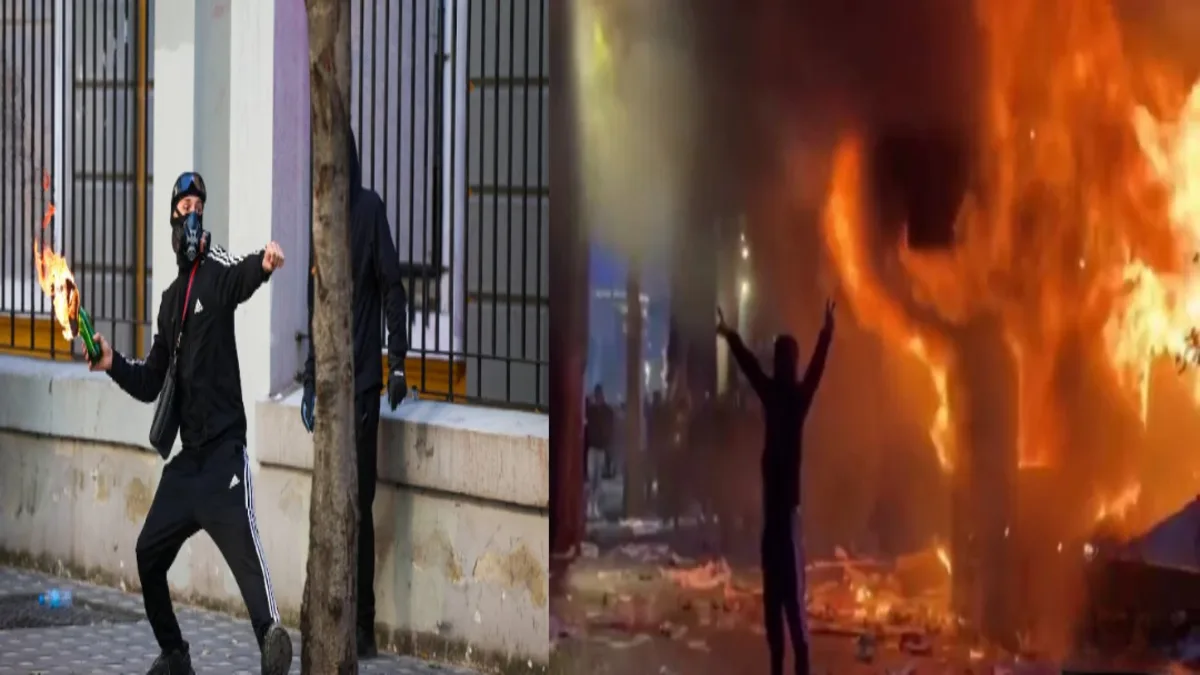
TIRANA: Albania’s capital, Tirana, has been rocked by massive, escalating anti-government protests, with demonstrators taking extremely unconstitutional & violent forms. The protestros have set the country’s Supreme Court on fire, targeted the banks and government buildings and have attacked police personnel. They have also demanded the resignation of Prime Minister Edi Rama.
Violent protest in Albania, is the latest among the series of unrest and demonstrations witnessed across Europe including France and Italy. The European continent is thus largely reeling under fire amid anti-governmental stunts by the young generation, who are targeting public spaces, government institutions and constitutional entities.
The Supreme Court burns to the ground in Albania, Parliament and the Department of Education has been stormed, the Prime Minister is in hiding and the country is effectively in the hands of the rebels.
Albania rejects blatant corruption and their country being sold. pic.twitter.com/EH22FBySId
— BladeoftheSun (@BladeoftheS) October 18, 2026
What began as student-led demonstrations over university fees, poor educational conditions and rising living costs has evolved into a wider movement fuelled by allegations of corruption, unemployment and anger over a controversial luxury resort project linked to US President Donald Trump’s son-in-law, Jared Kushner. Meanwhile, Prime Minister Rama has refused to step down, warning that the violence threatens Albania’s ambition to join the European Union (EU) by 2030.
The unrest in Tirana intensified over the weekend, with protesters setting fire to parts of Albania’s Supreme Court and damaging several other buildings. Fires were reported at the court, the entrance to the Bank of Albania and post offices, while a parked car was also set ablaze. Files were scattered and furniture burned inside affected premises, highlighting the scale of the destruction.
Demonstrators also targeted government offices, banks, businesses and the headquarters of the ruling Socialist Party. Petrol bombs and other projectiles were hurled at police, while burning rubbish bins and debris were used as barricades to obstruct the security forces. Thousands of demonstrators gathered outside the Education Ministry on Otober 18, Sunday, chanting “Rama, resign!” and throwing rocks at the police.
WATCH: Footage circulating online appears to show a police line in Tirana, Albania retreating in panic after protesters hurled improvised firebombs made from fuel-filled plastic bottles with fireworks attached.
The video comes amid days of violent anti-government protests… pic.twitter.com/AfJ39D5pa0
— Clash Report (@clashreport) October 19, 2026
The confrontation subsequently spread across central Tirana, as authorities attempted to disperse the crowds and restore order. Police responded with tear gas and water cannons. The violence marked a sharp escalation in demonstrations that initially centred on student grievances but have since developed into a broader violent confrontation against the government amid soaring violent protests across Europe.
The clashes have taken a significant toll on both protesters and law enforcement personnel. Albania’s Health Ministry reported that 65 people were injured during October 17, Saturday’s demonstrations, including 37 police officers, with 12 people requiring hospitalisation.
By Sunday morning, the cumulative number of injuries recorded since the unrest began on October 13 had reached 272, including 169 police officers, according to the ministry. State officials said at least 132 police officers had sustained injuries in the unrest. Authorities have arrested 167 individuals and initiated criminal proceedings against nearly 400 people for escalating violence.
Law enforcement agencies also reported receiving information about armed individuals in the crowds and gunshots during the demonstrations. Police seized cartridges and Molotov cocktails as the situation deteriorated.
🇦🇱🔥 Albania: fifth day of student-led protests; Reuters says 500 detained and about 120 police injured as clashes continue in Tirana
Thousands of young Albanians gathered outside the Education Ministry in Tirana on Oct. 17, the fifth day of a student-led movement demanding… pic.twitter.com/DgoTo9PZ6J
— 🔥🗞The Informant (@theinformant_x) October 17, 2026
Ambulances were seen transporting injured people from the protest sites, while shops and institutions across central Tirana secured their doors and windows with metal shutters. Municipal workers also removed paving stones from streets amid concerns that they could be used as projectiles.
The government has condemned the destruction of public property and attacks on police, insisting that the right to protest cannot justify violence and vandalism.
The latest wave of unrest began with students protesting against high university tuition fees, inadequate educational infrastructure, poor study conditions and limited employment opportunities after graduation. Demonstrators have also highlighted the rising cost of living, inadequate financial support for students and concerns about their economic prospects. Their grievances have since converged with longstanding opposition to Rama’s government over alleged corruption and governance failures.
The protests have drawn support from the so-called “flamingo” movement, which has organised demonstrations for months and demanded the Prime Minister’s resignation. The latest escalation followed a summer of largely peaceful demonstrations against government policies and a controversial luxury tourism development on Albania’s southern coast.
The proposed resort, backed by investors including Jared Kushner, has faced opposition from environmental groups and local critics concerned about construction near protected coastal areas. The project, estimated to cost more than $4 billion, has also been embroiled in legal disputes over land. Its association with the US President’s son-in-law has further fuelled the controversy.
On October 14, riots reportedly lasted more than eight hours, with at least four ministries damaged, 35 people detained and 29 people treated for injuries. The demonstrations have since spread beyond Tirana, with protests also reported in cities including Durres, Korce, Vlore, Elbasan and Shkodra.
Prime Minister Edi Rama has firmly rejected calls to resign, maintaining that his government’s legitimacy derives from elections rather than street demonstrations. He won a fourth term in office following the May 2025 elections and has remained in power since 2013. In a lengthy video address, Rama described the protests as the “work of an outside hand” and argued that the unrest threatened Albania’s European future.
He maintained that the demonstrations were challenging the country’s path towards EU membership rather than his government directly. Albania is targeting membership of the bloc by 2030, an ambition that Rama has repeatedly presented as a central national objective.
Rama asked Albanians to consider whether they wanted continued unrest or progress towards the European Union membership. He has also insisted that governments should be changed through elections rather than through violent street mobilisation. However, his refusal to step down has done little to ease tensions, with protesters continuing to demand his resignation amid allegations of corruption and growing economic discontent.
