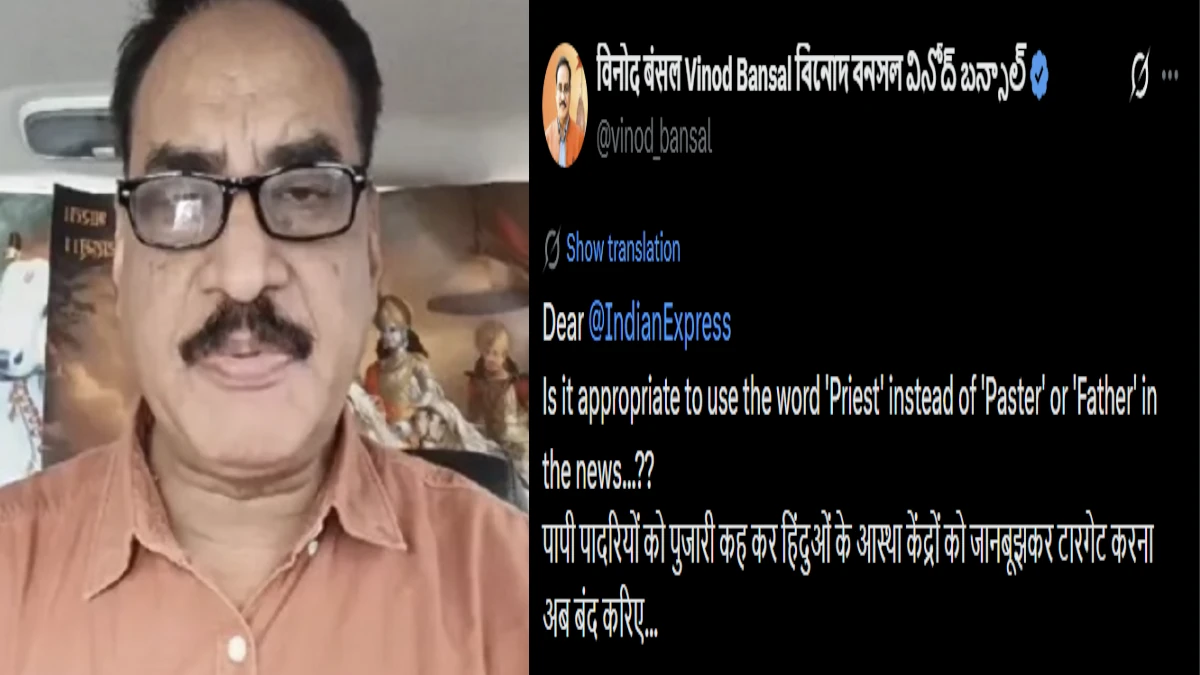
The arrest of Father Cyprian Pinto, associated with St Vincent Ferrer Church in Valencia, Mangaluru, over allegations of sexually abusing minor boys has triggered an important debate about journalistic accuracy, religious terminology and the responsibility of the media.
Vishwa Hindu Parishad (VHP) spokesperson Vinod Bansal has publicly questioned the use of the generic word “priest” in reports concerning alleged sexual abuse by a church cleric. Addressing The Indian Express and The Times of India on X, Bansal asked whether terms such as “Pastor” or “Father” would be more appropriate in this context. He argued that loosely used religious labels can mislead readers and unnecessarily associate a crime involving one individual with another religious tradition.
According to the reports, Father Pinto was arrested in Mangaluru following allegations of sexual abuse involving minor boys. The reports state that a Mysuru-based NGO, Odanadi, brought the matter to the attention of the police commissioner. Police were quoted as saying that they were investigating the allegations and gathering further details.
A church cleric, a Hindu temple priest, a Muslim cleric and a spiritual figure associated with another tradition do not necessarily occupy the same religious role. The terms used to describe them carry distinct meanings and associations. Where the person’s specific designation is known, using it can provide readers with clearer and more accurate information.
Calling a Catholic cleric a “Father” or identifying him as a Catholic priest, for example, can convey more context than an unexplained generic label. Similarly, a Hindu temple priest may appropriately be described as a pujari when that is the person’s actual role.
The point is not to restrict the word “priest” exclusively to Hindus. In English, “priest” is a legitimate term for clergy in several religious traditions, including Christianity and Hinduism. The point is that news organisations should use terminology that accurately identifies the individual, the religious tradition and the circumstances of the case.
Bansal has also objected to what he sees as the careless use of terms such as “baba,” “sadhu,” “tantric,” “religious leader” and “temple” in reports involving alleged wrongdoing. His broader concern is that imprecise descriptions can create misleading associations in the public mind, particularly when the identity of the accused or the location of the alleged crime is known.
That concern deserves a substantive response from news organisations rather than being dismissed as a mere political or religious objection.
If an incident takes place at a church, call it a church. If the accused is a Catholic cleric, identify the person’s actual designation where it is verified. If an accused individual is a Hindu sadhu, identify that person’s genuine religious role without automatically branding the entire Hindu religious community. The same principle must apply to every faith.
Religious terminology is not a trivial editorial matter in a country as diverse as India. Words influence how readers understand an incident, whom they associate with it and whether an individual’s alleged misconduct is unfairly projected onto an entire community.
A journalist’s responsibility is neither to protect one religion from scrutiny nor to expose another to suspicion. It is to report facts without distortion.
If Hindu religious figures are identified by specific titles when accused of wrongdoing, comparable specificity should be used for Christian, Muslim and other religious figures whenever the facts permit. Conversely, no outlet should deliberately use a misleading label to make an accused person appear connected to a faith or institution to which they do not belong.
It is equally important to distinguish between legitimate terminology and media bias. The word “priest” is not inherently anti-Hindu, and its use for a Christian cleric is not, by itself, evidence of deliberate targeting. Establishing a pattern of bias would require examining headlines, editorial practices and comparable cases.
