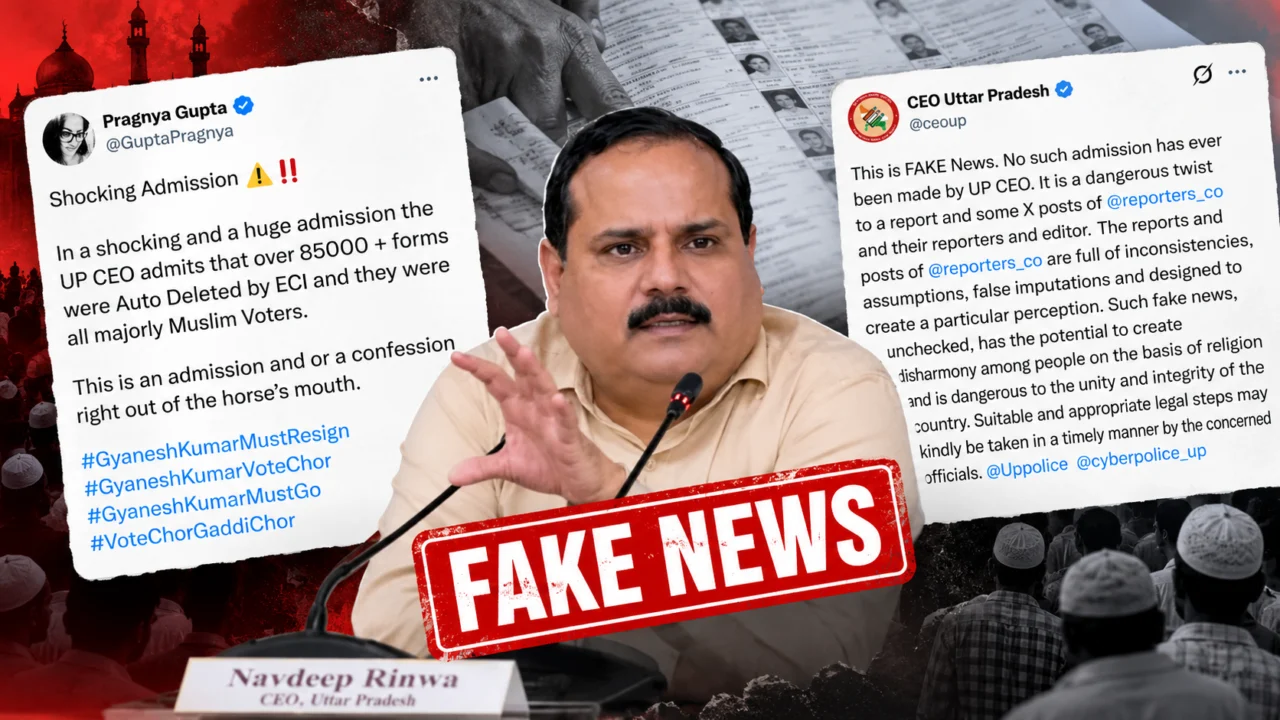
UP CEO Navdeep Rinwa rejects a viral claim that 85,854 voter forms were auto-deleted, calling it “fake news” and warning of communal disharmony.
Lucknow, October 19: A viral social media post claiming that Uttar Pradesh’s Chief Electoral Officer had made a “shocking admission” about the alleged auto-deletion of more than 85,000 forms belonging predominantly to Muslim voters has been publicly denounced as “FAKE News” by the CEO’s office.
The official X account of the Chief Electoral Officer, Uttar Pradesh (@ceoup), said no such admission had been made and accused the post of distorting the findings of reports published by The Reporters’ Collective.
The controversy centres on a post by @GuptaPragnya dated October 15, which claimed that the Election Commission of India (ECI) had auto-deleted over 85,000 forms and that the affected voters were “majorly Muslim”. The post went further, demanding accountability from Chief Election Commissioner Gyanesh Kumar and questioning the police response.
This is FAKE News. No such admission has ever been made by UP CEO. It is a dangerous twist to a report and some X posts of @reporters_co and their reporters and editor. The reports and posts of @reporters_co are full of inconsistencies, assumptions, false imputations and designed to create a particular perception. But this post goes much beyond their fault. Such fake news, If unchecked, has the potential to create disharmony among people on the basis of religion and is dangerous to the unity and integrity of the country. Suitable and appropriate legal steps may kindly be taken in a timely manner by the concerned officials.
@Uppolice @cyberpolice_up— CEO Uttar Pradesh (@ceoup) October 19, 2026
The CEO’s office rejected this interpretation on October 19, describing it as a dangerous distortion with the potential to create religious disharmony.
The episode highlights how a complex issue involving electoral records, software-generated forms and voter deletion procedures can be transformed into a sweeping communal allegation when figures and findings are presented without adequate distinctions.
In its statement, the UP CEO’s office said, “This is FAKE News. No such admission has ever been made by UP CEO.”
The office accused the post of taking the underlying reporting beyond what it established and alleged that the presentation was designed to create a particular perception. It also called for appropriate legal action by the concerned authorities.
The statement tagged the Uttar Pradesh Police and cybercrime authorities, urging them to examine the matter.
The viral claim merged these separate issues into a single allegation, presenting the alleged religious composition of the affected voters as an established fact.
The controversy originated with an October 9 investigation by The Reporters’ Collective, which examined Form 7 disclosures published on the UP CEO website during the Special Intensive Revision (SIR) of electoral rolls.
The investigation reported that 85,854 of 87,127 deletion requests filed by Electoral Registration Officers (EROs) and Assistant Electoral Registration Officers (AEROs) did not specify a reason in the relevant field. A small number contained only single letters.
Shocking Admission ⚠️‼️
In a shocking and a huge admission the UP CEO admits that over 85000 + forms were Auto Deleted by ECI and they were all majorly Muslim Voters.
This is an admission and or a confession right out of the horse’s mouth.Now this justifies the entire struggle/battle being fought against the present dispensation which seems to be shielding the @ECISVEEP & its CEC Gyanesh Kumar for Unconstitutionally and Unlawfully deleting voters belonging to one particular community, the Muslims.
Shouldn’t this admission alone be sufficient to bring CEC to books⁉️
Now the biggest question is why is Amit Shah’s Police shielding CEC Gyanesh Kumar in such a brazen and nefarious manner.
#GyaneshKumarMustResign
#GyaneshKumarVoteChor
#GyaneshKumarMustGo
#VoteChorGaddiChor
#VoteChori #ECI #SIR #BJP
#ScrapSIR #RollBackSIR
@UNHumanRights @UN_HRC
#HumanRightsViolations— Pragnya Gupta (@GuptaPragnya) October 15, 2026
The report alleged that the Election Commission’s ERONET software automatically generated these forms during the voter verification process and that officials signed them before forwarding them for approval. It questioned whether the procedure complied with the applicable rules governing voter deletions.
A follow-up report published on October 14 interpreted a video response by UP CEO Navdeep Rinwa as confirmation of key findings concerning the software-generated forms and bulk deletion attempts.
However, the viral claim that the CEO admitted that the 85,854 forms predominantly concerned Muslim voters goes beyond the numerical finding itself.
The number of forms without stated reasons and the religious composition of voters named in particular deletion requests are separate questions. Treating them as interchangeable risks misleading readers about what the data establishes.
The original investigation reported that in Tarabganj and Pilibhit constituencies, around 90 percent of the deletion requests it examined targeted Muslim voters. It also described instances of bulk applications filed under the same names.
These findings formed part of the outlet’s broader investigation into the conduct of the SIR process. They do not, however, establish that all 85,854 forms without stated reasons concerned Muslim voters.
In its subsequent response, the UP CEO referred to approximately 4,700 names associated with multiple Form 7 submissions, against an electorate of roughly 13.39 crore. The office argued that such cases were numerically small in the context of the state’s total electorate.
The CEO’s office has also maintained that notices, hearings, scrutiny and recorded orders preceded deletion decisions. It has disputed the characterisation of the process as irregular.
The viral post’s most consequential leap was its presentation of the 85,854 figure as an admission that Muslim voters had been predominantly targeted. Such framing risks turning a question about election administration into a communal confrontation without establishing the claimed connection.
Public debate about electoral rolls is legitimate and necessary. Journalists, political parties and citizens have every right to question unexplained entries, deletion procedures and the treatment of individual voters. But those concerns must be presented accurately, with clear distinctions between verified figures, investigative allegations and official responses.
A claim does not become established fact simply because it is framed as a confession by a constitutional authority. Nor does an official denial, by itself, settle every question raised by an investigation.
