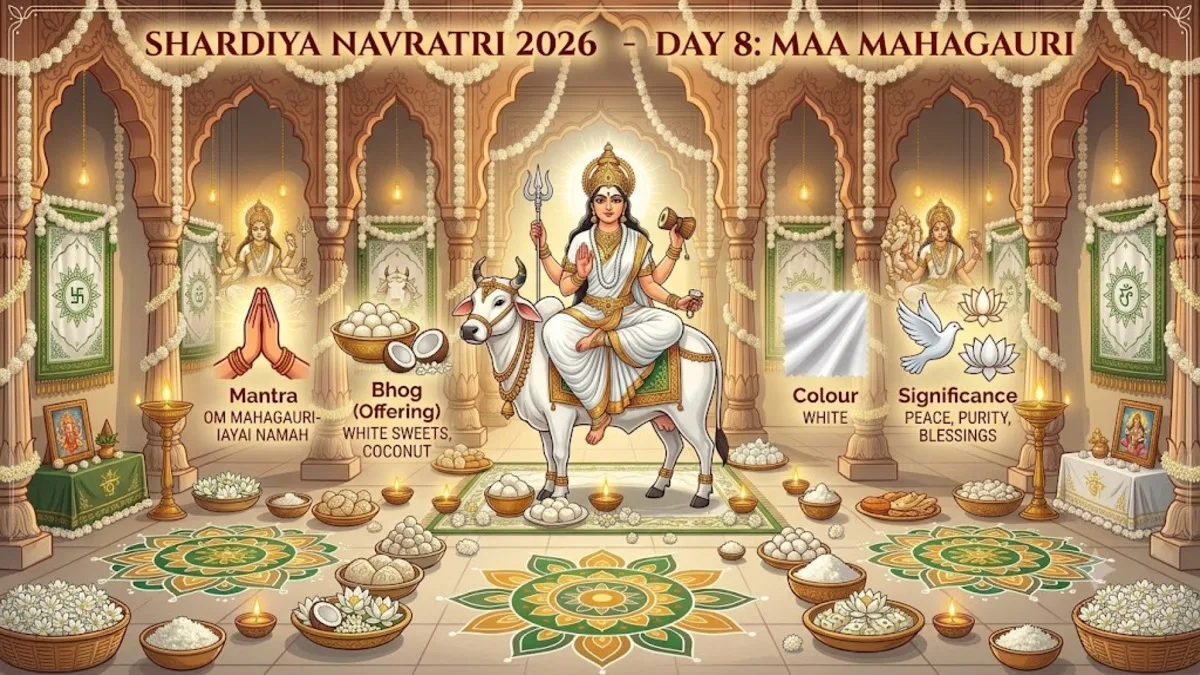
Maa Mahagauri
NEW DELHI: Maha Ashtami or Durga Ashtami 2026 holds special significance for devotees who worship Maa Mahagauri for peace, purity, prosperity and relief from suffering. It is also one of the most popular occasions for Kanya Pujan, a ritual in which young girls are worshipped as manifestations of the Divine Feminine. Have you ever wondered why young girls are worshipped during Navratri, and what is the belief behind this tradition? The answer lies in the Hindu understanding of Shakti, the divine feminine power believed to sustain and protect the universe. Maha Ashtami is not only a day of prayer. It also offers an opportunity to reflect on the values associated with Maa Mahagauri, including compassion, dignity, inner strength and respect for women and girls.
The word Mahagauri is commonly understood as “extremely fair” or “radiantly white”. She is generally depicted wearing white clothes, riding a bull and holding a trident and a damaru, with her other hands showing protective and blessing gestures. According to a popular Hindu belief, Goddess Parvati performed intense penance to attain Lord Shiva as her consort. During her long period of austerity, her body became darkened by dust and the effects of her penance. Pleased with her devotion, Lord Shiva restored her radiant complexion. This form came to be associated with Maa Mahagauri.
Her white appearance is commonly associated with purity, peace and serenity. Devotees take her blessings for the removal of difficulties, harmony in family life and spiritual progress. Maa Mahagauri represents the possibility of transformation: a difficult journey does not have to define the rest of one’s life.
Kanya Pujan is one of the most significant traditions associated with Maha Ashtami. On this day, nine girls are invited to represent the nine forms of the Goddess. Some families also invite a young boy, traditionally associated with Bhairav, as part of the ceremony. The ritual is also known as Kumari Puja. According to Hindu belief, the nine girls represent the nine forms of Goddess Durga, or Navdurga. By honouring them, devotees express their reverence for Shakti. The ritual generally includes washing the girls’ feet, applying tilak, offering food and giving them gifts or dakshina as a mark of respect. Customs and age-related interpretations may vary by region and family tradition.
Maa Mahagauri Mantra for Day 8 of Navratri 2026
Devotees chant Maa Mahagauri’s mantra to seek her blessings for peace, purity and well-being.
ॐ देवी महागौर्यै नमः॥
Om Devi Mahagauryai Namah
It simply means, Salutations to Goddess Mahagauri. Devotees may chant this mantra during their morning prayers, offer flowers and light a diya before the Goddess. Some traditions recommend chanting it 108 times using a mala.
Coconut is commonly offered to Maa Mahagauri as bhog. During Kanya Pujan, families traditionally prepare halwa, puri and kala chana and serve the meal to the invited girls.
After the ritual, the bhog is shared as prasad.
1. Invite the girls: Traditionally, nine young girls are invited to participate in the puja.
2. Welcome them respectfully: Their feet may be washed, and a tilak is applied to the forehead.
3. Offer prayers: Devotees worship the girls as forms of the Goddess.
4. Serve the bhog: Halwa, puri, kala chana, etc., are offered.
The tradition reminds families that every girl deserves respect not only when they are worshipped during Navratri but also in their everyday lives. Supporting their education, ensuring their safety and giving them equal opportunities are meaningful ways to uphold these values. Maa Mahagauri’s association with peace and purity also offers a personal lesson. Her story reminds devotees that no matter how difficult the past has been, life always offers a chance to change and start again.
The significance of Maha Ashtami 2026 lies not only in rituals but also in the values people carry forward from them. Thus, the true meaning of Kanya Pujan goes beyond one day of worship. It lies in making every girl feel loved, safe and respected, not just when we worship her as a Devi during Navratri, but every single day of the year.
